Right-Believing
Æthelberht of East Anglia
King of East Anglia
King of East Anglia in the eighth century, a realm covering modern Norfolk and Suffolk; died in 794.
- Feast
- May 20old style June 2
- Reposed
- 7948th century
- Place
- Herefordshire
Life
Saint Æthelberht of East Anglia was a king of East Anglia in the eighth century, in the lands that today make up Norfolk and Suffolk. He was killed in 794 by order of Offa of Mercia and is honoured as a martyr. His feast is on 20 May.
His reign
Very little is known of his life and reign, since few East Anglian records have survived. According to a late source of uncertain authority, his reign began in 779, but other sources disagree. The earliest extensive accounts of him date from the twelfth century and are connected with his cult at Hereford Cathedral. The earliest, the Passio S. Æthelberhti, written about 1080, says his parents were King Æthelred I of East Anglia and Leofrana of Mercia.
The story tells of a pious king, wisely elected and just in his rule. Urged to marry against his will, he is said to have agreed to wed Eadburh (other sources give other names), the daughter of Offa, and set out to visit her, though his mother foretold misfortunes and on the way he met terrifying signs: an earthquake, an eclipse of the sun and a vision. These stories, taken up by chroniclers such as William of Malmesbury, Roger of Wendover and Matthew Paris, are tradition rather than secure history.
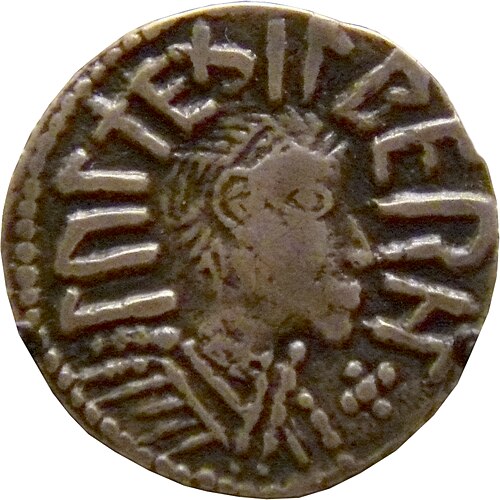
Four pennies minted by him are known. One, found in 1908 at Tivoli near Rome, resembles the coins of Offa and bears the word REX with the she-wolf suckling Romulus and Remus. Numismatists think that by striking his own coins Æthelberht sought more independence than Offa was willing to allow. In 793 the Vikings plundered Lindisfarne, and a year later Jarrow, which made the need for strong leadership more pressing.
Death
In 794 Æthelberht was put to death on Offa's orders, in unclear circumstances. According to the Anglo-Saxon Chronicle he was beheaded. Some historians place the killing at the royal estate of Sutton in Herefordshire, others at nearby Marden. Medieval sources say he was seized while visiting his intended bride, then murdered and buried. The Passio implies that Offa's queen, Cynethryth, was complicit, and later accounts put the blame on her. John of Worcester writes that she persuaded her husband to kill his guest. According to John of Brompton, the saint's head fell from a cart into a ditch, where common people found it, and worked miracles, among them restoring sight to a blind man. Offa's daughter is said to have withdrawn to Crowland, and Offa, repenting, to have founded monasteries and gone on pilgrimage to Rome. These details come from late sources and cannot be verified.
Veneration
Æthelberht was canonised locally and became the focus of a cult in East Anglia and at Hereford, where his shrine once stood. There are churches dedicated to him in Norfolk, Suffolk and the west of England, and he is a joint patron of Hereford Cathedral. He is commemorated on 20 May.
Commemorated the same day May 20
 LydiaApostle · Seller of Purple in PhilippiMay 20
 Dovmont of Pskov (Timothy)Right-Believing · Prince of PskovMay 20
 Austregisilus of BourgesSaint · Bishop of BourgesMay 20
 ThalelaeusMartyr · Physician of AegaeMay 20
 Stephen of PiperiVenerable · Saint of the Serbian ChurchMay 20
 Theodore of PaviaSaint · Bishop of PaviaMay 20
 PlautillaApostleMay 20
- Thalassius the LibyanVenerable · Abbot in the Libyan desertMay 20
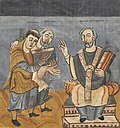 Alcuin of YorkVenerableMay 20
- Alexander of AegaeMartyrMay 20
- AnastasiusSaint · Bishop of BresciaMay 20
- AquilaMartyr · Martyr of ThebaisMay 20