Apostle
Plautilla
Roman matron who, by tradition, gave the apostle Paul her veil to cover his eyes at his execution.
Life
Plautilla is the name of a pious Roman widow, linked in late antique and medieval tradition with the martyrdom of the Apostle Paul. She is said to have died as a martyr around 67, in the time of the emperor Nero. The Byzantine Church commemorates her on 20 May. Nothing certain is known of her historically, and the stories rest on apocryphal writings and legend, so we present her as a saint of tradition.
According to tradition, she lived in the first century in Rome, a young widow struck by the preaching of the holy apostles, and was baptized, as the source supposes, by the Apostle Peter. It is believed that the further care of a group of Christian women, among them Saints Anastasia and Basilissa, was taken up by the Apostle Paul. She is also said to be the mother of Saint Domitilla.
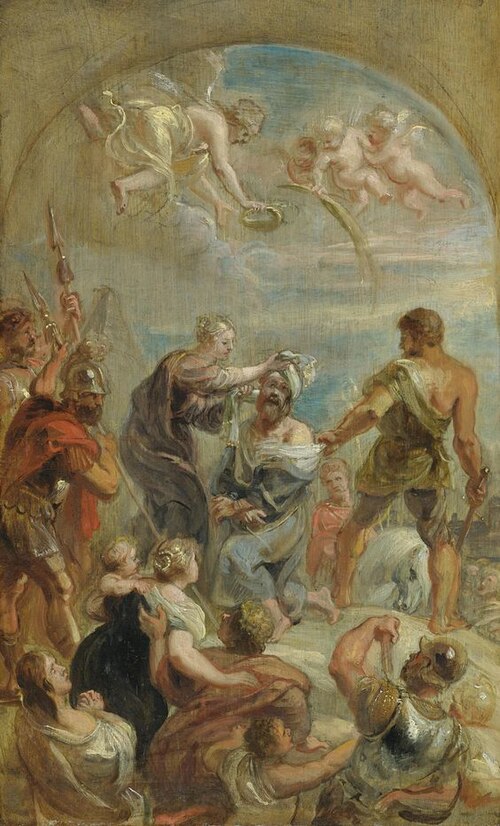
The earliest detailed version of the episode of the veil is in the apocryphal writing of late antiquity or the early Middle Ages, the Martyrdom of Paul (Martyrium Pauli), transmitted under the name of Linus. In section sixteen it is said that Paul bound his eyes with Plautilla's veil before execution. According to this account, she met Paul as he was led to execution outside the city and lent him her veil to cover his eyes; after his beheading the veil was returned to her miraculously.
Medieval compendia, especially the Golden Legend of Jacobus de Voragine, repeat and popularize the episode, sometimes giving Plautilla also the name "Lemobia". The legend says that, as Paul was led to the Ostian Gate, the Christian woman Plautilla wept and asked for his prayers; he asked her for the veil which covered her head, to cover his eyes with it, and then she should take it back. Some mocked the woman for having given so precious a cloth to an "enchanter", and the veil was returned to her miraculously.
The "veil of Plautilla" became a well-known motif in Western art, illustrating the beheading of Paul and the miracle that followed. A panel at the Princeton University Art Museum, usually titled The Beheading of Saint Paul, has been read in the light of this miracle in a study by Guy C. Bauman (1977). An Italian initial of the fourteenth century at the J. Paul Getty Museum shows the same scene, and the Museum of Fine Arts in Boston holds a Flemish tapestry, Saint Paul Requesting Plautilla's Veil, which explicitly cites the Golden Legend.
Commemorated the same day May 20
 LydiaApostle · Seller of Purple in PhilippiMay 20
 Dovmont of Pskov (Timothy)Right-Believing · Prince of PskovMay 20
 Æthelberht of East AngliaRight-Believing · King of East AngliaMay 20
 Austregisilus of BourgesSaint · Bishop of BourgesMay 20
 ThalelaeusMartyr · Physician of AegaeMay 20
 Stephen of PiperiVenerable · Saint of the Serbian ChurchMay 20
 Theodore of PaviaSaint · Bishop of PaviaMay 20
- Thalassius the LibyanVenerable · Abbot in the Libyan desertMay 20
 Alcuin of YorkVenerableMay 20
- Alexander of AegaeMartyrMay 20
- AnastasiusSaint · Bishop of BresciaMay 20
- AquilaMartyr · Martyr of ThebaisMay 20