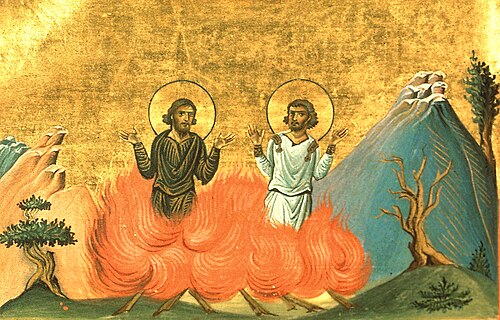
Holy Martyrs
Maximus, Asclepiodota and Theodotus of Adrianople
Christians of Marcianopolis in Moesia who suffered martyrdom in the early fourth century under Emperor Maximian Galerius.
- Feast
- September 15old style September 28
- Era
- unknown
- Place
- Adrianopolis
- Order
- Martyrs
Life
The Holy Martyrs Maximus, Asclepiodota (or Asclepiada, in one source Asclepiades) and Theodotus, called the martyrs of Moesia, of Marcianopolis or of Adrianople, suffered at the beginning of the fourth century, in the time of the emperor Maximian Galerius (305 to 311). The Church commemorates them on 15 September by the old calendar. The sources do not agree on the sex of Asclepiodota: the Russian source speaks of "the holy Asclepiada", the Serbian of "Asclepiades".
Maximus and Asclepiada were notable inhabitants of the city of Marcianopolis (today Devnya), in Moesia, and led a devout Christian life. By their example they brought many to faith in Christ and to holy Baptism. In the time of persecution the governor of Thrace, Tyrisus, travelling through the cities subject to him, persecuted the believers in Christ. He summoned Maximus and Asclepiada and urged them to renounce faith in Christ. But, seeing the martyrs' firm faith, he ordered them beaten without mercy. Then a pious man named Theodotus began to rebuke the governor for his inhumanity and cruelty. They seized him too and, hanging him on a tree, tortured him with iron hooks.
Then the three martyrs were thrown into prison. After two weeks Tyrisus travelled on, taking them with him. In the city of Adrianople he subjected them to still greater torments, ordering their bodies to be burned with red-hot plates. In the midst of the torments the sufferers were comforted by a Voice from heaven, which strengthened them in patience. After some days of torture the martyrs were thrown to be torn by beasts in the circus, but the she-bear loosed upon the holy Maximus and Theodotus began to fawn on them. The holy Asclepiada they bound to a bull, but it stood rooted to the spot and did not move. Irritated, Tyrisus travelled on and, before reaching Philippopolis, in the village of Saltis, he urged the martyrs again to renounce Christ and, at last, ordered their heads to be cut off. After a time he was punished by the wrath of God: lightning struck him as he sat in judgment.
Commemorated the same day September 15
 Symeon of ThessalonicaSaint · Archbishop of ThessalonicaSep 15
 Nicetas the GothGreat MartyrSep 15
 Nicomedes of RomeMartyrSep 15
 Joseph of AlaverdiVenerable · Abbot of Alaverdi MonasterySep 15
 Mamilian of PalermoSaint · Bishop of PalermoSep 15
- Acacius of BeroeaSaint · Bishop of Beroea in SyriaSep 15
 Nikita BesogonGreat Martyr · The Demon-BeaterSep 15
 Porphyrius of EphesusMartyr · ActorSep 15
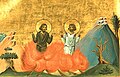 Maximus of AdrianopleMartyrSep 15
- Nicholas SkvortsovHieromartyr · PriestSep 15
- Phileas of ThmuisHieromartyr · Bishop of ThmuisSep 15
- Bessarion of LarissaSaint · Metropolitan of LarissaSep 15