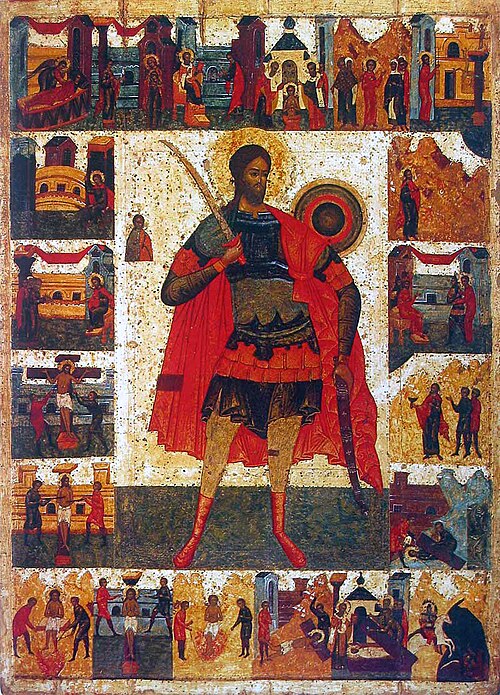
Great Martyr
Nicetas the Goth
Gothic martyr of the fourth century, venerated especially in the Orthodox Church and commemorated on 15 September.
- Feast
- September 15old style September 28
- Reposed
- 3724th century
- Place
- Romania
- Order
- Great Martyrs
Life
The Holy Great Martyr Nicetas the Goth was a Gothic soldier of the fourth century, burned alive for his faith in Christ around 372, in the persecution begun by Athanaric, chief of the Visigoths. He is venerated especially in the Orthodox Church. His feast is on 15 September.
He was born and lived on the banks of the Danube, in the lands of present-day Romania, of a family of noble rank. He received baptism and Christian teaching from Theophilus, bishop of Gothia, a participant in the First Ecumenical Council, probably then also the Greek name Nicetas. With Bishop Wulfila, who devised the Gothic alphabet, he laboured much to spread the faith among his people. The pagan Goths opposed Christianity, which led to strife between the tribes; Nicetas fought in the army of the Christian Fritigern against the pagan Athanaric. After Athanaric's defeat he laboured zealously among the Goths, but after some years Athanaric returned, defeated Fritigern and renewed the persecution. Nicetas went on preaching and rebuked Athanaric; his life sees in the persecution the work of the devil.
He was seized and tortured in many ways, but the torments by which they wanted to make him renounce had no success, and the torturer himself wondered that he could not bend to his impiety one servant of Christ, unshaken like a pillar. According to his Passion, the devil, in the form of an angel, urged him to sacrifice to the pagan gods to save his life; Nicetas put him to flight by prayer, helped by the Archangel Michael. He was condemned to the stake in the year 372, in the lands of present-day Bessarabia; according to his life, the fire did not burn his body. The body, left unburied, was soon found by his friend Marian, who took it to his native city, Mopsuestia in Cilicia, where he built a church; at the tomb miracles and healings took place. Later the relics were moved to Constantinople, and a part, the saint's hand, to the Visoki Dečani monastery in Serbia. His life, composed by Symeon Metaphrastes, became canonical along with the Church's rejection of the apocryphal life of Nicetas the Demon-Driver, venerated on the same day; in Russian iconography the images of the two sometimes merge.
Churches and monasteries bear his name in Greece, Russia, Ukraine, Serbia, Macedonia and Cyprus. From his veneration in the Middle Ages came the Slavic forms of the name, Nikita, Mykyta and Mikita. He is prayed to for the protection of children from birth defects. It is also said that at Manasija in Serbia a fresco shows three holy soldiers, among them Nicetas, with a sword in hand.
Commemorated the same day September 15
 Symeon of ThessalonicaSaint · Archbishop of ThessalonicaSep 15
 Nicomedes of RomeMartyrSep 15
 Joseph of AlaverdiVenerable · Abbot of Alaverdi MonasterySep 15
 Mamilian of PalermoSaint · Bishop of PalermoSep 15
- Acacius of BeroeaSaint · Bishop of Beroea in SyriaSep 15
 Nikita BesogonGreat Martyr · The Demon-BeaterSep 15
 Maximus, Asclepiodota and Theodotus of AdrianopleHoly MartyrsSep 15
 Porphyrius of EphesusMartyr · ActorSep 15
- Maximus of AdrianopleMartyrSep 15
- Nicholas SkvortsovHieromartyr · PriestSep 15
- Phileas of ThmuisHieromartyr · Bishop of ThmuisSep 15
- Bessarion of LarissaSaint · Metropolitan of LarissaSep 15