Hieromartyr
Phileas of Thmuis
Bishop of Thmuis
Bishop of Thmuis in Egypt and Christian writer, born into a wealthy family; he was martyred at Alexandria around 306.
- Feast
- September 15old style September 28
- Reposed
- 3074th century
- Place
- Alexandria
- Order
- Martyrs
Life
Holy Hieromartyr Phileas was bishop of Thmuis in Egypt and a Christian writer, born into a wealthy family and martyred at Alexandria around 306 (the sources give 304 to 307). Our sources give no certain day of commemoration; his life is in the Acta Sanctorum at 4 February, and the record gives 15 September.
Phileas was born at Thmuis in Egypt, of a noble family and considerable wealth. According to Eusebius of Caesarea, after making a career in various state offices and in discourses on philosophy, he was ordained bishop at Thmuis around 300. He wrote a lofty work in praise of the martyrs. Saint Jerome dedicates to him chapter 78 of his book On Illustrious Men, in which he relates that Phileas argued with the judge who was trying to compel him to sacrifice. In the persecution of Diocletian he was seized (in 304, according to the Greek source) and, after a few months, was put to death, after strong and persistent resistance. The Russian source says that he was beheaded for faith in Christ in the same persecution in which Lucian was killed at Nicomedia. Together with Phileas suffered Philoromus (Philor), who held at Alexandria the office of tribune and steward of the imperial household. Philoromus was brought to the Christian faith by Phileas. Both suffered for the confession of the faith at Alexandria, under the Egyptian prefect Culcianus, in the time of Diocletian and Maximian, in 307.
Two letters of Phileas are known. The Exhortation to Martyrdom, written to the people of Thmuis, describes the conditions of his imprisonment and, in detail, the kinds of torture, presenting the martyrs as models of endurance in torments; Eusebius of Caesarea preserved a considerable part of this work, quoting it in his Church History. The Letter to Meletius, bishop of Lycopolis, was written in the name of four Egyptian bishops, among them Phileas, who must have been its author; in it they rebuke Meletius for deeds and omissions connected with the ordination of clergy outside the limits of his bishopric and for not receiving the lapsed who repented. Meletius, secretly and without the knowledge of Peter of Alexandria, had ordained in Alexandria two seekers of priesthood, in order to form through them a party for himself; the bishops hastened to condemn the act. The proconsular Acts of Phileas' dispute with the prefect also survive, edited by T. Ruinart. Phileas' writings are edited in volume 10 of the Greek Patrology.
Commemorated the same day September 15
 Symeon of ThessalonicaSaint · Archbishop of ThessalonicaSep 15
 Nicetas the GothGreat MartyrSep 15
 Nicomedes of RomeMartyrSep 15
 Joseph of AlaverdiVenerable · Abbot of Alaverdi MonasterySep 15
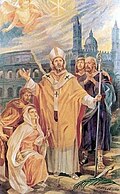 Mamilian of PalermoSaint · Bishop of PalermoSep 15
- Acacius of BeroeaSaint · Bishop of Beroea in SyriaSep 15
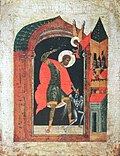 Nikita BesogonGreat Martyr · The Demon-BeaterSep 15
 Maximus, Asclepiodota and Theodotus of AdrianopleHoly MartyrsSep 15
 Porphyrius of EphesusMartyr · ActorSep 15
- Maximus of AdrianopleMartyrSep 15
- Nicholas SkvortsovHieromartyr · PriestSep 15
- Bessarion of LarissaSaint · Metropolitan of LarissaSep 15