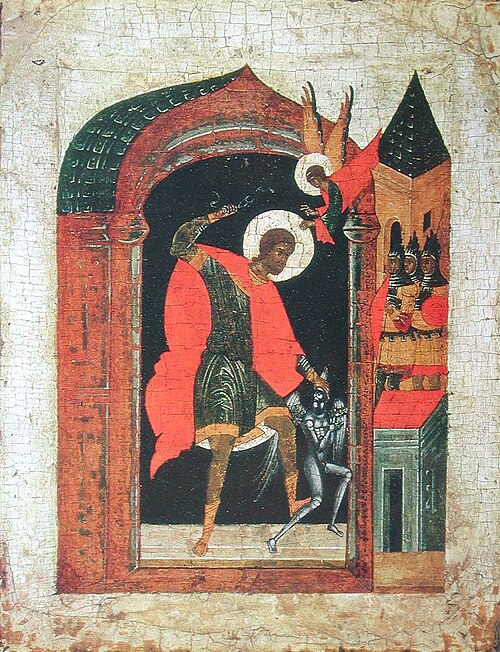
Great Martyr
Nikita Besogon
The Demon-Beater
Great martyr of apocryphal tradition, a son of Emperor Maximian, put to death at Constantinople; icons show him beating a demon.
- Feast
- September 15old style September 28
- Era
- unknown
- Order
- Great Martyrs
Life
Saint Nikita Besogon (the Demon-Beater) the Great Martyr is a saint of apocryphal tradition, said to have been tortured and put to death for Christ at Constantinople; in the legend he was a son of the pagan emperor Maximian. He is known above all from iconography, where he is shown beating a demon that sought to tempt him to accept paganism. He is commemorated on 15 September.
A legendary story
His Life comes from the apocryphon "The Tale of the Torments of Nikita". Scholars regard it as a reworking of the life of one of the early Christian martyrs named Nikita, who was celebrated on the same day as Nikita the Goth. The apocryphon is mentioned in the index of forbidden books of the eleventh century and entered "Canon 59 of the Council of Laodicea", with other writings called Bogomil, among them the "Martyrdom of George". The early existence of the apocryphal life in Rus is known from literary monuments, among them the "Tale of Boris and Gleb" of the mid-eleventh century, which says that in his prayer before death the holy prince Boris remembered the sufferings and torments of the saints Nikita, Vyacheslav and Barbara, killed by their relatives. According to N. S. Tikhonravov and V. M. Istrin the translation was made in southern Rus already in the twelfth century. The tale is known in several Greek and Slavonic manuscripts of the twelfth and thirteenth centuries. In Russian manuscripts of forbidden books it bears the title "The Torment of Nikita, Calling Him the Son of Maximian the Tsar", and the surviving copies date from the end of the fifteenth century.
In the time of Peter the Great the apocryphal life of Nikita, son of Maximian, was rejected, not because another life was recognized as true, but because of its lesser popularity. From then on only Nikita the Goth was honoured on this day. Later, in iconography, the subjects of the two were sometimes mixed, although Nikita the Goth did not fight a demon "physically".
The apocryphal story
According to the apocryphon, Nikita was the son of the pagan emperor Maximian, who with the emperor Diocletian was known for the great persecution of Christians, in particular the torments of the great martyrs George and Panteleimon. The real emperor Maximian, however, had a single son, Maxentius, who is not known as a martyr of Christianity.
One day Nikita tried to bring his father to the Christian faith, but he refused and tried to turn his son to paganism. In answer Nikita asked for twelve golden idols, to worship them in secret, and the emperor, glad, gave them, but Nikita miraculously ground them to powder. Seeing the remains of the idols, the emperor cried: "Was it not Saint George who taught you to do this?" Nikita answered that it was not and that he "hoped in God". Maximian also mentioned that George had been tormented by "Dadian", whom he calls his "brother", probably meaning Diocletian.
The destruction of the idols angered the emperor so much that he tried in several ways to kill his son, but miracles occurred and the executions failed. Then he threw Nikita into prison. There a demon appeared to him in the guise of an angel and began to tempt him to renounce Christianity. Hearing the devil's voice, Nikita prayed to see the tempter; then the Archangel Michael appeared to him, telling him to stretch out his hand and seize the demon. Nikita seized him, threw him down and stood on his neck. Then he took the chains from his own legs and began to beat the devil with them, who gave his name as Beelzebub.
Nikita spent three years in prison. Then the emperor remembered him and ordered him brought. Nikita came with the demon and threw him down on his face before the emperor, showing who ruled him. Yet the emperor was unyielding and again ordered his son put to a martyr's death, but again a miracle happened. With the help of the Archangel Michael, who appeared again, Nikita also worked the miracle of raising two people buried in a stone pillar, but the emperor again did not believe him. Then all the people with the empress rose against the emperor, and on that day Nikita baptized 18,400 people.
Veneration and iconography
The peak of popularity of images of Nikita, on icons, amulets and crosses, came in the sixteenth and seventeenth centuries, in the era of the Stroganov school of icon painting. He was the best-known and most honoured Nikita of the Christians until the schism of the Russian Church in 1666, and the Old Believers honoured him until the nineteenth century. The people called him "Besogon". In the imagination of the eastern Slavs, the apocryphal figure of the religious legend merges with folk legends about Nikita the Tanner, the hero who overcame an evil dragon.
The original image of the exorcist saint changed, coming closer to a general image of the victor over paganism (the demon). At first the illustrations were close to the text of the apocryphon, then they became images of a fighter against demons, related to saints such as Nikita the Goth, Nikita the youth of Asia Minor, Nikita of Novgorod, and also the Archangel Michael. It was believed that his image protects against unclean power, and he was called on in family troubles, in particular for the spoiling of children and for healing from "rodimets" (infant convulsions). There are two prayers to the martyr Nikita. Nikita Besogon, as the people called him, is usually painted with a staff or chains, beating a demon.
There is a bas-relief on the north wall of the Dmitriev cathedral in Vladimir (1197), which became popular among craftsmen of cast crosses and small icons of the twelfth to seventeenth centuries. In the Russian Museum is a three-register icon of the fifteenth-sixteenth century with the image of Besogon, and another icon, "Nikita Beating the Demon, with the Deesis and Chosen Saints", of the Novgorod school of the last third of the fifteenth century, is in a private collection. Old churches were dedicated to him: at Pereslavl-Zalessky, probably already in the twelfth century, a Nikitsky monastery, and in Novgorod, in the Carpenters' End, a church first mentioned in the chronicle in 1368. The Russian director and politician Nikita Mikhalkov named his programme "Besogon".
Commemorated the same day September 15
 Symeon of ThessalonicaSaint · Archbishop of ThessalonicaSep 15
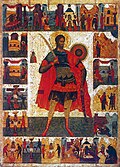 Nicetas the GothGreat MartyrSep 15
 Nicomedes of RomeMartyrSep 15
 Joseph of AlaverdiVenerable · Abbot of Alaverdi MonasterySep 15
 Mamilian of PalermoSaint · Bishop of PalermoSep 15
- Acacius of BeroeaSaint · Bishop of Beroea in SyriaSep 15
 Maximus, Asclepiodota and Theodotus of AdrianopleHoly MartyrsSep 15
 Porphyrius of EphesusMartyr · ActorSep 15
- Maximus of AdrianopleMartyrSep 15
- Nicholas SkvortsovHieromartyr · PriestSep 15
- Phileas of ThmuisHieromartyr · Bishop of ThmuisSep 15
- Bessarion of LarissaSaint · Metropolitan of LarissaSep 15