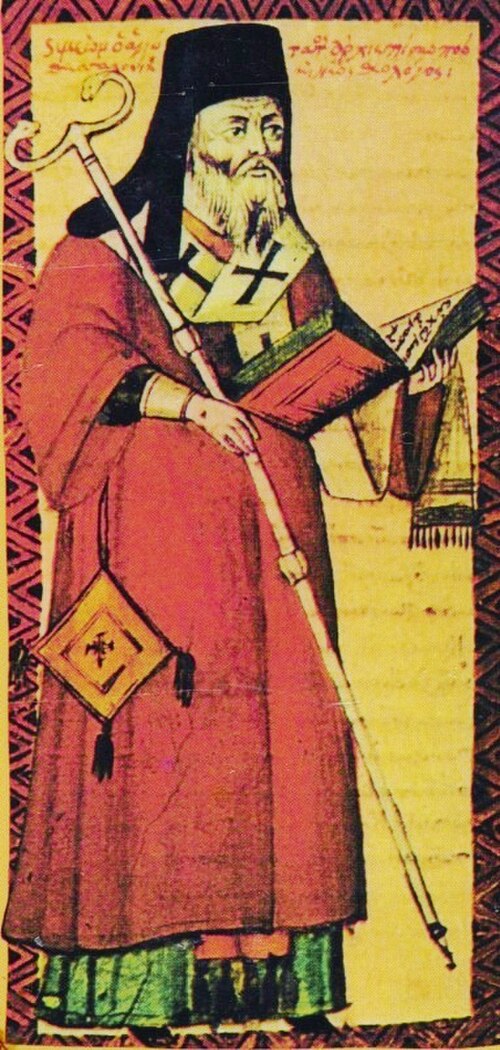
Saint
Symeon of Thessalonica
Archbishop of Thessalonica
Monk, theologian and archbishop of Thessalonica, who died in 1429; canonized in 1981.
- Feast
- September 15old style September 28
- Reposed
- 142915th century
- Place
- Thessaloniki
- Order
- Hierarchs
Life
Saint Symeon of Thessalonica was a monk, theologian and archbishop of Thessalonica in the early fifteenth century, the last shepherd of the city before it fell to the Turks. He is counted among the most important figures of the Church in the late Byzantine period and is regarded as the greatest Byzantine liturgist. He fell asleep in the Lord in September 1429, and the Church honors him on 15 September.
Youth and monastic life
Symeon was born in Constantinople in the second half of the fourteenth century, between 1381 and 1387 according to some historians. His name in the world is not known; Symeon is his monastic name. His writings show that he received a thorough church and theological education and that he knew well the Holy Scriptures and the Holy Fathers. He became a monk, probably at the monastery of the brothers Kallistos and Ignatios Xanthopoulos in Constantinople, lived in a small cell, leaned toward hesychasm and the theology of Saint Gregory Palamas, was ordained hieromonk, served as preacher and spiritual father, and, as historians report, frequented the patriarchal court.
Archbishop of Thessalonica
In 1416 or 1417 he was chosen archbishop of Thessalonica. He was consecrated in Constantinople, according to the custom for hierarchs of the Patriarchate of Constantinople, and his enthronement in the city came, it seems, with some delay, since the city was ever more tightly ringed by the Ottomans. By his own account his health faltered in the new see but was strengthened through prayer to Saint Demetrius the Great Martyr, protector of the city. He was a fearless defender of Orthodoxy and took care for the renewal of the liturgical life of his diocese, and he was known for his teaching and for the good order of the services.
When he arrived, the city was surrounded by Ottoman forces. In June 1422 he slipped out secretly toward Constantinople to persuade the emperor to send more troops, but he got only as far as Mount Athos, narrowly escaping the Turks who were beginning the siege. On Athos he was persuaded to return. From then on he led the city at a hard time, under siege by Sultan Murad II. Receiving no help from Constantinople, the governor, Andronikos Palaiologos, decided in 1423 to hand the city to Venice, in the hope that the republic would keep it from the Turks.
Symeon did not want Thessalonica given up to either the Turks or the Latins. He succeeded nonetheless in having conditions included in the agreement with Venice that secured the church rights of his diocese, and the city remained faithful to the Orthodox Church, resisting the temptation to submit fully, in canonical terms, to the Church of Rome in order to obtain protection. Venetian rule did not stop the siege, however, and the city's state remained desperate. Symeon recounts these events in his Logos Historikos.
He died suddenly in September 1429, a few months before Thessalonica fell to the Ottomans in March 1430. He was loved in his lifetime for his virtue, his justice and his care for the needy, and at his death both the Catholic Venetians and the Jews mourned him.
Writings
Symeon left a rich body of work, chiefly liturgical but also pastoral, canonical, dogmatic, apologetic, moral, historical and political, including homilies, pastoral letters, a discourse on the priesthood and many hymns. The largest is the Dialogue in Christ, which opens with a long section against heresies and then treats each of the Church's services; others are On Our One True Christian Faith and On the Sacred Rites and Mysteries of the Church. Some of his texts on the Jesus Prayer are included in the Philokalia.
He explains all the orders of service in detail, leaning toward mystical interpretation, following Saint Dionysius the Areopagite, which is why he is called the Mystagogue. He also wrote works defending Orthodoxy, directed chiefly against the Latins, and left the saying that the true good of men is to be Orthodox, and if not, it is better to die.
Veneration
Saint Symeon was canonized on 14 April 1981 by the Ecumenical Patriarchate, and the Church commemorates him on 15 September.
Commemorated the same day September 15
 Nicetas the GothGreat MartyrSep 15
 Nicomedes of RomeMartyrSep 15
 Joseph of AlaverdiVenerable · Abbot of Alaverdi MonasterySep 15
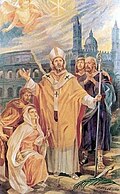 Mamilian of PalermoSaint · Bishop of PalermoSep 15
- Acacius of BeroeaSaint · Bishop of Beroea in SyriaSep 15
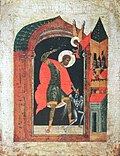 Nikita BesogonGreat Martyr · The Demon-BeaterSep 15
 Maximus, Asclepiodota and Theodotus of AdrianopleHoly MartyrsSep 15
 Porphyrius of EphesusMartyr · ActorSep 15
- Maximus of AdrianopleMartyrSep 15
- Nicholas SkvortsovHieromartyr · PriestSep 15
- Phileas of ThmuisHieromartyr · Bishop of ThmuisSep 15
- Bessarion of LarissaSaint · Metropolitan of LarissaSep 15