Hieromartyr
Michael Isaev
A hieromartyr of the Russian Church, who died in 1937.
- Feast
- October 20old style November 2
- Reposed
- 193720th century
- Order
- Martyrs
Life
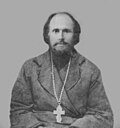
Holy Hieromartyr Michael Isaev, a deacon, was born on 11 January 1875 in the village of Krylovka, Chembar district of Penza province, to the peasants Vasily and Xenia Isaev. He attended the zemstvo school in the village and in 1891 entered the teachers' seminary at Penza, which he completed on 24 May 1894. On 1 August of that year he became a teacher at the zemstvo school of the village of Bolshoi Samovets in the Lipetsk district of Tambov province, and on 1 September 1894 he moved to the same post at the village of Studenki.
On 12 June 1899 he was married in the church of the Nativity of Christ at Studenki to Sophia Ivanovna Romanovskaya, aged twenty-five, daughter of the deacon of this church. In March 1901 he passed the examination for deacon according to the Synodal programme and was appointed deacon of the church at Studenki, in the place of his father-in-law. He was ordained on 8 April 1901 by Bishop George (Orlov) of Tambov and Shatsk. From 1901 to 1910 he was a teacher at the parish school, and until his arrest in 1935 he served as deacon at the church of the Nativity of Christ at Studenki. In the file he is called protodeacon. His family at the time of the arrest consisted of his wife and her sister, Evgenia Ivanovna.
He was arrested on 19 May 1935, in the same case as Bishop Uar (Shmarin) of Lipetsk, because of the parishioners' protest against the removal of the bells. At the interrogations he did not admit guilt and was sentenced to five years of deprivation of liberty. He served his sentence in Kazakhstan, in Karlag. On 16 September 1937 he was arrested again, together with the priest Alexander Orlov and other clergy, on the charge that "while at the Tartaul section, organized in a group, he carried on counter-revolutionary agitation among the prisoners". At the interrogation he said that he knew Karasev and Orlov because they lived in the same barracks, that they talked about household matters, that he sang hymns with Karasev when they went to the river, but that he had not seen who made on the sand the image of a church from stones, nor the altar, and that he did not admit guilt. An act of 3 September 1937 states that at the Tartaul section there were found on the sand the image of a church, an altar and small icons made of stones by the priests among the prisoners, who held services and prayers there, and that the commandant scattered the stones and drove them away. In October 1937 the indictment was drawn up, according to which a group of churchmen had made in the bushes on the river bank a church, with the likeness of an altar, icons and crosses, in which services, prayers and talks were held.
By decision of the NKVD troika of the Karaganda region of 31 October 1937, Protodeacon Michael Isaev was sentenced to death together with other clergy. The sentence was carried out on 2 November 1937 at midnight; the place of burial is not known. The Council of Bishops of the Russian Orthodox Church of the year 2000 numbered him among the New Martyrs and Confessors of Russia (20 August 2000). He is commemorated on 2 November, the day of his death, in the new style, with the Synaxis of the New Martyrs and Confessors of the Russian Church (a movable day) and, on 23 September, with the Synaxis of the Saints of Lipetsk.
Commemorated the same day October 20
 Gabriel of GeorgiaFool-for-Christ · Georgian MonkOct 20
 Artemius of AntiochGreat Martyr · Roman general, commander of EgyptOct 20
 Nicholas LyubomudrovHieromartyr · PriestOct 20
 Herman KokelHieromartyr · Bishop of BlagoveshchenskOct 20
 Zosimas PepeninHieromartyr · PriestOct 20
- John of BakuNew Martyr · Priest of BakuOct 20
- BarsabiasVenerable Martyr · Abbot and missionary in PersiaOct 20
- Acca of HexhamSaint · Bishop of HexhamOct 20
- Aderald of TroyesVenerableOct 20
- Aidan of MayoSaint · Bishop of MayoOct 20
- Alexander OrlovHieromartyrOct 20
- BachthesonMartyrOct 20