Hieromartyr
Michael Samsonov
A hieromartyr of the Russian Church, commemorated in the Orthodox calendar.
- Feast
- January 15old style January 28
- Reposed
- 194220th century
- Order
- Martyrs
Life
Holy Hieromartyr Michael Samsonov, an archpriest, was born on 15 September 1867 in the village of Shor-Kasy, Ataevo volost, Kurmysh district of Simbirsk province (now the Shumerlya district of Chuvashia), to a peasant family. In 1880 he finished the Khodary elementary people's school. In 1892 he graduated from the Simbirsk theological seminary and in the same year was ordained a deacon for the village of Tuvany, and in 1894 a priest for the village of Raskildino, Kurmysh district. In 1900 he was moved to the village of Krasnye Chetai, and in 1905 again to Raskildino. He took an active part in the life of the Church: in 1905-1908 he was a deputy of the clergy at district and diocesan congresses, from 1906 assistant dean, and from 1910 head of the two-class teachers' school at Krasnye Chetai, until 1918. From 1914 he was permanent investigator for the church department in the Kurmysh district. His service was rewarded with the epigonation (1900), the skufia (1904), the blessing of Bishop Nicander of Simbirsk, the kamilavka (1912), several medals (1915), the golden pectoral cross (1919), the rank of archpriest from the new bishop of Chuvashia, Timothy (Zakov), in 1923, and the palitsa in 1925. Between 1924 and 1929 he was dean of the district.
In 1925 the Renovationists seized for a time the church at Raskildino where Father Michael served. In 1929, serving at Krasnye Chetai, he was retired at his own request, and in 1930 Bishop Mitrophan (Grinev) of Alatyr blessed him to return to his parish at Krasnye Chetai and not leave the faithful without services on the great days. In 1931 he received a pectoral cross with ornaments, and in 1936 he was appointed dean of the parishes of the Alikovo district.
Continuing his pastoral ministry at Raskildino, he was arrested on 10 December 1937. At the interrogation of 12 December he was asked whether he had carried on counter-revolutionary agitation in the village by spreading provocative rumours about the collapse of Soviet power and the collective farms. He rejected the charges. At that of 19 December the investigator asked what instruction he had given to the chairman of the church council, Efim Fyodorov, for the disintegration of the collective farms and against the elections to the Supreme Soviet, and whether at his initiative the council had written the petition for permission to ring the bells on election day, to distract voters from voting. The priest answered that he did not admit guilt; he had written no petition, and Efim Fyodorov had come to him, but he had refused. He added that when the tax inspector came to the village council he too was summoned, was told that his income reached five thousand roubles and that he should pay the tax on this basis, and he answered that they took taxes out of the ceiling, that he had no such income, after which he paid and left.
On 14 March 1938, at Shumerlya, a closed session of the special collegium of the Supreme Court of the Chuvash ASSR was held, which tried the priest of the church at Raskildino, Michael Samsonov, the churchwarden Efim Fyodorov and two other peasants. They were charged under article 58, points 10 and 11. The verdict said that, being in close contact on the basis of the performing of religious rites, in 1937 they had organized themselves into a counter-revolutionary group headed by Samsonov and Efim Fyodorov, carrying on systematic agitation against the collective farms, against taxes and defeatist, at meetings of individual farmers and in private talk, and that through Samsonov's religious activity the influx of believers from neighbouring districts had increased, leading to disruptions of work in the collective farms. All four were found guilty and sentenced to ten years in a labour camp. The priest Michael Samsonov and the churchwarden Efim Fyodorov were taken to the labour colony at Alatyr, where many clergy were then held, among them the venerable martyr Ignatius (Lebedev), abbot of the Vysoko-Petrovsky Monastery in Moscow, and the holy hieromartyrs Demetrius Voskresensky and Nicholas Troitsky. The churchwarden Efim Fyodorov died on 25 September 1938, according to the doctor's note of a heart defect and enterocolitis. Father Michael, though aged (he was in his seventy-fourth year), outlived many brethren in Christ and endured almost four years in the conditions of the colony. Unable to bear the harsh winter and the constant lack of food, Archpriest Michael died on 28 January 1942 and was buried in the colony's cemetery, in an unknown grave.
The parish of Raskildino was given no more priests, and the church stood locked. On 8 August 1941 the official decision of closure was taken, and during the war it was turned into a state grain store; only in April 1945 was it reopened, and it functions to this day. By decision of the Holy Synod of 27 December 2007, Archpriest Michael Samsonov was numbered among the saints, the New Martyrs. He is commemorated on 28 January, the day of his death, in the new style, with the Synaxis of the New Martyrs and Confessors of the Russian Church (a movable day) and, on 11 July, with the Synaxis of the Saints of the Chuvash Metropolis (a movable day).
Commemorated the same day January 15
 RachelRighteous · The MatriarchJan 15
 Paul of ThebesVenerable · The First HermitJan 15
 Remigius of ReimsSaint · Archbishop of ReimsJan 15
 Remigius of RouenSaint · Archbishop of RouenJan 15
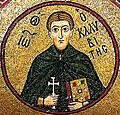 John the Hut-dwellerVenerable · Hermit of ConstantinopleJan 15
 Ceolwulf of NorthumbriaRight-Believing · King of NorthumbriaJan 15
- EugippiusVenerable · Abbot of LucullanumJan 15
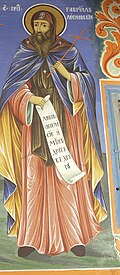 Gabriel of LesnovoVenerable · Hermit of LesnovoJan 15
 Ephysius of CagliariMartyr · Patron of CagliariJan 15
 Viator of BergamoSaint · Bishop of BergamoJan 15
 Nektary TelyashinSaint · Archbishop of Siberia and TobolskJan 15
- Salome of UjarmaRight-Believing · Queen of IberiaJan 15