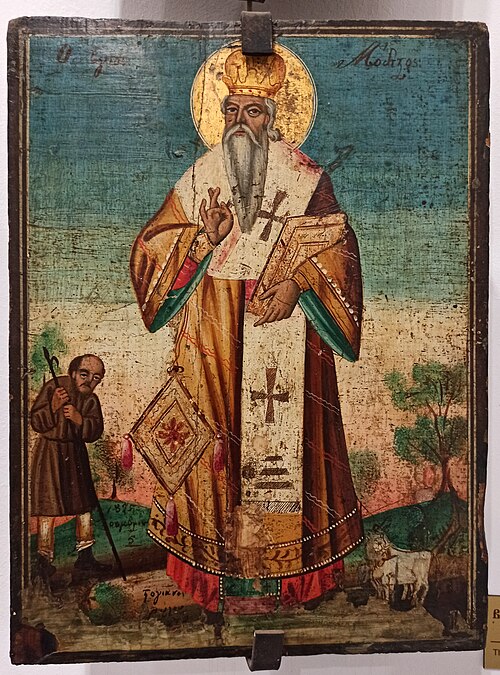
Saint
Modestus of Jerusalem
Patriarch of Jerusalem
Patriarch of Jerusalem from 632 to 634, who died in 634.
- Feast
- December 18old style December 31
- Reposed
- 6347th century
- Place
- Jerusalem
- Order
- Hierarchs
Life
Saint Modestus of Jerusalem was Patriarch of Jerusalem from 632 to 634 and, before that, for many years the patriarch's deputy in the years of devastation after the Persian conquest of 614. The Church remembers him for the care with which he laid the dead to rest and raised the holy places from their ruins. His feast is on 18 December.
Beginnings
He was born in Sebasteia, according to most sources Sebasteia in Cappadocia, in Asia Minor, and according to tradition he was orphaned at five months and raised by people of faith. One source says that as a man he was sold as a slave in Egypt, but turned his pagan master to the Christian faith and was freed by him. He entered monastic life, struggled on Mount Sinai, according to one source until the age of fifty-nine, and became abbot of the monastery of Saint Theodosius the Great in Palestine.
Deputy of the patriarch
In 614 the Persian king Chosroes II took Jerusalem and plundered it. Many Christians were killed, others carried into captivity, among them Patriarch Zacharias, and among the treasures taken was the Holy Cross. Modestus, who had set out to raise Greek soldiers against the Persians, escaped with difficulty from encirclement. He was chosen to hold the patriarchal throne in those hard times.
Under Persian rule, Modestus gathered the bodies of the fallen, especially the monks killed at the monastery of Saint Sabbas the Sanctified, and gave them an honourable burial. With the support of the Patriarch of Alexandria, Saint John the Merciful, he restored the Church of the Holy Sepulchre, the church of the Nativity at Bethlehem, and the other churches and monasteries of Palestine.
Patriarch
After fourteen years the emperor Heraclius defeated the Persians, and the captives who remained, among them Zacharias, could return, bringing the Holy Cross as well. Zacharias resumed his throne, which he had never formally left. He died in 632 or 633, and Modestus was elected patriarch, though according to one source he had already taken the leadership some years before. His ministry was short. The sources do not agree on his end. According to most, he fell asleep in the Lord on 18 December 634, at the age of ninety-seven, while one Serbian source gives the year 633. He was buried on the Mount of Olives, at the church of Eleona, and one Greek source says that he died during a journey. He is said to have written two homilies, on the Myrrh-bearing Women and on the Meeting of the Lord, mentioned by Photius, a letter to the Armenian bishop Komitas and a Kanonarion of Jerusalem.
Veneration
The head of Saint Modestus is kept at the monastery of Simonopetra on Mount Athos. In Bulgaria, in Pirin Macedonia, the Rhodopes and Strandzha, he is regarded as the patron of ploughmen, shepherds and draught oxen. Popular tradition says that he taught people to yoke oxen and to plough. On icons he is painted either with two yoked oxen or with a flock of sheep.
Commemorated the same day December 18
 SebastianMartyr · Roman soldierDec 18
 Mark and MarcellianHoly Martyrs · Martyrs of RomeDec 18
 Zoe of RomeMartyr · Martyr of RomeDec 18
 Gatianus of ToursSaint · First Bishop of ToursDec 18
 Winibald of HeidenheimVenerable · Abbot of HeidenheimDec 18
 Thaddeus UspenskyHieromartyr · Archbishop of TverDec 18
 Sebastian of SokhotaVenerable · Abbot of the Transfiguration MonasteryDec 18
- Carion the HermitVenerable · Hermit of ScetisDec 18
 Daniel the HesychastVenerable · Abbot of Voroneț MonasteryDec 18
 Nicholas KlementyevHieromartyr · Archbishop of Veliky UstyugDec 18
- Aedhgein of Ard LonainSaintDec 18
- AlphaeusMartyr · the ReaderDec 18