Martyr
Sebastian
Roman soldier
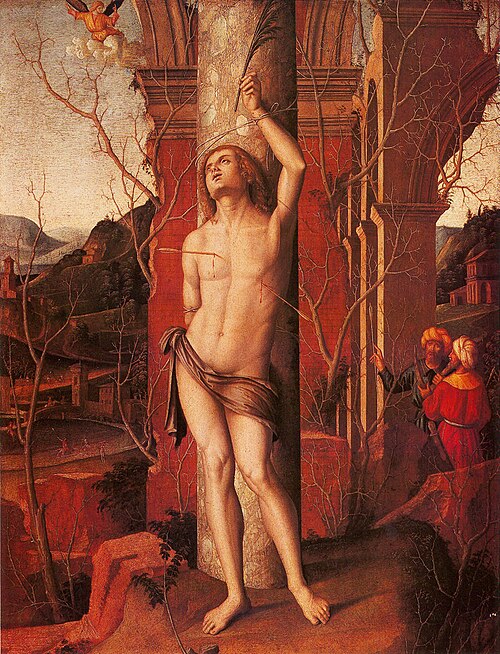
Roman soldier shot with arrows and killed for his faith in Christ in the persecution of Diocletian.
- Feast
- December 18old style December 31
- Reposed
- 2873rd century
- Place
- Rome
- Order
- Martyrs
Life
Sebastian was a Roman soldier who confessed Christ in the time of Diocletian's persecution and received the crown of martyrdom at Rome around 287. He has been honoured since the fourth century. The Orthodox Church commemorates him on 18 December, together with those who suffered with him, and the Roman Catholic Church on 20 January. Sebastian is the patron of archers, of athletes and, in the West, of those struck by plague.
The oldest witnesses
Little is known of his beginnings. The oldest mention is in the Chronograph of 354, which lists him among the martyrs honoured on 20 January. Saint Ambrose of Milan speaks of him in a sermon on Psalm 118, around the years 386 to 390, and says that he was from Milan and was already honoured there. The full story of the martyrdom is in the Passion of Saint Sebastian, a fifth-century text by an unknown author, long attributed to Ambrose.
According to this account Sebastian was born at Narbonne in Gaul, was educated at Milan and entered the army at Rome around 283. For his courage and justice he became captain of the guard of the emperors Diocletian and Maximian, who did not know he was a Christian. The Greek synaxarion says instead that he was born at Milan, and the sources do not agree on the year of his birth.
The soldier who strengthened his brethren
As a hidden Christian, Sebastian helped the persecuted brethren. Two brothers, the deacons Marcus and Marcellian, were in prison, and their pagan parents, Tranquillinus and Marcia, begged them with tears to renounce the faith. Sebastian came to them and urged them not to give up the banner of their victories for the tears of women, speaking of life without death. His face then shone like that of an angel, and all present believed. Zoe, wife of the official Nicostratus, who had been unable to speak for six years, received her voice when Sebastian made the sign of the Cross over her, and she confessed Christ.
The converts were baptized by the priest Polycarp: Tranquillinus and his family, Nicostratus, the prison keeper Claudius and sixteen condemned prisoners, sixty-four people in all. Then the prefect Chromatius, his son Tiburtius and their household believed, and the number of the enlightened rose to fourteen hundred. Chromatius left his office and withdrew to his estates in southern Italy. Pope Gaius ordained Tranquillinus a priest and Marcus and Marcellian deacons.
The suffering of his companions
The faithful gathered in the emperor's palace, with Castulus, a high official who was a hidden Christian. Zoe was seized while praying at the tomb of the Apostle Peter and died hanging by her hair, and her body was thrown into the Tiber. Tranquillinus was stoned. Nicostratus, Castor, Claudius, Victorinus and Symphorian were drowned in the sea, with stones tied to their necks. Tiburtius was set on burning coals, walked on them without feeling the heat and was beheaded. Castulus was buried alive, and Marcus and Marcellian died pierced by spears after standing the night in prayer, with their feet nailed to a stump.
The martyrdom of Sebastian
Sebastian was tried last. Diocletian, seeing him unshaken, ordered him led out of the city, bound to a post or a tree and shot by archers. Left for dead, he was found by the widow Irene, wife of Castulus, who had come to bury him and discovered him alive; she took him to her house and nursed him until he was healed. His friends begged him to leave Rome, but he stayed. One day, at a place where the emperors were to pass, he rebuked them for their cruelty to Christians. Astonished that the man believed dead was speaking, Diocletian ordered him beaten to death with clubs and his body thrown into the sewer.
Sebastian appeared in a vision to a Christian woman, Lucina, and told her to take his body. She buried him in the catacombs, at the entrance of the cemetery of Callixtus, where the basilica of San Sebastiano fuori le mura stands today. Part of the relics reached Soissons in France in 826, and his skull was brought to Ebersberg in Germany in 934.
Veneration
The custom of calling on him against the plague comes from an addition of the late Middle Ages: arrow wounds looked like the buboes of the disease. The chronicler Paul the Deacon relates that in 680 Rome was delivered from an epidemic after an altar was set up in his honour. The earliest known image is a mosaic in the basilica of Sant'Apollinare Nuovo at Ravenna, of the sixth century. Sebastian is patron of the cities of San Sebastian, Rio de Janeiro (Sao Sebastiao) and Sankt Sebastian am Rhein.
Commemorated the same day December 18
 Modestus of JerusalemSaint · Patriarch of JerusalemDec 18
 Mark and MarcellianHoly Martyrs · Martyrs of RomeDec 18
 Zoe of RomeMartyr · Martyr of RomeDec 18
 Gatianus of ToursSaint · First Bishop of ToursDec 18
 Winibald of HeidenheimVenerable · Abbot of HeidenheimDec 18
 Thaddeus UspenskyHieromartyr · Archbishop of TverDec 18
 Sebastian of SokhotaVenerable · Abbot of the Transfiguration MonasteryDec 18
- Carion the HermitVenerable · Hermit of ScetisDec 18
 Daniel the HesychastVenerable · Abbot of Voroneț MonasteryDec 18
 Nicholas KlementyevHieromartyr · Archbishop of Veliky UstyugDec 18
- Aedhgein of Ard LonainSaintDec 18
- AlphaeusMartyr · the ReaderDec 18