Venerable
Winibald of Heidenheim
Abbot of Heidenheim
Abbot of the Benedictine double monastery of Heidenheim, brother of Willibald and Walpurga; died in 761.
- Feast
- December 18old style December 31
- Reposed
- 7618th century
- Order
- Venerables
Life
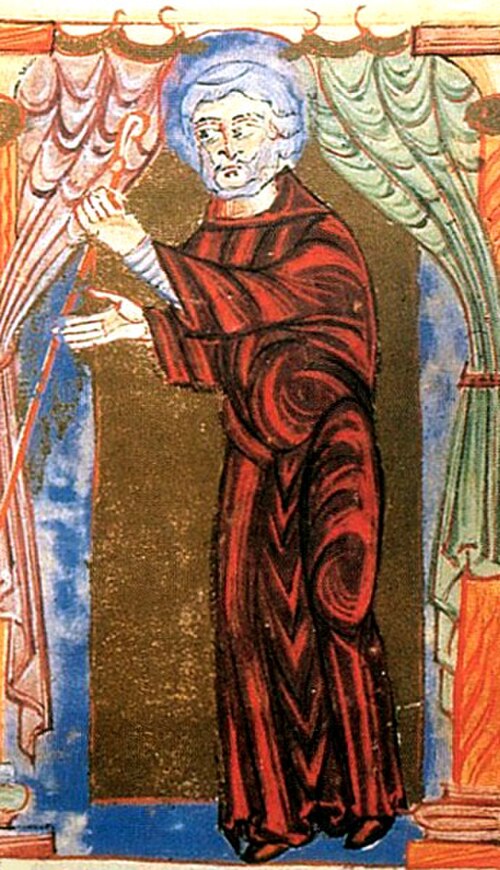
Venerable Winibald of Heidenheim was abbot of the Benedictine double monastery of Heidenheim am Hahnenkamm, in Franconia, brother of Willibald and Walburga. He died on 18 December 761 and is remembered on the same day. In the Orthodox tradition he is also remembered on the third Sunday after Pentecost, in the Synaxis of the saints of Britain and Ireland.
He was born about the year 702, in Wessex, the son of the Anglo-Saxon nobleman Richard the Pilgrim and of Wuna of Wessex, both venerated as saints. With his father and brother he made a pilgrimage to Rome in 720-721. His father died in Italy (he was buried at Lucca). At Rome they fell ill, perhaps with malaria. After recovering, Willibald went on to the Holy Land, while Winibald, who from childhood did not have a strong constitution, stayed at Rome, to recover and study, and became a monk. In 730 he returned to England and took with him a third brother and several kindred and acquaintances, to go back to Rome and begin the monastic life there.
Around 737 Boniface visited Rome. Willibald had by then returned from his travels and become a monk at Monte Cassino. Boniface recruited both nephews for the German mission. Willibald was ordained and based at Eichstätt. Winibald arrived in Thuringia on 30 November 740 and was ordained priest. He was put in charge of seven churches, among them one at Erfurt. He established a monastery at Schwanfeld, but in 742 (in other sources, 752) moved it to Heidenheim, where the brothers built a double monastery for the training of priests and as a centre of learning. Winibald was its first abbot. He took part in the Concilium Germanicum, in 742, and subscribed Pepin's donation to Fulda in 753. All this he accomplished in spite of continual illness, which prevented him from ending his life at Monte Cassino, as he had hoped; in his last years he suffered from rheumatism and visited the monasteries of Würzburg and Fulda. He fell asleep at Heidenheim on 18 December 761, in the arms of his brother Willibald. After his death the leadership of the monastery passed to his sister, Walburga.
In art he is portrayed as an abbot with a bricklayer's trowel, and he is patron of construction workers. Adelbert of Heidenheim wrote a biography of him in the twelfth century.
Commemorated the same day December 18
 SebastianMartyr · Roman soldierDec 18
 Modestus of JerusalemSaint · Patriarch of JerusalemDec 18
 Mark and MarcellianHoly Martyrs · Martyrs of RomeDec 18
 Zoe of RomeMartyr · Martyr of RomeDec 18
 Gatianus of ToursSaint · First Bishop of ToursDec 18
 Thaddeus UspenskyHieromartyr · Archbishop of TverDec 18
 Sebastian of SokhotaVenerable · Abbot of the Transfiguration MonasteryDec 18
- Carion the HermitVenerable · Hermit of ScetisDec 18
 Daniel the HesychastVenerable · Abbot of Voroneț MonasteryDec 18
 Nicholas KlementyevHieromartyr · Archbishop of Veliky UstyugDec 18
- Aedhgein of Ard LonainSaintDec 18
- AlphaeusMartyr · the ReaderDec 18