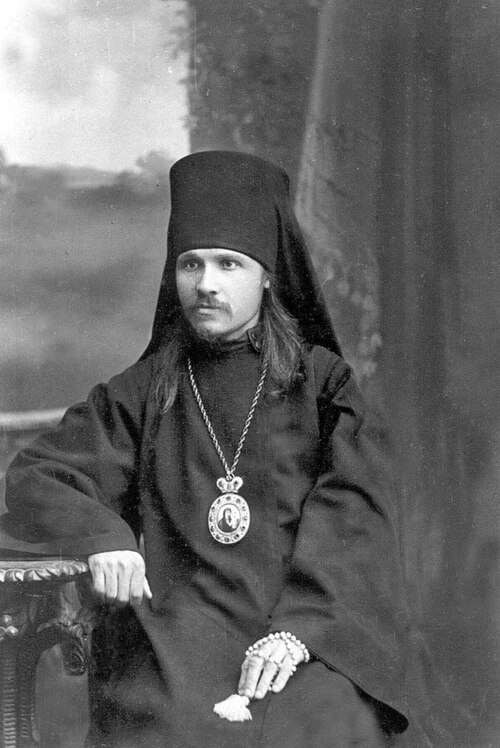
Hieromartyr
Thaddeus Uspensky
Archbishop of Tver
Archbishop of Tver (Kalinin) and Kashin, killed on December 31, 1937.
- Feast
- December 18old style December 31
- Reposed
- 193720th century
- Place
- Tver
- Order
- Martyrs
Life
Saint Thaddeus Uspensky, Archbishop of Tver (then called Kalinin) and Kashin, was one of the brightest hierarchs of the Russian Church in the years of Soviet persecution. He was born in 1872 in the Nizhny Novgorod region and was killed in the prison at Kalinin on 31 December 1937. The Church venerates him as a hieromartyr for his strict ascetic life, his love for his flock and his confession of faith unto death.
Family and education
His name in the world was Ivan Vasilyevich Uspensky. He was born on 12 November 1872 in the village of Naruksovo, in the Lukoyanov district of Nizhny Novgorod province, in the land of the Erzya people. He was named Ivan in honour of Saint John of Damascus.
His father, Vasily Fyodorovich, was an archpriest and the local dean, later honoured with the palitsa (1916) and the Order of Saint Vladimir, fourth class (1912). His mother was Lydia Andreyevna. The family had nine sons and two daughters.
He graduated from the Nizhny Novgorod Theological Seminary and then from the Moscow Theological Academy in 1896 as a candidate of theology. Even as a student he stood out among his classmates for his ascetic way of life.
In 1896 and 1897 he stayed on at the Academy as a scholar preparing for a professorship. In 1901 he received the degree of master of theology for a dissertation on the unity of the Book of the Prophet Isaiah.
Monastic life and teaching
Under the influence of the rector of the Academy, Bishop Anthony (Khrapovitsky), he decided to become a monk. In August 1897, at the age of 25, he was tonsured with the name Thaddeus, after the Apostle Thaddeus of the Seventy, and ordained a hierodeacon.
From 21 September 1897 he was a hieromonk and taught logic, philosophy and didactics at the Smolensk seminary. On 19 November 1898 he was transferred to the Minsk seminary as inspector, also teaching Holy Scripture.
From 1900 he taught fundamental dogmatic and moral theology at the Ufa seminary. On 5 March 1902 he became its inspector and was raised to the rank of archimandrite. In these years he published his Notes on Didactics, his main work on church pedagogy and education.
From 8 January 1903 he was rector of the Olonets Theological Seminary.
Bishop in Volhynia
On 21 December 1908 he was consecrated Bishop of Vladimir-Volynsky, second vicar of the diocese of Volhynia. The consecrating bishops were Archbishop Anthony (Khrapovitsky) of Volhynia, Bishop Michael (Yermakov) of Grodno, Bishop Eulogius (Georgievsky) of Kholm and Bishop Vladimir (Tikhonitsky) of Bialystok.
On 28 February 1913 he became first vicar. As a bishop he did not abandon the monastic struggle he had taken on. He fasted strictly and prayed much.
In the autumn of 1916 he was entrusted with the temporary administration of the diocese of Vladikavkaz during the illness of Bishop Antonin (Granovsky). On 28 January 1917 he returned to his own see.
In 1919, when Archbishop Eulogius (Georgievsky) was forced to leave his see and go abroad, Bishop Thaddeus took over the administration of the diocese of Volhynia. During the time of the Ukrainian People's Republic he refused to correspond with its officials in Ukrainian, despite threats of expulsion.
First arrests
In November 1921 the Bolsheviks arrested him in Zhytomyr on a charge of taking part in the insurgent movement in Volhynia. The faithful petitioned for his release. They wrote that there was no church in the city where he had not served and preached, that they knew him as a man of prayer and a true pastor, and that he had never meddled in politics.
He was taken to Kharkiv, where after interrogation the Ukrainian Cheka decided to hand him over to Patriarch Tikhon, with the right to live only in certain provinces of northern Russia and Western Siberia. On 9 March 1922 he was released from the Kharkiv prison, and the next day he left for Moscow.
Archbishop of Astrakhan
On 13 March 1922, after a conversation with Patriarch Tikhon, he was appointed to the see of Astrakhan and raised to the rank of archbishop. He was not able to reach Astrakhan, however, until December 1923.
In 1922 he was arrested again and accused of helping to print an appeal by Metropolitan Agathangel, who was temporarily leading the Church after the arrest of Patriarch Tikhon. The appeal urged the faithful to keep the foundations of the Church pure and to beware of those trying to seize church authority unlawfully, that is, the leaders of the Renovationist movement backed by the Bolsheviks.
He was held in the Vladimir prison together with Metropolitan Cyril (Smirnov), who later recalled those days. They were put in a large cell with thieves and murderers and had to sleep on the floor in a corner. Metropolitan Cyril was crushed by despair, while Archbishop Thaddeus sat calmly, deep in thought, and prayed at night. One night he took Cyril by the hand and encouraged him, saying that a truly Christian time had come for them, that their souls should be filled with joy rather than sorrow and open to sacrifice, because Christ was with them.
He handed the parcels he received to the cell elder, who shared them among all the prisoners. He gave his pillow to another imprisoned bishop and slept with his arm under his head. He was then exiled for a year to the Zyryan region.
In the summer of 1923, after his exile, he lived at Volokolamsk and served in Moscow churches, and later that year he left for Astrakhan. He lived in great poverty, wearing an old patched cassock and mended boots, with only one set of vestments and one mitre.
He served often, and after the services he talked with the faithful, explaining the Scriptures to them, and he preached a great deal. He opposed the Renovationists and supported the local clergy.
Patriarch Tikhon once told a resident of Astrakhan that Archbishop Thaddeus was a holy man, a rare and remarkable lamp of the Church. He added that he must be looked after, because such extreme asceticism and complete disregard for worldly things took a toll on his health, and that one should pray for God to strengthen him on that hard path.
In 1926, after the arrest of the deputy patriarchal locum tenens, Metropolitan Sergius (Stragorodsky), Metropolitan Joseph (Petrovykh) took over his duties for a time. On 8 December 1926 Joseph named as his successors, in case of his own arrest, Archbishops Cornelius (Sobolev) of Yekaterinburg, Thaddeus (Uspensky) of Astrakhan and Seraphim (Samoilovich) of Uglich.
After Metropolitan Joseph was arrested, and knowing that Archbishop Cornelius was in exile and could not take up the charge, Archbishop Thaddeus set out from Astrakhan for Moscow in mid-December 1926 to assume the temporary leadership of the Church. He was stopped in Saratov, however, and banished to the town of Kuznetsk in Saratov province.
Saratov and Tver
After Metropolitan Sergius was released and issued his declaration of 1927, Archbishop Thaddeus remained under the deputy locum tenens. According to the sources he was briefly assigned to Pyatigorsk.
In March 1928 he was freed and appointed Archbishop of Saratov. A parishioner remembered that he served unhurriedly, the Liturgy lasting from ten in the morning until three in the afternoon. He celebrated every Sunday and feast-day vigil and Liturgy, akathists and saints' days, and preached at every service so well that even children stood listening without tiring. Already in his lifetime people considered him a saint.
In November 1928 he was transferred to Tver as Archbishop of Kalinin and Kashin. As in Astrakhan, he preached a great deal and was much loved by his flock, which irritated the authorities.
The people of Tver often came to him for advice, even at his home. He became known for the gift of clairvoyance. It is told that a woman once asked his blessing for her daughter's wedding to a wealthy suitor. He insisted that they wait two weeks, and within that time the suitor's wife arrived with two small children and took him home.
Arkady Ilyich Kuznetsov, who knew him in Astrakhan and Tver, described him as a man of rare monastic beauty, mystical in spirit, ascetic, devoted to the Church to the point of self-sacrifice, humble, meek, and full of boundless kindness and love for people.
In summer he rented a house in the village of Prechisty Bor, not far from the city. He said that many thought he went there to rest, when in fact he went there to work and went to bed at three in the morning, having no secretary and doing everything himself. People sought him out there too, and he received everyone who needed a word from him.
Arrest and martyrdom
On 29 September 1936 the authorities withdrew his registration and forbade him to serve, but he continued to serve. In the summer of 1937 mass arrests began in Kalinin, as everywhere, and almost all the clergy of the diocese were imprisoned.
In October one of the priests, after prolonged torture, agreed to sign false statements against the archbishop. Representatives of the Renovationists readily came forward as false witnesses.
On 20 December 1937 Archbishop Thaddeus was arrested. Under interrogation he stood firm and refused to admit to any counter-revolutionary activity. Asked who gave material help to the diocese, he answered that gifts were brought to him in church by believers whose names he did not know.
In prison he was put among common criminals, who mocked him, and he had to sleep under the bunks. According to his Life, the Mother of God appeared in a dream to the leader of the criminals and forbade them to touch the holy man. The next morning the prisoners looked under the bunks and saw a bright light shining from there. They drew back in fear and asked his forgiveness. From then on the mockery stopped and they even began to care for him, and the prison authorities, noticing the change, moved him to another cell.
Ten days after his arrest he was sentenced to death on a charge of leading a church and monarchist organization. According to Archpriest Georgy Mitrofanov, a member of the Synodal Commission for the Canonization of Saints, the investigator grew so embittered against him that he ordered him not to be shot but drowned alive in the prison latrine. He received the crown of martyrdom on 31 December 1937.
Relics and veneration
The prison doctor told the faithful when the burial would take place. Like the others who were executed, the archbishop was buried without a coffin, but thanks to this warning the place was known.
In the spring of 1938, after Pascha, believers secretly opened the grave, laid the body in a hastily made coffin and placed a red Paschal egg in his hand. News of his death reached Metropolitan Sergius (Stragorodsky), the patriarchal locum tenens, who served his funeral in absentia.
A cross with an inscription was set up over the grave but was soon destroyed by the authorities. The place nevertheless remained venerated by the Orthodox throughout the Soviet years.
His writings, chiefly his sermons and his Notes on Didactics, were published in Tver in 2002 and 2003, and several of his homilies appeared in the Journal of the Moscow Patriarchate.
Archpriest Georgy Mitrofanov called him the brightest and at the same time most tragic example of steadfastness among the persecuted. His relics were uncovered on 26 October 1993 and now rest in the Cathedral of the Ascension in Tver. In 1997 the Council of Bishops of the Russian Orthodox Church numbered him among the new martyrs.
Since 2007 an Orthodox teachers' seminary in the diocese of Yekaterinburg has borne his name. Saint Thaddeus is commemorated on 31 December (18 December, Old Style), the day of his martyrdom, and on 26 October (13 October, Old Style), the uncovering of his relics.
Commemorated the same day December 18
 SebastianMartyr · Roman soldierDec 18
 Modestus of JerusalemSaint · Patriarch of JerusalemDec 18
 Mark and MarcellianHoly Martyrs · Martyrs of RomeDec 18
 Zoe of RomeMartyr · Martyr of RomeDec 18
 Gatianus of ToursSaint · First Bishop of ToursDec 18
 Winibald of HeidenheimVenerable · Abbot of HeidenheimDec 18
 Sebastian of SokhotaVenerable · Abbot of the Transfiguration MonasteryDec 18
- Carion the HermitVenerable · Hermit of ScetisDec 18
 Daniel the HesychastVenerable · Abbot of Voroneț MonasteryDec 18
 Nicholas KlementyevHieromartyr · Archbishop of Veliky UstyugDec 18
- Aedhgein of Ard LonainSaintDec 18
- AlphaeusMartyr · the ReaderDec 18