Martyr
Natalia Kopytina
Christian woman martyred for the faith of Christ in 1942, during the Soviet persecution.
- Feast
- September 10old style September 23
- Reposed
- 194220th century
- Order
- Martyrs
Life
Holy Martyr Natalia Kopytina was born on 25 August 1885 in the village of Poroi, Kuiman volost, Lebedyan district of Tambov province (now Lipetsk region), to the state peasant Feodor Mikhailovich Frolov and his wife Matrona Gerasimovna. On the same day she was baptized by the priest Pyotr Nikiforov and the deacon Vasily, in the church of the Archangel Michael at Poroi, receiving her name in honour of the holy martyr Natalia, commemorated on 25 August. The Frolov family was pious and hard-working; it lived in a stone house near the church, from the labour of the land. At twenty she was given in marriage to Anton Ivanovich Kopytin, aged nineteen, of the same village, the wedding being held on 6 November 1905 in the church of the Archangel Michael. The husband's family was known in the village for piety and strict moral order; Anton's brother Ignat was churchwarden and sang in the choir. On feasts the whole family went to the service. Soon the children came: Vasily (1907), Daria (1911), Feodor (1913) and Maria (1916).
Her husband, Anton Ivanovich, was strong and handsome, working as a "keeper of keys" (storekeeper) at the sugar factory in Trubetchino, but at thirty-three he was struck by the disease called among the people "Anton's fire". Natalia was left a widow with four children and did not marry again. The family lived modestly: until 1931 it had a house, a horse and a cow, without bought or rented land, and after 1931, when collectivization began, it had nothing but the house. By then Natalia's elder children had families of their own; with their mother lived the family of her son Vasily and her daughter Maria. Despite the persecution, services were held in the church of Poroi, and tradition says that only the bell was taken. There were many believers in the village. In 1929, after the closing of the Sezenovo monastery, the nuns of the monastery returned to their relatives in Poroi and the villages around. They went zealously to church, read the Psalter for the dead, kept close contact with each other, and were a spiritual support for the faithful in the time of trial. This alarmed the authorities, and at the beginning of the 1930s the first wave of arrests took place. The nuns and several believers from Poroi and the surrounding villages were arrested and sentenced.
In August 1937 the order for mass arrests was issued, among them of lay churchgoers. NKVD men questioned witnesses in the village, who said that there existed a "counter-revolutionary group of churchmen", who, besides going often to church, also gathered in houses, where they sang church hymns and read the Gospel, gathered also in the forest and sang hymns there, and after the hymns carried on anti-Soviet agitation, complaining of the conditions of life that the Communists had created. The chief fault was refusal to take part in the elections to the Supreme Soviet. One of the witnesses said that, coming to a house where there were believers, he invited the householder to come and vote, and the latter said, "For antichrists and destroyers I shall not vote." Another, present, supported him: "Now we are needed by you, but when they plundered us and took the last cattle and even a rag, then you did not need us." Natalia Feodorovna was there too, and other women, who began to lament: "Lord, Lord... they have tormented us utterly. Will God not hear us and deliver us from these antichrists?" On 20 December 1937 the authorities arrested the whole group of believers in the village, among them Natalia Feodorovna, accusing her of having "been an active member of a counter-revolutionary church group and of carrying on among the population anti-Soviet agitation, using religious prejudices".
The arrested were placed in the Dankov prison. The same day Natalia Feodorovna was interrogated by the investigator. She said that she denied belonging to a counter-revolutionary organization and that she had carried on no anti-Soviet agitation among the population. She denied the witnesses' testimony of her counter-revolutionary activity. A chronicler says that, knowing by what methods inquiry was then conducted, one can imagine what strong faith, courage and steadfastness this woman, not at all young, fifty-two years old, had, who did not admit guilt and spoke ill of no one. Toward the end of December the inquiry was ended and on 30 December 1937 the NKVD troika passed sentence on Natalia Feodorovna: eight years of imprisonment. She served the sentence first in the Ryazan prison, then was sent to a women's camp in the Akmolinsk branch of Karlag of the NKVD. In 1942 she was arrested in the camp, in the group case "The case of Evdokia (Andrianova) and 11 other prisoners, Akmolinsk, 1942", and on 20 April 1942 the criminal judicial collegium of the Karaganda regional court, in the Akmolinsk branch of Karlag, sentenced her to death. She was shot in April 1942; the place of burial is not known. On 30 May 1989 she was rehabilitated by the procurator's office of the Lipetsk region, for the year 1937, and on 14 April 1993 by the law of the Republic of Kazakhstan, for the year 1942. She was canonized among the holy martyrs at the Council of Bishops of 13-16 August 2000, on the proposal of the Alma-Ata diocese. She is commemorated with the Synaxis of the New Martyrs and Confessors of the Russian Church (a movable day) and, on 23 September, with the Synaxis of the Saints of Lipetsk.
Commemorated the same day September 10
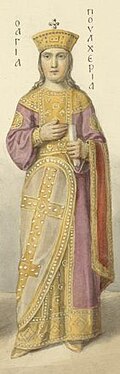 PulcheriaRight-Believing · Empress of ByzantiumSep 10
 Aubert of AvranchesSaint · Bishop of AvranchesSep 10
 Salvius of AlbiSaint · Bishop of AlbiSep 10
 Menodora, Metrodora and NymphodoraHoly Martyrs · Virgin martyrsSep 10
 Benjamin of the Kiev CavesVenerable · Monk of the Kiev CavesSep 10
 Palladius PopovHieromartyr · Priest of IzhmaSep 10
 Victor of ChalcedonMartyr · SoldierSep 10
 Tatiana GrimblitMartyr · NurseSep 10
 Juvenaly MaslovskyHieromartyr · Archbishop of RyazanSep 10
- Sophia of SicilyMartyrSep 10
 Varus ShmarinHieromartyr · Bishop of LipetskSep 10
 Sosthenes of ChalcedonSaintSep 10