Hieromartyr
Nicholas Aristov
Cleric martyred for the faith of Christ in 1931, during the Soviet persecution.
Life
Holy Hieromartyr Nicholas Aristov was a deacon at Zagorsk (Sergiev Posad), a former photographer, and was shot on 10 June 1931 for commemorating the emperors at services.
His life
He was born in 1872 in the village of Strakhovo, in the Kashira district of the Tula province, in a noble family. His father, Stepan Aristov, owned an estate at Strakhovo and over five hundred desyatinas of land at Ovechkino. Nicholas attended the gymnasium and in 1895-1896 was steward of an estate for a landowner in the Tula district. He was drawn to artistic photography, so he became an apprentice in a studio in Sergiev Posad, and in 1900 he opened his own studio in the town of Aleksandrov. With his wife Lidia he had two daughters; at the birth of a third child his wife died, and after half a year the infant died too. Nicholas remained a widower and raised his daughters alone in piety and love for the Church. One of the daughters fell ill with meningitis and bore its effects all her life.
In 1917 he moved with his daughters to Sergiev Posad and opened a photographic studio, but he gave it up in 1929, when the scale of the country's ruin became clear to him, and he wished to dedicate the rest of his life to the Church. In July 1930 he was ordained deacon at the church of the Holy Apostles Peter and Paul in Sergiev Posad, renamed Zagorsk, and on 5 April 1931 he was arrested and imprisoned at Butyrka, in Moscow.
Martyrdom
At the interrogation Deacon Nicholas said that he had not spoken against the authorities and that he held we must pray for them, as for the state in which we live, that the Church's condition might ease and the persecution stop, and that he had been arrested because he had given himself to the service of God. He was accused of belonging to the Zagorsk branch of a counter-revolutionary organisation and of monarchist agitation, that is, of reading aloud the names of the Russian emperors from the lists for the departed. For the OGPU this was enough. On 6 June 1931 the OGPU collegium sentenced him to death, and on 10 June he was shot and buried in an unknown common grave at the Vagankovo cemetery in Moscow.
After the execution his daughters were given his remaining belongings and a note in which he asked the younger, Nadezhda, not to leave her sick sister. Nadezhda was twenty-three and a teacher. The school director told her, "You have been seen in church: either church or school." She chose the Church without hesitation and left the school. Soon after her father's death the sisters took into their home the family of an arrested archpriest, Vladimir Medvedyuk. Nadezhda then lived in peace and piety, caring for her sister.
Nicholas Aristov is remembered on 10 June, on 7 February (a movable day) in the Synaxis of the New Martyrs and Confessors, and on 5 September (a movable day) in the Synaxis of the Saints of Moscow, in the new style.
Commemorated the same day May 28
 William of GelloneVenerable · Duke of Toulouse, monkMay 28
 Germain of ParisSaint · Bishop of ParisMay 28
 Justus of UrgellSaint · Bishop of UrgellMay 28
 Gerontius of MoscowSaint · Metropolitan of MoscowMay 28
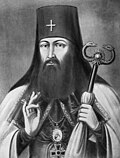 Barlaam of TobolskSaint · Archbishop of TobolskMay 28
 Emilian of CagliariHieromartyr · Bishop of CagliariMay 28
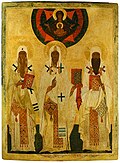 Ignatius of RostovSaint · Bishop of RostovMay 28
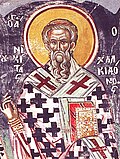 Nicetas of ChalcedonConfessor · Archbishop of ChalcedonMay 28
 Podius of FlorenceSaint · Bishop of FlorenceMay 28
 Elena of DiveevoVenerable · Virgin at DiveevoMay 28
 Helikonis of CorinthMartyr · Martyr of CorinthMay 28
- HelladiusHieromartyr · Bishop and martyrMay 28