
Hieromartyr
Nicholas Okolovich
Cleric martyred for the faith of Christ in 1934, during the Soviet persecution.
Life
Holy Hieromartyr Nicholas Okolovich was an archpriest at Vitebsk, a teacher, missionary and seminary rector, and died in prison in the year 1934.
Beginnings
He was born on 4 May 1863 in the village of Uzhlyatino in the Vitebsk district, in the family of a psalm-reader. From childhood he stood out for deep faith and love of the church. He finished the theological school at Vitebsk, then, in 1877, the seminary at Vitebsk, first category, and between 1883 and 1887 the Moscow Theological Academy, with the title of master. For his peaceable nature and innate tact he was called, already at school, "Nicholas the Peacemaker". On 4 December 1887 Bishop Marcellus of Polotsk named him missionary against the schism in the diocese of Polotsk. In 1888 he married Alexandra Mikhailovna Detsikevich, daughter of the archpriest Michael Detsikevich, and they had two sons and two daughters. He was ordained deacon, and on 2 February 1888 priest. From 1889 he was teacher of religion at the Polotsk cadet corps, member of the diocesan trusteeship, chairman of the council of the Polotsk Church Brotherhood and of the local branch of the school council, and in 1897 he received a certificate of the Holy Synod and a Bible. At the first Missionary Congress at Vitebsk, of 5-10 June 1901, he was unanimously elected chairman.
Because of a serious illness he moved in 1907 to the diocese of Voronezh, where, between 13 August 1907 and 1 July 1913, he was rector of the Voronezh seminary and editor-in-chief of the Diocesan Gazette. In the seminary he organised an observatory, a biology station and an electrical station. He was chairman of the diocesan missionary council and took part in fourteen institutions of culture and charity. In May 1910 he took part in the transfer of the relics of Saint Euphrosyne, abbess of Polotsk, to her monastery, where he met Metropolitan Anthony (Khrapovitsky). In 1911 he founded pedagogical and missionary courses at Voronezh for teachers and clergy. He had a remarkable literary talent and, as editor of the Polotsk Diocesan Gazette, wrote over a thousand pages.
Persecution
Returned to Vitebsk, while the seminary had been closed, he led a pastoral school at the Saint Nicholas Cathedral and gave lectures on the history of religions, church history and theology. In 1922 he became rector of the cathedral. In the campaign of confiscation of valuables he sought to avoid bloodshed and succeeded in recovering an object confiscated at the Dormition Cathedral. In 1922 he was arrested for a few weeks and given a suspended sentence of one year. Losing his place at the cathedral, he served at the church at Novinki and was rector at Komshany until autumn 1924. In 1924 and in 1927 Renovationist leaders, Metropolitan Joseph (Krechetovich) and Archbishop Alexander (Shcherbakov), proposed in writing that he join Renovationism, receive episcopal rank and lead the diocese of Polotsk; each time he refused resolutely, remaining faithful to the Church. From October 1924 to the arrest, in 1931, he was rector of the church of Saint Elijah in Vitebsk; after the closing of the battalion church, in 1929, he took its priest into the clergy and took its parishioners under his care. He celebrated the Liturgy daily and did not cease to pray for peace in the world. Between 1929 and 1931, as dean of the city's churches, he brought some forty parishes under the omophorion of the Patriarchate, and in the reopened churches thousands of believers gathered. In 1929 he prepared, at the request of Metropolitan Sergius, a memorandum on the church and historical significance of Vitebsk as the seat of an autonomous administration of the Church in Belarus.
On 24 April 1931, at sixty-eight, he was arrested again, charged with anti-Soviet and anti-collective-farm agitation. He died in detention in 1934.
He is remembered on 30 August, on 17 September in the Synaxis of the Saints of the Voronezh Metropolis, on 11 July (a movable day) in the Synaxis of the Saints of Belarus, and on 7 February (a movable day) in the Synaxis of the New Martyrs and Confessors, in the new style.
Commemorated the same day August 17
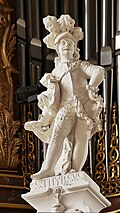 ThyrsusMartyr · Martyr of Apollonia in PhrygiaAug 17
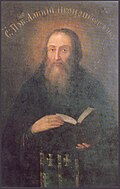 Alypius of the CavesVenerable · Icon painter of the Caves LavraAug 17
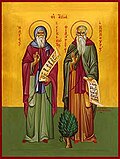 Elias of EnnaVenerable · Monk from SicilyAug 17
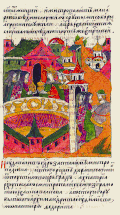 Theodoret of KolaVenerable · Archimandrite, enlightener of the SamiAug 17
 Myron of CyzicusHieromartyr · Priest of CyzicusAug 17
 Pimen of UgreshaVenerable · Abbot of Nikolo-Ugresha MonasteryAug 17
 Tbeli AbuserisdzeSaint · Georgian scholarAug 17
 Safta BrâncoveanuVenerableAug 17
- Nazaria of VăratecVenerable · First abbess of Văratec MonasteryAug 17
- Olympias of VăratecVenerable · Founder of Văratec MonasteryAug 17
- AeglonVenerableAug 17
- Alexis VelikoselskyHieromartyrAug 17