Venerable
Nikephoros of Vazheozero
Founder of the Vazheozero hermitage
Disciple of Alexander of Svir, he withdrew in 1508 to Lake Vazhe, where he founded a hermitage.
- Feast
- February 9old style February 22
- Reposed
- 160016th century
- Place
- Olonetsky District
- Order
- Venerables
Life
Venerable Nikephoros of Vazheozero was a Russian monk, a disciple of Saint Alexander of Svir, who founded the hermitage at Vazheozero, in the Olonets region, in the first half of the sixteenth century. He is remembered on 9 February, the day of his repose, together with Saint Gennady, whose labours he continued. His relics lie in a cave at the Transfiguration church of the Zadne-Nikiforovsky monastery. Our sources give 1508 for his departure to Vazheozero and about 1510 for his arrival at Svir, without reconciling the two.
Beginnings
He was born in a village churchyard, Vazhesky, near the river Svir, to a pious peasant family, and in his parents' house he learned the fear of God. Nothing is known of his childhood and youth. At that time the whole Olonets land was full of the news of the labours of Saint Alexander, who had already founded the monastery of the Holy Trinity on the river Svir. Nikephoros came to the Svir monastery already as a monk, around 1510, and was received by Alexander as one of the brethren, for the holy abbot knew of his ascetic life, and that he wore heavy chains on his body. Another source says only that, by tradition, Alexander blessed him to withdraw to Vazheozero in 1508.
He lived for some years in the Svir monastery. Alexander saw his virtues, understood the spiritual benefit that Nikephoros brought the brethren, and gave thanks to God. From the monastery Nikephoros made two long journeys: one, at Alexander's command, to the ascetic Cyril of Novoezero, and the other, of his own will, to Kyiv, to venerate the holy places of the Caves.
Journey to Cyril and to Kyiv
Alexander gave him the obedience to go to Cyril, on the White Lake, at the monastery of the Resurrection of Christ, to ask the abbot's blessing and prayers, to converse with him and learn the monastic life from him. Nikephoros accepted the obedience gladly and set out on the long road. After some days he arrived safely on the western shore of the lake, in the village of Kobilina Gora, two miles from the monastery, which stood on the opposite shore. Evening was coming. The traveller went to the wooded north shore and fell asleep there.
Meanwhile Cyril was performing his evening cell rule. After that he went alone to the shore, took a boat and crossed to the north shore of the lake, where Nikephoros was waiting. From there they went across to the Novoezero monastery, where Nikephoros stayed eight days, sharing the prayerful labours of the brotherhood and delighting in the abbot's instructive conversations. Probably after this he went on pilgrimage to Kyiv.
The Vazheozero hermitage
He returned from his journey to Kyiv with a burning desire to found his own monastery, and Alexander supported him. Going about and surveying the places of his homeland, he stopped at last where Gennady had recently ended his earthly journey, and founded a monastery and a church in the name of the Transfiguration. He served in his monastery many years, built ten cells, cleared the forest and drained the marsh, and sought a charter from the tsar for the surrounding lands, a mile on each of the four sides (a charter of 1557). When he had finished the work that had long weighed on him, surrounded by the brethren he had gathered, he fell asleep in peace on 9 February.
At the beginning of the seventeenth century the Olonets region was laid waste by foreigners who roamed everywhere. The monastery Nikephoros had built was plundered, the monks were driven out and the property destroyed. But the memory of Saints Gennady and Nikephoros did not fade. When the danger had passed, the chapel over their common grave was restored and then, little by little, the monastery. In 1846 it received an independent existence, and in 1854 permission to build, in place of the old wooden chapel, a church over the saints' relics. With the blessing of the Holy Synod and Archbishop Arcadius of Olonets, it was consecrated on 8 August 1858 in the name of All Saints.
Commemorated the same day February 9
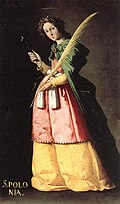 Apollonia of AlexandriaMartyr · of AlexandriaFeb 9
 Pancras of TaorminaHieromartyr · Bishop of TaorminaFeb 9
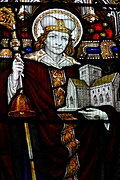 Teilo of LlandaffSaint · Bishop of LlandaffFeb 9
 Peter of DamascusVenerable · Author in the PhilokaliaFeb 9
 Nicephorus of AntiochMartyrFeb 9
 Gennady of VazheozeroVenerable · Hermit of VazheozeroFeb 9
- AthenodorusSaintFeb 9
- Alexander of VologdaRighteous · Priest of VologdaFeb 9
- Nikephoros of BorovskVenerable · HegumenFeb 9
- Aemilianus and BrachioHoly VenerablesFeb 9
- Aemilianus of PionsatSaintFeb 9
 AltoVenerableFeb 9