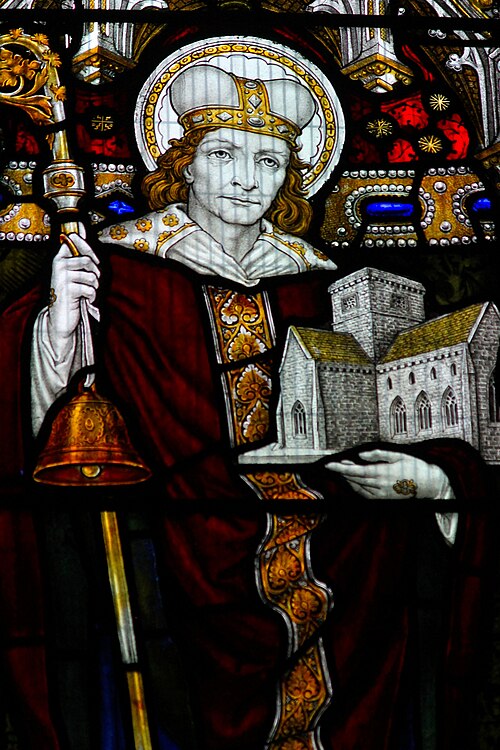
Saint
Teilo of Llandaff
Bishop of Llandaff
British monk and bishop, founder of monasteries and churches in Wales, who died around 560.
- Feast
- February 9old style February 22
- Reposed
- 5606th century
- Place
- Llandeilo
- Order
- Hierarchs
Life
The Holy Hierarch Teilo of Llandaff (Eliud) was a monk, bishop and founder of monasteries and churches in Wales, patron of the city of Cardiff. He was born around 500 at Penalun (Penally), near Tenby, in Pembrokeshire, and fell asleep around 560 at Llandeilo Fawr. His feast is on 9 February.
Family and training
Teilo seems to have been known in Old Welsh as Eliau or Eilliau. His father is usually taken to be Ensich ap Hydwn, and he was brother of Anowed and uncle of Saints Ismael and Euddogwy. Some modern sources make him a grandson of Ceredig, son of Cunedda, and so of the royal house of Gwynedd, to which Saint David too was reckoned; but this link is doubtful, since it rests on the Iolo manuscripts, now known to have been forged by Edward Williams. He studied at two schools directed by saints: the first founded by the great church leader and teacher Dubricius (Dyfrig), the second directed by Paulinus of Wales at "Wincdi-Lantquendi" (thought to be Whitland), where he met Saint David (Dewi) and became his close companion.
Bishop of Llandaff
Like many founder-bishops, he seems to have had experience of arms: together with Aeddan and Ysfael he went to Mynyw (St Davids), where Dewi had founded his abbey, and drove out an Irish pirate named Bwya, killed his cattle and burned his fortress to the ground. He succeeded Dubricius as bishop of Llandaff, after the latter retired as a hermit to Bardsey Island. Teilo founded the first church at Llandaff, headed a monastic school, and was bishop over Glywysing and Gwent. He also founded Llandeilo Fawr and Penally Abbey, at his birthplace.
In the 540s a plague, probably that of Justinian, struck Britain. In 549 Teilo, with a small group of monks, moved to Dol in Brittany. He is said to have stayed there seven years and seven months, so he left in 556 or 557, though some sources imply he returned in 554. They travelled through Dumnonia and, according to the account, received the confession of King Geraint and joined Saint Samson of Dol at Dol: the fruit groves they planted are still known as the groves of Teilo and Samson. The legend says that Budic II of Brittany asked him to subdue a fierce winged dragon, which the saint tamed and tied to a rock in the sea off the coast of Brittany. Returning to Llandeilo Fawr, where he is known to have fallen asleep on 9 February, the year being unknown but probably around 560, he became one of the most venerated men of Wales.
Relics and veneration
At his repose, says the account, his body miraculously became three identical bodies, probably because three foundations claimed his relics: Llandaff Cathedral, Llandeilo Fawr and Penally Abbey. One tomb lies to the right of the altar of Llandaff Cathedral; his skull is kept in a reliquary in the south chapel. The reliquary was in the possession of the Mathew family from 1480 to 1658, after Sir David Mathew restored Saint Teilo's shrine in Llandaff Cathedral, which had been desecrated by pirates, and it had been given by Bishop Marshall. It is said that many miracles were seen there, both in his lifetime and at his tomb. His relics are now more widely distributed still: they are venerated at Landeleau and Plogonnec (Finistère) and at Saint-Thélo (Côtes-du-Nord). The 2004 Roman Martyrology lists him under 9 February with the Latin name Teliavus, as bishop and abbot of the monastery at Llandaff; he is said to have been canonized, but the date is not known. He is often shown, as in many Breton churches, riding a stag.
At least twenty-five churches and schools in Wales, Brittany, Cornwall and Devon bear his name, among them St Teilo's Church at Llandeloy and Llantilio Pertholey; three Breton villages, Landeleau, Landêliau and Saint-Thélo, took his name. His festival is kept at different dates: 9 February in Wales and at Saint-Thélo, 29 November at Dol, 25 November in the other Breton churches; after 1752 his fair at Llandeilo stayed on 9 February by the old calendar, that is 20 February by the new, or the Sunday after that date.
Troparion, Tone 4: As a fountain of the true Faith, you caused the life-giving waters of salvation to flow, O Hierarch Teilo; therefore we beseech you, intercede with Christ our God that our souls may be saved.
Commemorated the same day February 9
 Apollonia of AlexandriaMartyr · of AlexandriaFeb 9
 Pancras of TaorminaHieromartyr · Bishop of TaorminaFeb 9
 Peter of DamascusVenerable · Author in the PhilokaliaFeb 9
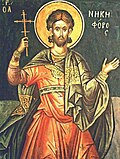 Nicephorus of AntiochMartyrFeb 9
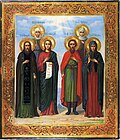 Gennady of VazheozeroVenerable · Hermit of VazheozeroFeb 9
- AthenodorusSaintFeb 9
- Nikephoros of VazheozeroVenerable · Founder of the Vazheozero hermitageFeb 9
- Alexander of VologdaRighteous · Priest of VologdaFeb 9
- Nikephoros of BorovskVenerable · HegumenFeb 9
- Aemilianus and BrachioHoly VenerablesFeb 9
- Aemilianus of PionsatSaintFeb 9
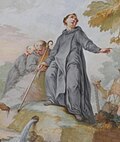 AltoVenerableFeb 9