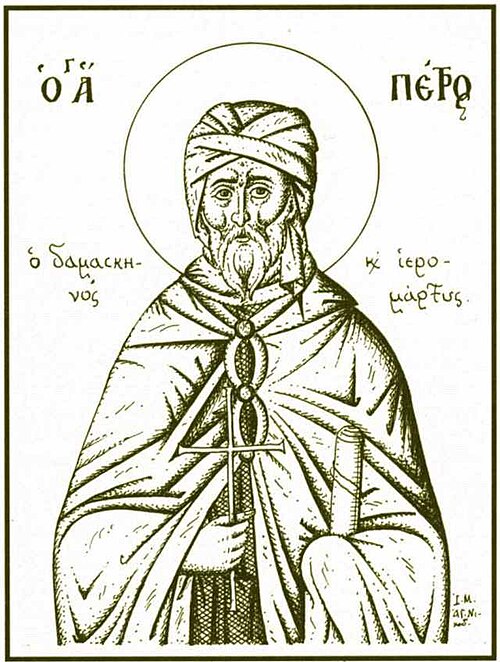
Venerable
Peter of Damascus
Author in the Philokalia
Monk and theologian of the 12th century, the second most voluminous author in the Philokalia.
- Feast
- February 9old style February 22
- Reposed
- 120012th century
- Place
- Byzantine Empire
- Order
- Venerables
Life
Saint Peter of Damascus was a twelfth-century monk and spiritual father whose writings fill, after those of Saint Maximus the Confessor, the largest place in the Philokalia. Very little is known of his life, but his teaching on watchfulness, humility and the salvation of all people has remained one of the most prized in the hesychast tradition. The Church commemorates him on 9 February.
What is known of his life
No life of him has survived, and the name "of Damascus" does not necessarily mean he was born at Damascus, as was the case with Saint John of Damascus. In the past he was confused with another Peter of Damascus, a bishop and martyr who lived almost four hundred years earlier. The confusion appears in the third volume of the Philokalia, where Saint Nicodemus the Hagiorite attributes the monk's writings to the eighth-century martyr. The earlier Peter, according to tradition, had been a bishop at Damascus and, because he spoke against Islam and the Manichaean heresy, the Arabs cut out his tongue and sent him to prison deep in Arabia, where he preached the Gospel, brought many to the faith and died as a confessor and martyr. The two commemorations fall on the same day, 9 February, which shows how closely their names were tied.
The monk Peter lived in the twelfth century, at the height of monastic reform in Byzantium. He was a monk, as his own words show: he speaks of "us monks", of his monastic habit and calls himself a fully tested monk. He says that he lived in a cell, never owned books or possessions and was under the guidance of a spiritual father. He writes of three kinds of monastic life, cenobitic, eremitic and semi-eremitic, and it seems he followed the last. His writings are generally dated to about the twelfth century, from a thirteenth-century manuscript in the Vatican and a fourteenth-century one in Paris, and he mentions Symeon the Metaphrast, who died in the last quarter of the tenth century, so he lived after him.
Writings
His works form a wide range of practical spiritual counsel for monks. He stresses both ascetic labour and the grace of God in salvation. There are 107 known manuscripts with writings attributed to him, full of quotations from the Holy Fathers: Athanasius the Great, Anthony the Great, Basil the Great, Dionysius the Areopagite, Isaac the Syrian, John of Damascus, John Chrysostom and Abba Philemon. Since he says he never had books, he probably wrote them from memory, which would explain a few slight misquotations.
Scholars disagree about his originality. The historian Jean Gouillard holds that he invented nothing but put into clear formulas the teaching of the great contemplatives of the East; Fr Greg Peters argues that Peter also contributed something new to spiritual theology. A notable theme is his affirmation that salvation is not only for monks but also for laypeople. He writes that "marriage is natural" and that if someone wants to be saved, no person, time, place or occupation can prevent him. Bishop Kallistos Ware observed that, though he wrote for monks, he insists that salvation and spiritual knowledge are within reach of everyone and that continual prayer is possible in all circumstances.
In the Philokalia
In 1782 Saint Nicodemus the Hagiorite and Macarius of Corinth published at Venice the Philokalia, an anthology of the teachings of spiritual fathers from the fourth to the fifteenth century, compiled from manuscripts at Vatopedi and other Athonite monasteries. Peter of Damascus's writings fill a large part of the third volume and are divided into two books. The first, "A Treasury of Divine Knowledge", treats among other things the seven forms of bodily discipline, the four virtues of the soul, the guarding of the intellect, obedience and stillness, the eight stages of contemplation, humility, dispassion and the discernment of thoughts and provocations, and gives two long lists, of 228 virtues and 298 passions. The second contains twenty-four discourses, one for each letter of the Greek alphabet, on spiritual wisdom, the two kinds of faith and of fear, hope, humility, love, knowledge of God, courage, justice, peace, joy, Holy Scripture and awareness in the heart. Saint Nicodemus called them "a concentrated Philokalia within the more extended Philokalia".
They were first translated into Slavonic by Paisius Velichkovsky, who described with unspeakable joy how he found the book on Athos: "I felt that I had found a heavenly treasure on earth". Theophan the Recluse's Russian translation did not include them, probably because Archimandrite Juvenal Polovtsev had earlier translated them at Optina. They have since been translated into many other languages. Juvenal said of them that in the author one sees a man who did not only borrow words from others but knew the truths of the inner life himself, from experience, and showed others the right path.
Veneration
Peter of Damascus is among the ancient writers especially respected by the Russian Old Believers, because in one of his writings in the Philokalia it is taught that the two fingers and one hand show the crucified Christ known in two natures and one hypostasis. This passage was left out of Paisius's Slavonic translation, in Theophan's version the writings were removed altogether, and the same was done in the Russian editions of his works. The Russian Church commemorates him on 9 February Old Style as a hieromartyr, as a result of the same confusion with the bishop of Damascus; the Serbian Church commemorates him on the same day.
Commemorated the same day February 9
 Apollonia of AlexandriaMartyr · of AlexandriaFeb 9
 Pancras of TaorminaHieromartyr · Bishop of TaorminaFeb 9
 Teilo of LlandaffSaint · Bishop of LlandaffFeb 9
 Nicephorus of AntiochMartyrFeb 9
 Gennady of VazheozeroVenerable · Hermit of VazheozeroFeb 9
- AthenodorusSaintFeb 9
- Nikephoros of VazheozeroVenerable · Founder of the Vazheozero hermitageFeb 9
- Alexander of VologdaRighteous · Priest of VologdaFeb 9
- Nikephoros of BorovskVenerable · HegumenFeb 9
- Aemilianus and BrachioHoly VenerablesFeb 9
- Aemilianus of PionsatSaintFeb 9
 AltoVenerableFeb 9