Martyr
Nikephoros Zaitsev
Christian martyred for the faith of Christ.
Life
Holy Martyr Nikephoros Zaitsev was a believing peasant of the Moscow region, condemned for his faith in 1937 and dead in a camp on 21 May 1942.
His life
He was born on 23 March 1884 in the village of Pupki, in the Ruza district of the Moscow province, to the peasants Peter Konstantinovich and Marfa Sozontovna Zaitsev. He finished the village school, loved learning and was a very well-read man. Hardworking, he kept a good farm, which brought him many troubles under Soviet rule. In the First World War he was called up and sent to the baggage train. Returned home, he took up peasant work again. A believer and steady parishioner, he was a member of the church council, sang in the choir, took part in processions and services of supplication, and urged his fellow villagers to pray and go to church, regardless of the persecution. Those who knew him testified that he was a deeply churchly man of spotless morals, an enemy of drunkenness and ready to help anyone. During collectivisation, though he did not agree with the way it was carried out, he joined the collective farm. He never began work without prayer, which the party leadership did not like.
Arrest and confession
In the persecution of 1937 being a believer was enough for arrest. On 23 September 1937 he was arrested and imprisoned at Volokolamsk. The chairman and secretary of the village soviet and a collective farmer testified that, speaking of the execution of Tukhachevsky and others, he had said it was wrong to shoot them, that brother shoots brother; that at a meeting he had shouted that people were being openly robbed; that he was against state loans; that he constantly asked for the church to be repaired and held services of supplication and singing at home; that at Pascha he urged the collective farmers to hold a procession with icons, saying the new constitution allowed it; and that he said the Holy Scripture was the truth and all the rest lies against Christ.
At the interrogation Father Nikephoros admitted that the priest visited him and took tea at his house, but denied any agitation. He said that slanderers had multiplied in the country because Christian faith was missing, that the executed men were clever but had erred by turning to treason, and that shooting them seemed to him too cruel a punishment; that collective farms are a good thing but the people are not prepared; that he had not spoken against state deliveries and loans; that the priest had told him the new constitution permits processions with icons; and that his wife, Maria Ignatievna, held the same views.
Camp and death
The investigation ended, and he was moved to the Taganka prison in Moscow. On 11 November 1937 an NKVD troika sentenced him to eight years in a labour camp, and he was sent to the White Sea-Baltic Canal, to Medvezhyegorsk station. When the works were scaled back he was sent to Kargopollag in the Arkhangelsk region, where he arrived on 28 July 1941; there he wove fishing nets. He died in the camp on 21 May 1942 and was buried in an unknown place.
He is remembered on 21 May, on 7 February (a movable day) in the Synaxis of the New Martyrs and Confessors, on 5 September (a movable day) in the Synaxis of the Saints of Moscow, and on 1 November in the Synaxis of the Saints of the Archangelsk Metropolis, in the new style.
Commemorated the same day May 8
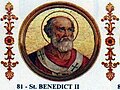 Benedict II of RomeSaint · Bishop of RomeMay 8
 Boniface IV of RomeSaint · Bishop of RomeMay 8
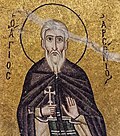 Arsenius the GreatVenerable · Hermit of EgyptMay 8
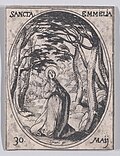 Emmelia of CaesareaVenerable · Mother of St. Basil the GreatMay 8
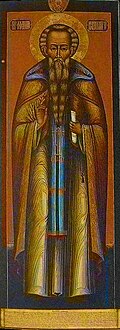 Philip of IrapVenerable · Founder of Irap HermitageMay 8
 Arsenius the Hard-workerVenerable · Monk of the Kiev CavesMay 8
- Helladius of AuxerreSaint · Bishop of AuxerreMay 8
 Pimen the Faster, AbbotVenerable · Abbot of the Kiev CavesMay 8
- Basil the ElderSaint · Father of Saint Basil the GreatMay 8
- AbranVenerableMay 8
- AdrianVenerableMay 8
- Adrian of VolokolamskVenerableMay 8