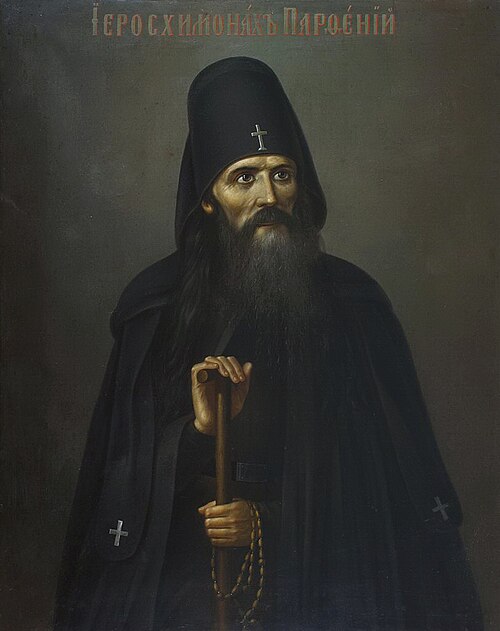
Venerable
Parthenius Krasnopevtsev
Venerable monk of Kiev, venerated in the Orthodox calendar; died in 1855.
- Feast
- March 17old style March 30
- Reposed
- 185519th century
- Order
- Venerables
Life
Saint Parthenius Krasnopevtsev, called of Kiev (in the world Peter Ivanovich, 1790-1855), was a hieroschemamonk and confessor of the Kiev Caves Lavra. He was born on 24 August 1790 in the village of Simonovo in the Aleksin district of Tula province, in the family of a church sexton, and grew up in poverty, learning from childhood that one must not bind one's soul to earthly goods. He studied at the school and seminary of Tula, which he left in 1815. Already in youth, on a night of travel toward home, he looked at the sky and felt unspeakable joy in his heart, then saw a white dove above him; another time, dozing under a tree, he saw an old monk who told him that a monk is a stranger and dead to earthly things. In 1814 he visited the Caves Lavra and wished to stay there.
His parents first made him sexton in the village and tried to find him a bride, but seeing that his heart was not in the world, they accepted his choice. In 1819 he entered the Lavra. His first obediences were in the monastery vineyard and garden, then in the prosphora bakery, where he became the head. He lived in perfect poverty; when a stranger stole his sheepskin coat one winter, he said not to touch him, left him the coat and money, with the advice not to take another's goods again. In 1824 he was tonsured a monk with the name Pafnuty, then ordained hierodeacon. Severe headaches then began, which he bore for more than thirty years without complaint; because of them, as a hierodeacon, he served for a time in the churches of the Far Caves. In 1829 he was ordained hieromonk, after a vision in which the Hierarch commanded him to take the Gospel and serve, and the Queen, whom he recognized as the Most Pure Virgin, said she pledged herself for him. He was soon named confessor of the brotherhood.
In 1838 he received the great schema with the name Parthenius. His cell rule was long and varied: the Jesus Prayer, the Hail Mary, the Gospel, the Psalter and akathists. Daily he said the Hail Mary three hundred times. The Mother of God explained to him: The schema means to devote oneself to prayer for the whole world. He was tormented by headaches, a chest illness and the attacks of demons. In spring and summer he lived at Goloseevo, where after the Liturgy he withdrew into the forest to pray. Toward the end of his life he was the confessor of Metropolitan Filaret Amfiteatrov of Kiev, and for sixteen years served the Liturgy daily in the metropolitan's house church. To his spiritual children he handed on the struggle with the passions, unceasing prayer to acquire the Holy Spirit, and the daily reading of the Gospel and the Psalter.
Those who knew him testified that his gaze was luminous and his speech gentle, and that his words seemed different from anyone else's. He passed to the Lord on 25 March 1855, in the morning, sitting in the vestibule of the house church in the Near Caves, where he was preparing for the service. He was buried at the church of the Icon of the Mother of God, the Life-Giving Spring, at Goloseevo. The church was blown up in the 1930s and the tomb destroyed; his relics now lie under the ground.
Veneration by the people began at once after his death. He was glorified in the Ukrainian Orthodox Church on 27 July 1993 and was included in the calendar of the Russian Orthodox Church by the Council of Bishops on 30 November 2017. He is commemorated on 30 March and on 28 July, in the new style.
Commemorated the same day March 17
 Patrick of IrelandSaint · Bishop and Enlightener of IrelandMar 17
 Alexis the Man of GodVenerableMar 17
- Ambrose of AlexandriaSaint · Friend of OrigenMar 17
 Makary of KalyazinVenerable · Founder of Kalyazin MonasteryMar 17
 Marinus of CaesareaMartyr · Roman soldierMar 17
 Paul KratirovSaint · Bishop of StarobelskMar 17
- Gabriel MtsireSaintMar 17
- Agricola of ChalonSaint · Bishop of Chalon-sur-SaôneMar 17
- Alexander and TheodoreHoly MartyrsMar 17
- Alexander PolivanovHieromartyrMar 17
- Beccan of RumVenerableMar 17
- Dativus of AquileiaSaintMar 17