Hieromartyr
Peter Pushkinsky
Cleric martyred for the faith of Christ in 1937, during the Soviet persecution.
- Feast
- September 30old style October 13
- Reposed
- 193720th century
- Order
- Martyrs
Life
Holy Hieromartyr Peter Pushkinsky, an archpriest, was born on 23 December 1891 in the village of Barkovo, Dmitrov district of Moscow province, in the family of the priest Vasily Pushkinsky. After the spiritual school at Perervino he entered the Moscow seminary, which he finished in 1913 in the first category; for the way he composed and delivered sermons the pedagogical council gave him a special award. For a year he taught the Law of God at the people's school in Orekhovo-Zuevo. In 1914 he married Zinaida, the daughter of Archpriest Vasily Smirnov, abbot of the church of the Beheading of Saint John the Baptist in the village of Dyakovskoe. Soon he was ordained priest and named abbot of the church of Saint Elijah in the town of Vereya and religion teacher at the town's girls' progymnasium. From 1915 he was lecturer and secretary of the popular catechetical courses in Vereya.
During the First World War a hospital was opened in Vereya, where Father Peter served without pay as priest. After the revolution, because of the ruin and the crowding of the sick, an epidemic of black smallpox and typhus broke out. Father Peter went to the hospital to give communion to the sick and bury the dead, usually alone, because no one was let into the wards of the contagious. He had to suffer typhus himself, but did not cease to go to the sufferers.
In 1918 he was arrested by a punitive detachment of Latvians sent by the Bolsheviks to the Vereya district to suppress a peasant uprising. They seized him on the street itself, as he accompanied a dead man to the cemetery, took him to the town hall, then to prison, in such a way as to frighten him as much as possible. In prison he was put in a cell with hostages, priests, merchants and rich townspeople. All were released after paying ransom, and Father Peter was released free, as a man caught by chance on the street. In the civil war he was called into the town militia, as secretary. Once, because he refused to stay at work in the evening, it being the eve of a feast and he having a service at church, he received in the morning a notice of exile to Serpukhov, where he was put to the garrison stable, then to the supply department. Later he served again as a priest.
He was arrested on 31 July 1937, charged with counter-revolutionary activity, and held at Mozhaysk. As a false witness appeared the dean, the priest Victor Ozerov, who said that Father Peter was hostile to Soviet power and that of the Stalinist constitution he had said: What can we expect from this constitution, I will go to no election. He said also that he had ties with Moscow priests, father and son Mechev, known monarchists, who under the guise of charity collected money and helped persecuted priests. The priest Victor Ozerov was not arrested; he died with his wife of hunger in 1942, during the German occupation of Vereya, and no one helped him, knowing the role he had played in the destruction of others. Father Peter was asked whether he had known Alexis Mechev and his son Sergei and whether he had helped priests in prison. He answered that he had known the Mechevs and had helped the wife of an imprisoned priest, a relative of his. He categorically rejected any counter-revolutionary activity.
On 9 October 1937 an NKVD troika sentenced him to death. Archpriest Peter Pushkinsky was shot on 13 October 1937 and buried in an unknown common grave at the Butovo range.
He is commemorated on 13 October, on 29 May (a movable date) in the Synaxis of the New Martyrs of Butovo and on 5 September (a movable date) in the Synaxis of the Saints of Moscow, in the new style.
Commemorated the same day September 30
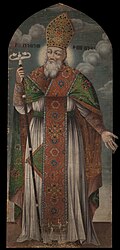 Gregory the IlluminatorHieromartyr · Bishop of Greater ArmeniaSep 30
 HripsimeGreat MartyrSep 30
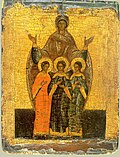 Faith, Hope, Love and their Mother SophiaHoly MartyrsSep 30
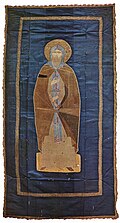 Gregory of PelshmaVenerable · Founder of Pelshma MonasterySep 30
 GayaneVenerable Martyr · Armenian abbessSep 30
 Aimilianos of GrevenaHieromartyr · Metropolitan of GrevenaSep 30
- Alexander OrlovHieromartyr · ArchpriestSep 30
- 32 Virgin MartyrsMartyrSep 30
- 70 Martyrs Slain with RhipsimeMartyrSep 30
- Airinne of BreachmhaghSaintSep 30
- Alexander ShishinHieromartyrSep 30
- Alexandra ChervyakovaVenerable MartyrSep 30