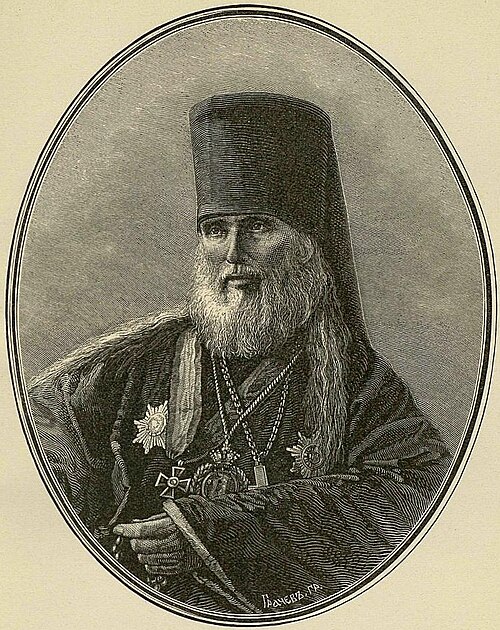
Saint
Philaret Gumilevsky of Chernigov
Archbishop of Chernigov
Archbishop of Chernigov, a church historian and spiritual writer of the 19th century.
Life
Holy Hierarch Philaret Gumilevsky of Chernigov (1805-1866) was Archbishop of Chernigov and Nezhin, an outstanding man of the Russian Church of the nineteenth century, a scholar, a shepherd and a tireless labourer. He died on 9 August 1866, as he was travelling through his diocese in a time of cholera to strengthen his flock.
Childhood and calling
He was born on 23 October 1805 in the village of Konobeevka, in the Shatsk district of the Tambov province, in a priest's family, and was named Demetrius Grigorievich Konobeevsky. It is told that, before anyone in the village knew of the birth of the priest's son, a fool for Christ, Alexei, climbed the bell tower and rang the bells, and when the people beat him for the uproar, he said that he rejoiced because a great man had been born who would ring through all Russia. The child was given the name Demetrius, after Saint Demetrius of Thessalonica.
His father was known as a wonderful preacher and an exemplary priest, and his mother was a pious woman of the old Russian pattern. The piety of his parents and the austere life of an aunt who guided him and who died a virgin at ninety awakened in him early an inclination to monastic life. Demetrius was small, slender and lively, with eyes in which mind and energy shone. At five he read the Psalter in church, and he knew nearly all of it by heart. At seven his father placed him at the Vysha Hermitage with the learned hierodeacon Nikon, with whom he stayed two years, and then he entered the Shatsk church school. There Bishop Jonas Vasilevsky of Tambov, seeing his small stature and humility, changed his surname from Konobeevsky to Gumilevsky, from the Latin humilis, that is, humble.
Once Demetrius went with his aunt to the Sarov Hermitage, to the elder Seraphim, who, blessing them and looking at the boy, said that this child would be a great lamp of the Church and would be renowned throughout Russia as a learned man. To his elder brother Basil, who came later to ask a blessing for monastic life, the elder said that God had given his brother a talent to draw a book from his pocket every month, and that he should go home and live as God would show him.
His father dreamed that Demetrius would take his place and insisted that he marry. After the first year in the theology course Demetrius began seeking a bride, fulfilling his father's wish. But during his last vacation, walking with his brother and friend Nikita in his father's large garden, he stopped at an apple tree and told them of a vision received in sleep under that tree. With tears of joy he said that he had seen a hierarch like Saint Basil the Great come to him, who told him that his plan and his father's would fall apart, that what Bishop Jonas had foretold would be fulfilled, that he should take his writings from the library of the Tambov seminary, in which he would see his likeness, read them in Latin and Greek, and go daily to matins at the archdeacon's church and stand before the icon of Saint Dimitry of Rostov. He told no one but his friend, but from that time he changed his life completely. Despite his father's displeasure and even threats, he gave up the thought of marriage altogether.
Monk and teacher
In 1826 he entered the Moscow Theological Academy, where on 19 August 1829, at the end of his studies, he was tonsured a monk. Metropolitan Philaret of Moscow, who had followed his studies closely, gave him at tonsure his own name, a case without parallel in the history of the academy. Toward the young monk the Moscow hierarch showed fatherly care and, at the same time, unusual strictness. Philaret was ordained hierodeacon on 3 February 1830 and hieromonk on 29 June the same year. While still a student he had been named librarian of the academy, and after finishing he stayed there, took in 1831 the chair of church history, then that of Holy Scripture, then of moral and pastoral theology. On 1 May 1833 he was appointed inspector, on 27 January 1835 he was raised to archimandrite, and on 14 December of the same year he was named rector of the Moscow Theological Academy. On 9 March 1837 the charge of the Epiphany Monastery was laid upon him.
He was of extraordinary diligence. He counted laziness among his faults, while witnesses of his tireless activity wondered whether he ever slept. With the greatest zeal he taught the history of the Russian Church.
Bishop of Riga
In October 1841 the great metropolitan Philaret named his beloved disciple to the see of Riga. The metropolitan knew his ardent love for the Church, his submission to the will of God, his humility, his deep understanding of the truths of faith and of the errors of Protestantism, and his good acquaintance with German theological literature and the German language. The news of the appointment struck the archimandrite like thunder, for he was greatly attached to the academy, to his work, to the library. He was consecrated bishop of Riga on 21 December 1841 in the Kazan cathedral in Saint Petersburg, and in July 1842 he left for Riga.
From the first moment when he stood before the throne of God as a servant of the altar until his death, at every service, from the Cherubic hymn until communion, tears flowed from his eyes. Taking the Lamb and reading the prayer before communion, he sobbed, and after communion he could not for a long time stop his tears.
The conditions of his ministry in Riga were very hard. Among the native people, Latvians and Estonians, a leaning toward Orthodoxy and toward their own culture was seen, toward services and teaching in schools in their mother tongue, and the saint supported this wish with all his strength. During his years in Riga he opened sixty-three parishes, built twenty permanent churches and forty-three temporary ones and pressed for the opening of a church school and parish schools. This activity, contrary to the interests of the barons and the German party, who wished to Germanize the region, stirred sharp opposition; they tried to paralyse his work and did not shrink from the dirtiest denunciations. The unequal struggle, which lasted seven years, ended in 1848 with his transfer to the see of Kharkov.
At Kharkov and Chernigov
At Kharkov and at Chernigov the saint gave great attention to the spiritual education of young people, set up seminaries and diocesan schools, followed the educational process, drew up teaching programmes for the schools, giving the income from his printed works for their material support. In the monasteries he established common life, and he did not neglect the building of churches and their beauty. He was gentle in manner; in conversation he listened to his partner with patience and goodwill, then explained the heart of the matter with great softness and brought the one in error to the right path. He was sensitive to the misfortune of others, and money had no value for him, as though he feared it. Even with the considerable means at his disposal at Kharkov he had constantly to reduce his expenses, because the money went mostly to works of charity. In 1857 he was raised to archbishop, and on 2 May 1859 he was named Archbishop of Chernigov and Nezhin.
He won great fame by his literary activity. He wrote very much and read without ceasing; those who knew him closely said that he worked and rested, ate and drank always with a book in his hand. Among his most valued works is the Historical and Statistical Description of the Kharkov Diocese, which contains the history of many parishes and the lives of ascetics of the Starobelsk district. He was also an outstanding preacher; especially edifying are his Discourses on the Passion of Our Lord Jesus Christ, delivered to the flock of Kharkov in the days of Great Lent.
Despite his intense scholarly work he responded keenly to events of public life: he visited the prisons, and during the Sevastopol campaign he distributed linen to the passing militias, blessed them and served supplicatory services; when the hospitals were filled with wounded, he gave the seminary buildings for them without hesitation, moving the students to private lodgings.
Repose and veneration
He did not abandon his flock even in the hardest moments. During the cholera of 1866 he set out to tour the diocese, saying that the people had lost heart and must be encouraged. On the way he himself fell ill and died on 9 August 1866 at Konotop. From Konotop to Chernigov, over a distance of one hundred and eighty versts, ten to twelve thousand people, relieving one another, accompanied the coffin of the beloved archpastor. In all this time there was not a single case of cholera. Cholera did not reach Chernigov and ceased. The saint's remains were buried in the Trinity cathedral of the Trinity-Ilyinsky Monastery, beneath the altar. Today his relics rest in this cathedral, beside the relics of Saint Theodosius of Chernigov and Venerable Lawrence of Chernigov.
By decision of the Holy Synod of the Ukrainian Orthodox Church, on 14 April 2009 he was numbered among the saints of local veneration in the Chernigov diocese. On 30 November 2017 the Council of Bishops of the Russian Church decided on his glorification for the whole Church, establishing his commemoration on 22 August in the new style. The Azbyka page also gives for him the days 23 June and 1 December.
Commemorated the same day August 9
 MatthiasApostle · Apostle chosen in place of JudasAug 9
 Irene of AthensRight-Believing · Byzantine EmpressAug 9
 Sava of OhridSaint · Disciple of Saints Cyril and MethodiusAug 9
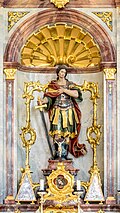 Romanus OstiariusMartyr · Doorkeeper of the church in RomeAug 9
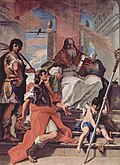 Firmus and RusticusMartyr · Martyrs of VeronaAug 9
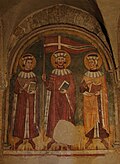 Secundianus, Marcellianus and VerianusHoly Martyrs · Martyrs of ItalyAug 9
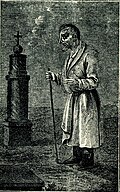 Anthony MonkinFool-for-ChristAug 9
- Jacob of SolovkiVenerable · Abbot of Solovki MonasteryAug 9
- Marcellus of VologdaSaint · Archbishop of VologdaAug 9
- Adrian of SolovkiVenerable · HermitAug 9
- Alexis of ConstantinopleMartyrAug 9
- Alexis of SolovkiVenerable · HermitAug 9