Saint
Regulus of Patras
Monk or bishop of Patras
Legendary monk or bishop of Patras said to have brought the relics of Saint Andrew to St Andrews in Scotland.
- Feast
- October 17old style October 30
- Reposed
- 4004th century
- Place
- St Andrews
Life
Saint Regulus (Rule) was, according to legend, a monk or bishop of Patras in Greece in the fourth century, who is said to have brought to Scotland, according to tradition in 345 or 347, part of the relics of the Holy Apostle Andrew and to have placed them at the place now called St Andrews. His day is 17 October (in the Aberdeen Breviary). He is a legendary saint of the Scots: our sources show no Orthodox canonization and no veneration in the Orthodox Church, only the Scottish tradition, also known from the Roman Catholic Church.
The story
The details of his life are unclear and differ from source to source. He was a monk or bishop in Patras, then in the Roman Empire, and guardian of the relics of Saint Andrew. According to one account, an angel told him in a dream that the emperor Constantine had decided to move the apostle's relics to Constantinople; according to another, Constantine was about to attack Patras. Regulus was to take as many bones as he could and carry them to the western end of the world, where he should raise a church in Saint Andrew's name. The Greek source says that an angel ordered him to take from the relics a shoulder blade, three fingers of the right hand, the knee bone and a tooth, and then, years later, a second vision told him to leave Patras with them. He was accompanied by several consecrated virgins, among them Saint Triduana.
According to some sources he came ashore in Fife, at the place called Kilrymont, a settlement of the Picts, now St Andrews, either after a shipwreck or guided by an angel to stop there. He was welcomed by a Pictish king, Óengus (according to the story the first of that name, though in reality he lived in the eighth century, which shows that the story is legendary); according to the Greek source, the king later accepted Christianity together with his subjects. He is said to have brought three fingers of the apostle's right hand, the upper bone of an arm, a kneecap and a tooth. According to the Russian source, he and two companions reached Scotland in 347.
Veneration
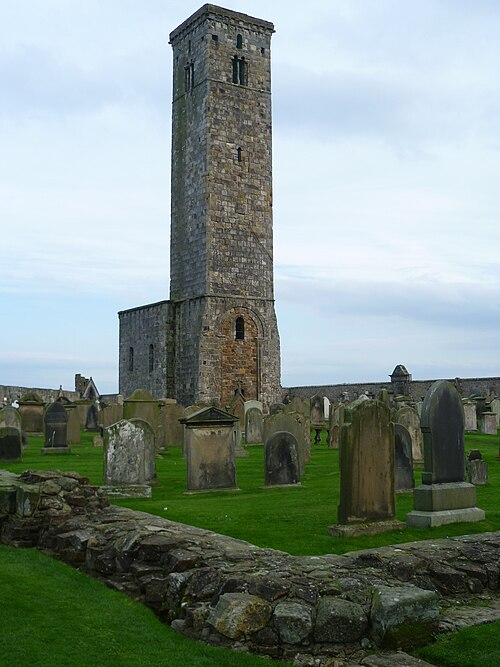
About 1070 Robert I, prior of St Andrews, built the church of Saint Regulus to house the relics brought, according to tradition, by Regulus, a place of rest for pilgrims; today it is known chiefly for its tower, "St Rule's Tower". The legend took on political significance in the late Middle Ages: it strengthened Saint Andrew as patron of Scotland, a distinct identity from England and a founding date for the Scottish Church older than those of the English and Irish Churches. In the wars of independence the Scots used it to persuade Pope Boniface VIII to issue the bull of 1299 demanding that King Edward I of England end the war. The legend also led to the adoption of the saltire on the flag of Scotland. A student hall of the University of St Andrews bears his name.
Commemorated the same day October 17
 HoseaProphet · The ProphetOct 17
 LazarusRighteous · The Four-Days-DeadOct 17
 ShushanikMartyrOct 17
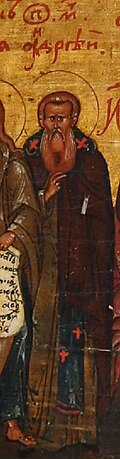 Andrew of Crete the MartyrVenerable Martyr · Monk and martyr, defender of iconsOct 17
- Heron of AntiochHieromartyr · Bishop of AntiochOct 17
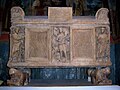 CatervusSaint · Patron of TolentinoOct 17
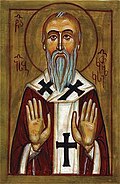 Joseph JandieriSaint · Catholicos-Patriarch of GeorgiaOct 17
- Anatoly IvanovskyHieromartyr · PriestOct 17
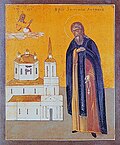 Anthony of LeokhnovoVenerable · Founder of Leokhnovo MonasteryOct 17
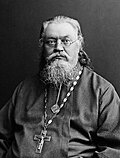 Neophytus LyubimovHieromartyr · Archpriest in MoscowOct 17
- Anstrudis of LaonVenerable · Abbess at LaonOct 17
- Anthimus of CiliciaMartyrOct 17