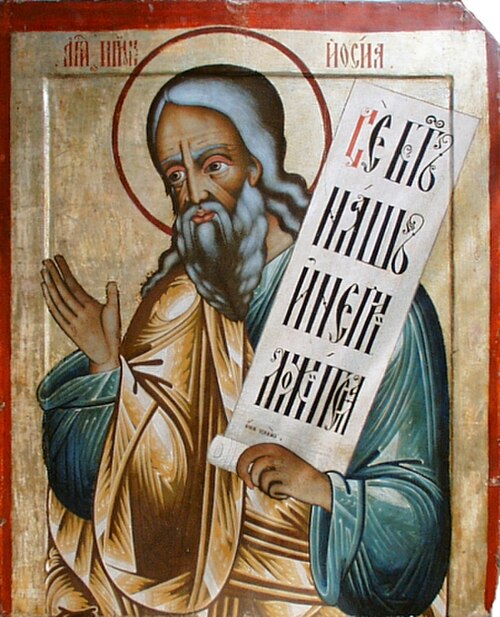
Prophet
Hosea
The Prophet
One of the twelve minor prophets, son of Beeri, who preached in Israel in the eighth century BC.
- Feast
- October 17old style October 30
- Born
- 784 BC7th century BC
- Place
- Safed
- Order
- Prophets
Life
The Holy Prophet Hosea, the son of Beeri, is the first of the twelve minor prophets of the Old Testament. He prophesied in the northern kingdom, Israel, in the eighth century before Christ, calling the people to turn from idols to the Lord. His name means salvation. His book, Hosea, speaks of the Lord's love for an unfaithful people. The Church commemorates him on 17 October (the Menaion date; by the civil calendar of Churches on the old calendar it falls on 30 October).
His family and his time
According to the Synaxarion, Hosea was of the tribe of Issachar. The book places his prophecy in the days of the kings Uzziah, Jotham, Ahaz and Hezekiah of Judah and of Jeroboam, son of Joash, king of Israel. His ministry lasted, according to the Synaxarion, more than sixty years. He was a contemporary of Isaiah, Micah and Amos. The sources differ in some details: the page of the Orthodox Church in America places him in the ninth century, but the others, like his own book, place him in the eighth.
Hosea prophesied in the northern kingdom, of which he was a native, and lived until near the fall of Samaria to the Assyrians, about 722. Scholars note that he is the only prophet of Israel of his time whose word was put in writing.
The prophet's marriage
God commanded him to take as wife Gomer, the daughter of Diblaim, and to have children whose names are signs: Jezreel, Lo-ruhamah, meaning not pitied, and Lo-ammi, meaning not my people. His marriage showed painfully what lay between God and Israel. Gomer drifted away from him, but the prophet redeemed her and took her back, as a sign of the Lord's unchanging love for the people who had forsaken Him.
His prophecy
Hosea rebuked Israel for idolatry and lawlessness and announced misfortunes from foreign nations and the Assyrian captivity. Yet beneath the announcement of punishment there is always a promise of renewal. The book ends with the call: return, O Israel, to the Lord your God.
The Church sees in him a herald of Christ. The words of Hosea 11:1, out of Egypt I called My son, are applied by the Evangelist Matthew to the return of the Saviour from Egypt. From Hosea 6:6, I desire mercy and not sacrifice, the Lord answers the Pharisees. The words of Hosea 6:2, on the third day He will raise us up, are read as a foretelling of the Resurrection, and the Apostle Paul speaks, in the First Epistle to the Corinthians, of the victory over death proclaimed in Hosea 13:14. The Synaxarion adds that he foretold the end of the old sacrifices and of the priesthood of Aaron (Hosea 3:4-5) and the spread of the knowledge of God over all the earth.
His end
The Synaxarion says that he died in deep old age, having devoted his life to fulfilling the will of God, and was buried in peace in his own land. Jewish tradition tells it differently: that he died in Babylon and was buried at Safed in Galilee, where a tomb of his is still shown. This is a Jewish tradition, not that of the Church.
His troparion honours him as one who taught those who had strayed from the truth and turned them back to the faith of their fathers.
Commemorated the same day October 17
 LazarusRighteous · The Four-Days-DeadOct 17
 ShushanikMartyrOct 17
 Andrew of Crete the MartyrVenerable Martyr · Monk and martyr, defender of iconsOct 17
- Heron of AntiochHieromartyr · Bishop of AntiochOct 17
 Regulus of PatrasSaint · Monk or bishop of PatrasOct 17
 CatervusSaint · Patron of TolentinoOct 17
 Joseph JandieriSaint · Catholicos-Patriarch of GeorgiaOct 17
- Anatoly IvanovskyHieromartyr · PriestOct 17
 Anthony of LeokhnovoVenerable · Founder of Leokhnovo MonasteryOct 17
 Neophytus LyubimovHieromartyr · Archpriest in MoscowOct 17
- Anstrudis of LaonVenerable · Abbess at LaonOct 17
- Anthimus of CiliciaMartyrOct 17