Hieromartyr
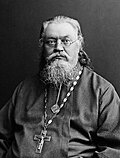
Anatoly Ivanovsky
Priest
Priest orphaned at the age of three, who died a martyr in 1918 at Urzhum; since 2008 in the Synaxis of the New Martyrs.
- Feast
- October 17old style October 30
- Reposed
- 191820th century
- Place
- Urzhum
- Order
- Martyrs
Life
Holy Hieromartyr Anatoly (Anatoly Dimitrievich Ivanovsky) was a cleric of the Russian Church, born in 1863 in the village of Pektubaevo, Yaransk district, Vyatka province, and shot on 30 October 1918 at Urzhum. By decision of the Patriarch and the Holy Synod of 23 June 2008 he was entered in the Synaxis of the New Martyrs and Confessors of Russia. The sources do not agree on his rank: our record calls him a priest, but his life as they give it stops at the rank of deacon, which he held from 1901.
He was left without parents at three and was raised by an uncle and aunt, the priest Euthymius and Elizaveta Kelsievna Ivanovsky, in the village of Maskanur, Urzhum district. His father had been the priest Dimitry Ivanovich Ivanovsky. He sang in the church choir. He moved to Kirov with the help of the bishop of Vyatka, who noticed him on one of his journeys through the diocese. Soon he entered the Vyatka seminary. During his studies he also sang in the bishop's choir and became a hypopsaltes. In June 1883 he graduated from the seminary, and in September 1884 was appointed psalm-reader at the Holy Trinity church in the village of Salobelyak, Yaransk district. He taught singing at the church school and played the violin. In April and July 1887 he was psalm-reader at the cemetery church of Yaransk. In the same year he entered Kazan University, studied three years and, because of illness, was released at his own request on 30 April 1890.
He lived in turn at Kazan, Elabuga and Chistopol and sang in the choir, then settled in the village of Shulka, Yaransk district, where his wife's parents lived. He re-entered diocesan service only on 24 February 1895, appointed psalm-reader at the church of the Forerunner in the village of Suvod. On 11 November 1895 he was moved to the Sign church at Tsekeevo. On 17 February 1901 he became a deacon and was sent to the Kazan Mother of God church in the village of Saltak-Yal, Urzhum district, where he served seventeen years. He taught religion and directed several parish and zemstvo schools. He received in 1905 the epigonation, in 1913 the skufia, a breast badge in memory of the three hundred years of the House of Romanov (1913) and the medal in memory of twenty-five years of the parish schools.
On 30 September 1918 he was arrested by the Urzhum district extraordinary investigative committee for the struggle with counter-revolution and taken to Urzhum, where on 3 October he was placed under guard. He was interrogated on 16, 18 and 19 October 1918 and did not admit guilt. On 18 October 1918 he was sentenced to death by decision of the Extraordinary Commission for the struggle with counter-revolution, speculation, sabotage and crimes in office, attached to the Council of People's Commissars on the Czechoslovak front. The sentence was carried out on 30 October 1918 at Urzhum.
Commemorated the same day October 17
 HoseaProphet · The ProphetOct 17
 LazarusRighteous · The Four-Days-DeadOct 17
 ShushanikMartyrOct 17
 Andrew of Crete the MartyrVenerable Martyr · Monk and martyr, defender of iconsOct 17
- Heron of AntiochHieromartyr · Bishop of AntiochOct 17
 Regulus of PatrasSaint · Monk or bishop of PatrasOct 17
 CatervusSaint · Patron of TolentinoOct 17
 Joseph JandieriSaint · Catholicos-Patriarch of GeorgiaOct 17
 Anthony of LeokhnovoVenerable · Founder of Leokhnovo MonasteryOct 17
 Neophytus LyubimovHieromartyr · Archpriest in MoscowOct 17
- Anstrudis of LaonVenerable · Abbess at LaonOct 17
- Anthimus of CiliciaMartyrOct 17