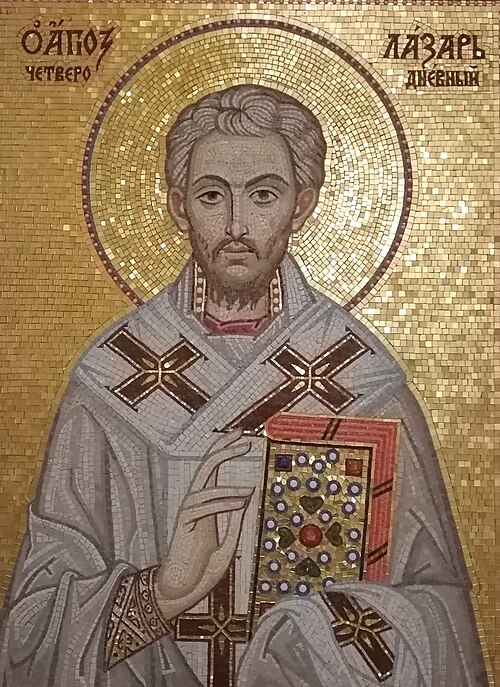
Righteous
Lazarus
The Four-Days-Dead
Friend of Christ from Bethany, raised by the Lord four days after his death.
- Feast
- October 17old style October 30
- Born
- 100 BC1st century
- Place
- Bethany
- Order
- The Righteous
Life
The Holy Righteous Lazarus the Four-Days-Dead, friend of Christ, lived at Bethany near Jerusalem and was raised from the dead by the Lord Jesus Christ four days after he was laid in the tomb. According to the tradition of the Church, he later became the first bishop of Kition in Cyprus. The Church remembers his raising on Lazarus Saturday, before Palm Sunday, and the translation of his holy relics to Constantinople on 17 October.
The friend of the Lord
Bethany was a village on the slope of the Mount of Olives, fifteen stadia, about three kilometres, from Jerusalem. Today it is called Al-Eizariya, "the place of Lazarus". Lazarus lived here with his sisters, Martha and Mary. His name is the Greek form of the Hebrew Eleazar, "God has helped".
The Lord Jesus loved this house and often stayed in it. The Gospel of John says that Jesus loved Martha, her sister and Lazarus, and calls Lazarus His friend. Only John speaks of him; the Lazarus of the parable of the rich man in the Gospel of Luke is a different person.
The raising
When Lazarus fell ill, the sisters sent word to the Lord: "Behold, he whom You love is sick." Jesus answered that this sickness was not unto death but for the glory of God, and He stayed two more days where He was. Then He told the disciples that Lazarus had fallen asleep and that He was going to wake him, and when they did not understand, He said plainly that Lazarus was dead.
When He came to Bethany, Lazarus had been in the tomb four days. Martha went out to meet Him and said that if He had been there, her brother would not have died. The Lord answered: "I am the resurrection and the life; he who believes in Me, though he die, yet shall he live." Martha confessed her faith that Jesus is the Christ, the Son of God. Then Mary came, and the Lord wept.
The tomb was a cave closed by a stone. Jesus ordered the stone to be taken away, although Martha said that the body already smelled. After a prayer to the Father, He cried with a loud voice: "Lazarus, come out." The dead man came out, bound hand and foot with strips of cloth and with his face wrapped in a napkin, and the Lord said: "Unbind him, and let him go." Many of the Jews who were present believed in Him.
The hymns of the Church see in this scene the two natures of the Saviour. As man He asks where Lazarus has been laid and weeps; as God He calls him out of death with a single command.
After the raising
Six days before the Passover the Lord came again to Bethany, where a supper was made for Him. Martha served, and Lazarus sat at table with Him. Crowds came there, not only for Jesus but also to see the man who had been raised. The chief priests then resolved to put Lazarus to death as well, because many believed in Jesus on his account.
The raising of Lazarus also prepared the Lord's entry into Jerusalem, when the crowd met Him with branches. Of his later life the Gospel says nothing more.
Bishop in Cyprus
According to the tradition of the Orthodox Church, Lazarus left Judea because of the danger that threatened him and reached the island of Cyprus. There the Apostles Paul and Barnabas appointed him first bishop of Kition, the city now called Larnaca. Tradition says that he lived thirty more years in strict abstinence and fell asleep a second time in Cyprus, where he was buried. It is also told that the Mother of God sent him an omophorion woven with her own hands.
These are reports of tradition, not of Scripture. In the West another tradition, from Provence, says that Lazarus became bishop of Marseille, and the cathedral of Autun in France bears his name.
The relics
In the year 890 a marble coffin was found at Kition with the inscription "Lazarus the four days dead, friend of Christ". Emperor Leo VI the Wise ordered the relics to be taken to Constantinople, which was done around 898, and placed in a church dedicated to Saint Lazarus. Their translation is kept on 17 October, and the hymns of the day speak of the treasure that came from Cyprus by the command of a faithful emperor.
At Larnaca, Leo raised a church over the tomb. The present building, of the seventeenth century, stands on the site of the older church, and the tomb can be seen beneath the altar. In November 1972, during works in the church, remains in a marble sarcophagus were found under the altar and recognized as part of the saint's relics. In 2012 the Church of Cyprus gave a part of them to the Russian Orthodox Church. Pilgrims also venerate the tomb at Bethany, a cave entered by steps; Lazarus is thus honoured in two places, at Bethany and at Larnaca.
Lazarus Saturday
On the Saturday before Palm Sunday the Church celebrates the raising of Lazarus as an announcement of the Resurrection of Christ and a promise of the general resurrection. The day is a moment of joy between Great Lent and Holy Week. At the Liturgy the hymn "As many as have been baptized into Christ" is sung in place of the Trisagion, and in the week before, the services follow the sickness and death of Lazarus and the Lord's journey to Bethany.
Commemorated the same day October 17
 HoseaProphet · The ProphetOct 17
 ShushanikMartyrOct 17
 Andrew of Crete the MartyrVenerable Martyr · Monk and martyr, defender of iconsOct 17
- Heron of AntiochHieromartyr · Bishop of AntiochOct 17
 Regulus of PatrasSaint · Monk or bishop of PatrasOct 17
 CatervusSaint · Patron of TolentinoOct 17
 Joseph JandieriSaint · Catholicos-Patriarch of GeorgiaOct 17
- Anatoly IvanovskyHieromartyr · PriestOct 17
 Anthony of LeokhnovoVenerable · Founder of Leokhnovo MonasteryOct 17
 Neophytus LyubimovHieromartyr · Archpriest in MoscowOct 17
- Anstrudis of LaonVenerable · Abbess at LaonOct 17
- Anthimus of CiliciaMartyrOct 17