Martyr
Stephen the Protomartyr
First Martyr and Archdeacon
One of the seven deacons chosen by the apostles, stoned in Jerusalem, the first Christian martyr.
- Feast
- December 27old style January 9
- Reposed
- 361st century
- Place
- Jerusalem
- Order
- Martyrs
Life
The holy Archdeacon Stephen the Protomartyr is the first martyr of the Church of Christ. He was one of the seven deacons chosen by the apostles at Jerusalem. He preached the Gospel with power and was stoned to death for confessing Christ, praying for those who killed him. His name, in Greek Stephanos, means crown, and the Church sees in him the first to receive the crown of martyrdom.
A deacon full of grace
The only source for his life is the Acts of the Apostles. When the number of disciples grew, the widows of the Greek-speaking believers were being overlooked in the daily distribution. The apostles asked the community to choose seven men of good repute, full of the Holy Spirit and wisdom, to take charge of the serving of tables. The first chosen was Stephen, a man full of faith and of the Holy Spirit. The others were Philip, Prochorus, Nicanor, Timon, Parmenas and Nicolas of Antioch. The apostles prayed and laid their hands on them.
The Church sees here the beginning of the order of deacons. Orthodox tradition holds that Stephen was the eldest of the seven, and for this reason calls him archdeacon. He is thought to have been a Greek-speaking Jew of the diaspora, since his name is Greek, but nothing certain is known of his earlier life.
Full of grace and power, Stephen did great wonders and signs among the people. Some from the synagogues of the Jews of Cyrene, Alexandria, Cilicia and Asia began to dispute with him, but they could not stand against the wisdom and the Spirit with which he spoke.
Confession and martyrdom
They then brought forward false witnesses, who accused him of blasphemy against Moses, the Law and the Temple, and led him before the Sanhedrin. Those who looked at him saw his face like the face of an angel. In his defence Stephen traced the history of Israel from Abraham and Moses to the building of the Temple. He showed that God does not dwell in houses made with hands, and rebuked his hearers for resisting the Holy Spirit as their fathers had done, who persecuted the prophets and killed the Righteous One.
Gazing into heaven, he saw the glory of God and Jesus standing at the right hand of God, and he said so aloud. The crowd covered their ears, rushed upon him, drove him out of the city and stoned him. The witnesses laid their garments at the feet of a young man named Saul, the future Apostle Paul, who consented to his death. Stephen prayed, Lord Jesus, receive my spirit, and asked that this sin not be held against his killers. Then he fell asleep. His prayer, so like the words of the Saviour on the Cross, remains the pattern of love for enemies.
The Orthodox Synaxarion adds that the Mother of God and the Apostle John, standing far off on the heights, prayed fervently for the martyr. He is said to have been about thirty years old.
Burial and relics
Devout men buried him and mourned greatly over him. According to tradition his body, left to be eaten by beasts, was taken up in secret by Gamaliel, the teacher of the Law, and his son Habib, who laid it in a tomb on their own estate near Jerusalem. Both believed in Christ and later received Baptism.
In 415 the saint appeared three times to a priest named Lucian and revealed the place where his relics lay hidden. Patriarch John of Jerusalem found them at the spot, near Caphargamala (today Beit Jimal), and they were carried in procession to Jerusalem, to the church on Mount Sion. The account tells of an earthquake and a sweet fragrance at the finding, and healings began to flow from the relics. In 439 they were placed in a new church built north of the city by the empress Eudocia. That church was destroyed in the twelfth century, and modern churches of the saint now stand near the site.
In the reign of Theodosius the Younger a part of the relics was brought to Constantinople and placed in the church of the holy Deacon Lawrence, and later in a church dedicated to Stephen. His right hand is kept at the Trinity-Sergius Lavra. In the Western tradition the relics rest in Rome in the Basilica of San Lorenzo, beside those of Saint Lawrence the Archdeacon. Blessed Augustine describes the many miracles worked in North Africa when a part of them was brought there.
Commemoration
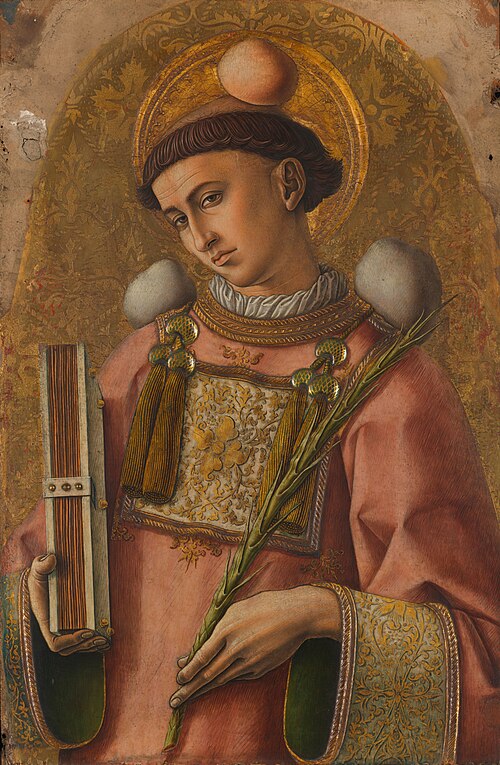
The Orthodox Church commemorates him on 27 December, the third day of the Nativity, because 26 December is given to the Synaxis of the Theotokos. The finding of his relics is kept on 15 September, and their translation to Constantinople on 2 August. Roman Catholics, Anglicans and Lutherans keep his feast on 26 December. He is honoured as patron of deacons and of those who serve at the altar, and in icons he appears as a young man in a deacon's vestments, with the censer and the stones of his martyrdom.
Commemorated the same day December 27
 FabiolaSaint · Roman matron and physicianDec 27
 Theodore I of ConstantinopleSaint · Patriarch of ConstantinopleDec 27
 Tikhon NikanorovHieromartyr · Archbishop of VoronezhDec 27
 Theodore the BrandedConfessorDec 27
 Vassian PyatnitskySaint · Archbishop of Tambov and ShatskDec 27
- Vonifaty of FeofaniaVenerable · Elder in KyivDec 27
- Mauritius of ApameaMartyrDec 27
- Antonina BryanskikhMartyrDec 27
- FiachaSaintDec 27
- Luke of TrigliaVenerable · Venerable of Triglia, BithyniaDec 27
- Tiopraite of Magh RathaSaintDec 27
 DavidProphet · King and ProphetDec 27