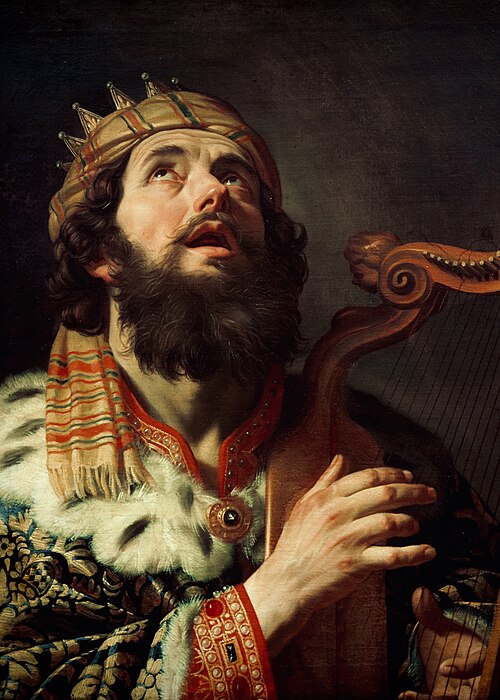
Prophet
David
King and Prophet
Second king of Israel, psalmist, and ancestor of Christ according to the flesh.
- Feast
- December 29old style January 11
- Born
- 1040 BC10th century BC
- Place
- Jerusalem
- Order
- Prophets
Life
The holy Prophet and King David was the second king of Israel, the singer of the Psalms, and the forefather of our Lord Jesus Christ according to the flesh. His name means "beloved". Historians place him around the year 1000 before Christ, and the Church honours him for his faith, his repentance and his songs, which sound in every service. His life is told in the books of Samuel, Kings and Chronicles, and his heart is open in the Psalter.
The shepherd anointed king
David was the youngest of the eight sons of Jesse of Bethlehem and tended his father's flock. The Book of Ruth names him as the great-grandson of Ruth the Moabite. The prophet Samuel anointed him king while Saul was still reigning, since Saul had turned from the commandments of the Lord. The young man was called to court to play the harp and calm the king's troubled spirit.
Trusting in God, David defeated the Philistine giant Goliath in single combat with a sling and a stone, and this victory decided the war in favour of Israel. The people loved him, and Saul began to hate and pursue him. David fled to the wilderness and lived for years as a fugitive. Twice, when he could have killed Saul, he did not raise his hand against him, because Saul was the Lord's anointed. His friendship with Jonathan, Saul's son, remains in Scripture a picture of loyalty, and his lament for both of them is kept in the second book of Samuel.
The reign
After Saul's death David was anointed king of Judah at Hebron. When Saul's second son was also killed, the elders of Israel came to Hebron and anointed him king over the whole people. He captured Jerusalem, the old Jebusite stronghold, made it the capital of the kingdom, brought the Ark of the Covenant there and prepared a new tent for it. He defeated the Philistines and the neighbouring peoples who rose against him, and these nations became tributaries.
David wished to build a Temple for the Lord, but the prophet Nathan told him that this work would belong to his son, and God promised that the throne of his house would endure. The Church sees this promise fulfilled in Christ, who is called in the Gospels the Son of David.
Fall and repentance
For all his faith, David fell into sin with Bathsheba, the wife of Uriah the Hittite, and arranged for Uriah to die in battle. The prophet Nathan rebuked him through a parable, and the king did not defend himself but confessed that he had sinned against the Lord. The child born of that union died, and troubles followed in his house: the shame of his daughter Tamar, the killing of Amnon, and the rebellion of Absalom. David fled from Jerusalem and returned only after Absalom was defeated in the forest of Ephraim and killed by Joab, and the king mourned him with the cry kept in Scripture, "O my son Absalom".
His repentance has remained a pattern for all. Psalm 50, "Have mercy on me, O God", is the prayer in which he asks forgiveness, and the Church says it in her daily services. David accepted the sorrows sent as punishment with humility and faith.
The Psalter
Tradition ascribes many of the psalms to David, and the whole Psalter is the prayer of the people of God. In the Orthodox Church it is divided into twenty kathismata and read through in the course of a week, and in Great Lent it is read twice a week. The psalms are sung at Vespers, Matins and the Liturgy, and the Fathers saw in them prophecies of Christ. Monastics and lay people pray with the same words.
Repose and veneration
When David grew old, Adonijah, the eldest surviving son, tried to seize the throne, but David, at the urging of Nathan and Bathsheba, made Solomon king and counselled him to walk in the ways of the Lord. David died at the age of seventy after a reign of forty years and was buried in the City of David at Jerusalem. The holy Prophet and King David is remembered on the Sunday of the Holy Forefathers and the Sunday of the Holy Fathers before the Nativity of the Lord, and on the Sunday after the Nativity together with the righteous Joseph and Saint James, the brother of the Lord. He is painted in churches among the prophets of the Old Testament, with a harp in his hand, and those who face a difficult trial call upon him in prayer.
Commemorated the same day December 29
 Martinian of MilanSaint · Archbishop of MilanDec 29
 EbrulfVenerable · Frankish hermit and abbotDec 29
 Lawrence of ChernigovVenerable · Schema-archimandriteDec 29
 Mark the Grave-digger of the CavesVenerable · Monk of the Kiev CavesDec 29
 Marcellus of AcemataVenerable · Monk of the Unsleeping OnesDec 29
 George of NicomediaSaint · Metropolitan of NicomediaDec 29
 Theophilus the WeeperVenerable · Monk of the Kiev CavesDec 29
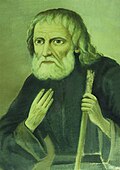 Basiliscus of SiberiaVenerable · Siberian hermitDec 29
- Euthymius of KareliaVenerable · Founder of Nikolo-Korelsky MonasteryDec 29
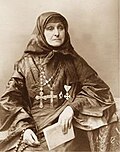 Nino the HegumenVenerableDec 29
- Chrysostomos PapasarantopoulosVenerable · Missionary in AfricaDec 29
- Nicholas I of ThessalonikiSaint · Bishop of ThessalonikiDec 29