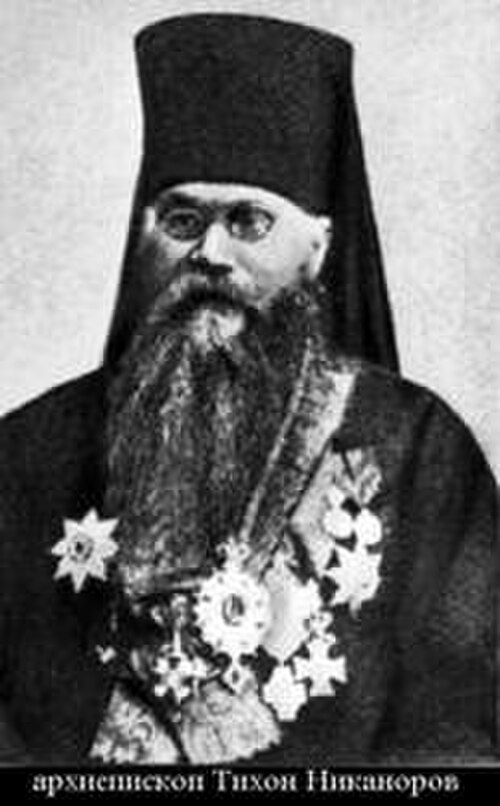
Hieromartyr
Tikhon Nikanorov
Archbishop of Voronezh
Archbishop of Voronezh and Zadonsk from 1913, who died on February 27, 1920 at Voronezh.
- Feast
- December 27old style January 9
- Reposed
- 192020th century
- Place
- Voronezh
- Order
- Martyrs
Life
Saint Tikhon (in the world Vasily Varsonofievich Nikanorov, 1855-1920) the hieromartyr was, from 13 May 1913, archbishop of Voronezh and Zadonsk. He was killed or died in the time of persecution after the revolution, at Voronezh, and in August 2000 the Council of Bishops of the Russian Church glorified him as a hieromartyr. He is commemorated on 27 December (9 January in the new style).
Youth and monasticism
He was born on 30 January 1855 in the village of Kiryuga, Kirillov district, Novgorod governorate, in the family of a psalm-reader. He graduated from the theological school at Kirillov (1871), the theological seminary of Novgorod (1877) and the Saint Petersburg Theological Academy, with the degree of candidate of theology (1881). From 1 August 1881 he was assistant superintendent of the Belozersk theological school, and from 1884 inspector of the Novgorod seminary. On 5 June 1884 he was tonsured a monk, on 10 July 1884 ordained hieromonk, and from 6 December 1888 hegumen. From 25 December 1890 he was rector of the Novgorod seminary and abbot of the monastery of Saint Anthony in Novgorod, raised to archimandrite.
Bishop
From 2 February 1892 he was bishop of Mozhaisk, vicar of the diocese of Moscow, from 20 August 1899 bishop of Polotsk and Vitebsk, and from 4 June 1902 bishop of Penza and Saransk. At Penza, in the years of his rule, a society of aid to those who teach or taught in the church schools of the diocese (1902), a church singing society (1902), a committee of the Orthodox missionary society (1904) and a brotherhood in the name of Saint Tikhon of Zadonsk at the Tikhon theological school (1903) were opened. He was awarded a panagia with precious stones (1896) and the Order of Saint Anne first class and the Order of Saint Vladimir third (1895) and second (1905) classes.
On 25 July 1907 he was retired. The cause may have been the disturbances in the diocese linked with the revolutionary events: during the disorders at the Penza seminary one rector was wounded and another killed, and the authorities were forced to close the seminary. He was also accused by the acting governor of Penza of "harbouring revolutionaries", because he defended his flock and did not dismiss clergy who were thought unreliable, wrongly, as was later shown. According to one version, the cause of the dismissal was Stolypin's order to the chief procurator of the Synod "to retire the bishop immediately", who had allowed a memorial service for the member of the First State Duma M. Ya. Gertsenshtein, murdered by the "Black Hundreds". From 31 July 1907 he was administrator, with the rights of abbot, of the New Jerusalem monastery in Moscow, and from 23 June 1912 bishop of Kaluga and Borovsk.
At Voronezh
From 13 May 1913 he was archbishop of Voronezh and Zadonsk. His cell attendant, later Archpriest John Zhityaev, recalls that he was "a quiet, meek, humble archpastor, of extraordinary kindness and a great man of prayer", who could often be seen in the cathedral at the early service, which began at four in the morning, sang in the choir and loved the services according to the typikon. In the seven years of his episcopate, he says, he was in the full sense a father to his flock; people could come to him with their needs and sorrows openly and without fear. Simplicity, gentleness and warmth in dealing with people were the marks of his spiritual character, and no one ever saw him irritated or angry.
He began the preparation for the glorification of Saint Anthony (Smirnitsky). He blessed Archimandrite Alexander (Kremenetsky) of the Mitrofanov monastery to gather information on the many miracles at the tomb of this Voronezh hierarch. In 1914, in his presence, the crypt was opened, and he testified to the miraculous incorruption of the relics. He sent the Synod a petition for the glorification, but the revolution prevented it then (the canonization took place only in 2003). From the beginning of the First World War, care councils were opened at the churches of the diocese to give material and moral help, and gifts were collected and sent to the army; in October 1914, with his blessing, a hospital with a hundred beds for the wounded was set up in the hostel of the Mitrofanov monastery. In 1916 a diocesan committee for refugees was formed, who were housed in the monasteries of the diocese.
According to the recollections of the priest Alexander Palitsin, in the revolutionary year 1917 there was no "election of a bishop" at Voronezh, because the people and clergy loved Archbishop Tikhon for his humility and meekness. Yet a village priest, Shakin, by his actions forced him to suspend him and remove him from his place, and then complained to the Soviet of Workers', Peasants' and Soldiers' Deputies, presenting the archbishop's actions as counter-revolution. On 8 June 1917 the Soviet arrested the archbishop and sent him to Petrograd under soldiers' escort. On 14 June the Synod declared that there was nothing unlawful in his actions, and he returned to Voronezh and on 6 July resumed the governance of the diocese. He was a member by right of the Local Council of 1917-1918 and took part in its first session. In 1918 he received a diamond cross for his klobuk. On 3 February 1919 he was present at the opening of the relics of Saint Mitrofan of Voronezh, made by a commission led by the secretary of the local Cheka, and signed the record. In October 1919, when Voronezh was occupied by the White Army, he served many memorial services for the victims of the Bolshevik terror. At the retreat of the White Army he did not leave the city, staying with his flock.
His death
According to the testimony first published by Protopresbyter Mikhail Polsky, on 9 January 1920 the archbishop was hanged on the Royal Doors of the Annunciation cathedral during the service. But according to Bishop (later Metropolitan) Sergius (Petrov), author of the "History of the Voronezh Diocese", Archbishop Tikhon fell ill with typhus, which was then raging in Voronezh, and died on 27 February 1920; he was buried in the crypt of the Annunciation cathedral. The secretary of the Holy Synod, N. V. Numerov, also writes that "Tikhon (Nikanorov) died in early 1920", and he calls bishops who died violent deaths directly "murdered". Serbian sources say that he died a martyr on 27 December 1918 (9 January), hanged on the Royal Doors. In 1956 his remains were moved to the city's Comintern cemetery, and in 1993 to the newly created necropolis of the Alexeevsky Akatov convent in Voronezh.
On 1 November 1981 the Council of Bishops of the Russian Church Outside Russia canonized the synaxis of the New Martyrs and Confessors of Russia, without a canonization by name, and later Archbishop Tikhon was included among them, without a day of commemoration of his own. In August 2000 the Council of Bishops of the Russian Church glorified him as a hieromartyr.
Commemorated the same day December 27
 Stephen the ProtomartyrMartyr · First Martyr and ArchdeaconDec 27
 FabiolaSaint · Roman matron and physicianDec 27
 Theodore I of ConstantinopleSaint · Patriarch of ConstantinopleDec 27
 Theodore the BrandedConfessorDec 27
 Vassian PyatnitskySaint · Archbishop of Tambov and ShatskDec 27
- Vonifaty of FeofaniaVenerable · Elder in KyivDec 27
- Mauritius of ApameaMartyrDec 27
- Antonina BryanskikhMartyrDec 27
- FiachaSaintDec 27
- Luke of TrigliaVenerable · Venerable of Triglia, BithyniaDec 27
- Tiopraite of Magh RathaSaintDec 27
 DavidProphet · King and ProphetDec 27