Holy Martyrs
The Six Martyrs of Megara
Seraphim, Dorotheos, James, Demetrios, Basil and Sarandes, martyrs of Megara; canonized in 1998.
Life
The Six Martyrs of Megara, Seraphim, Dorotheos, Iakovos, Demetrios, Vasileios and Sarantis, are martyrs of the age of persecutions whose relics were found in a wondrous way at Megara in Attica, at the end of the eighteenth century and in the first decades of the nineteenth. The Ecumenical Patriarchate numbered them among the saints in 1998, and the Church commemorates them on 16 August. Together with four other martyrs of the same city they are honoured as the Ten Martyrs of Megara.
The finding of the relics
Nothing is known of who they were in life, in which year they suffered, or how they died. Local tradition shows them as Roman soldiers, as a child saw them in a vision. In 1798 a boy of nine named Paisios saw three men dressed as Roman soldiers, who asked him to take their remains out of the earth. His grandfather did not believe him and scolded him. A year later, after the grandfather had died, the men appeared to the boy again, and Paisios told his father John. On the night of 16 August, for fear of the Turks, the two of them dug and found the holy relics, which gave off an unusual fragrance. From that time miracles began to take place through the relics.
The people of Megara did not know the martyrs' names, so they fasted, kept vigil and prayed that God would reveal them. The relics found first were those of the saints called Seraphim, Dorotheos and Iakovos. After a year two other martyrs appeared to Paisios and told him that their names were Demetrios and Vasileios, showing him where to dig, a few metres from the first graves. With the help of other faithful, the tomb was opened and their relics were venerated. Twenty years later the same Paisios saw another saint, who said his name was Sarantis and asked that his relics be uncovered. Paisios led the priest John Moustakas to a rural spot north of the town, among bushes and a large stone. At first they could not dig because of two enormous snakes, but after they knelt and prayed the snakes vanished and a light shone around the bushes. The relics were gathered with reverence, brought to Megara and placed with those of the other five. Later a small country church was built where they had been found, and it still stands today in the bed of a river.
The church and veneration
Paisios had never gone to school, yet with the help of the martyrs he became learned enough to be ordained a priest in 1828, at the age of forty. He fell asleep in the Lord in 1848. After his death the people of Megara, helped by the martyrs, began to build a church for the relics, which until then had been kept in a ruined house. The foundation stone was laid in 1889, and the church was raised over the site of their tombs. Throughout the year the faithful come there to seek the martyrs' help.
Among the miracles ascribed to them is one from 1977. On the eve of the feast, Archimandrite Damaskinos Katrakoulis, founder of the Monastery of St John the Forerunner at Makrini, fell so gravely ill that he thought he could not reach the feast and the procession of the relics. The sisters of the monastery left the outer door open so that the martyrs might pass through, and around midnight they heard a sound like galloping horses while an unearthly light shone in some of their cells. The elder was healed. The monastery lies about twenty-two kilometres from Megara.
Archimandrite Dorotheos Mourtzoukos has suggested that the martyrs may have suffered under the Emperor Julian the Apostate, between 361 and 363, because they always appear as Roman soldiers and the name Sarantis recalls the Forty Martyrs of Sebaste. This is a scholar's opinion, not a certain record. The service and hymns in their honour were written by Fr Gerasimos Mikragiannanites. Their feast is kept on 16 August, in the church at Megara where their relics rest.
Commemorated the same day August 16
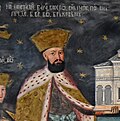 Constantine BrancoveanuMartyr · Prince of WallachiaAug 16
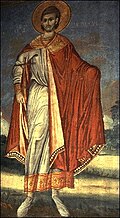 Diomedes of TarsusMartyr · Unmercenary physician, martyr of TarsusAug 16
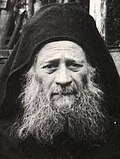 Joseph the HesychastVenerable · Athonite elderAug 16
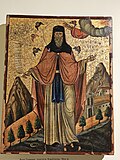 Gerasimos of KefaloniaVenerable · Patron of KefaloniaAug 16
 Joachim of OsogovoVenerable · Hermit of Mount OsogovoAug 16
 Maria BrâncoveanuRight-Believing · Princess of WallachiaAug 16
 Apostolos the NewNew MartyrAug 16
- Chaeremon of NitriaVenerableAug 16
- Cosmas II of NaplesSaint · Bishop of NaplesAug 16
 Ianache VăcărescuMartyr · Grand Treasurer of WallachiaAug 16
 Matthew BrâncoveanuMartyr · Son of Constantin BrâncoveanuAug 16
 Radu BrâncoveanuMartyr · Son of Constantin BrâncoveanuAug 16