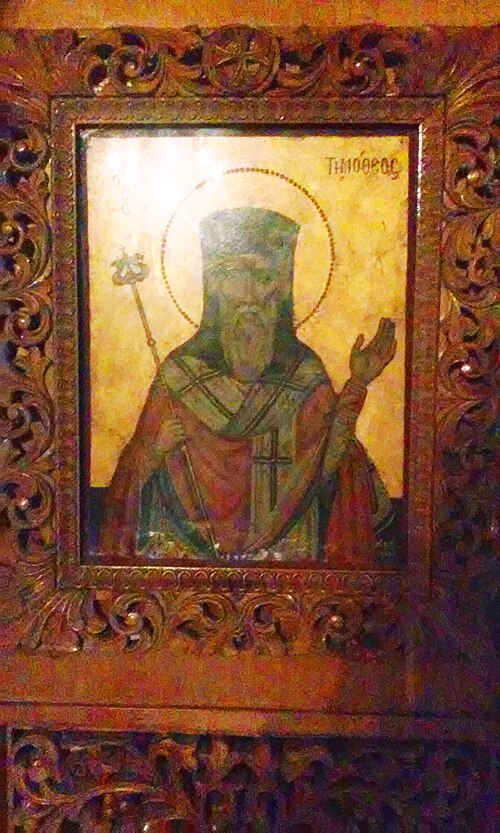
Saint
Timothy of Euripos
Bishop of Euripos
Bishop of Euripos in the 16th century, venerated as a saint in the Church of Greece.
Life
Saint Timothy of Euripos (in the world Tasos Kalamiotis, about 1510 to 1590) was bishop of Euripos, seated at Chalkis in Euboea, in the time of Turkish rule, and founder of the monastery of the Dormition of the Mother of God on Mount Pentelicus, near Athens. His family came from Kalamos in Attica. He is venerated in the Church of Greece and commemorated on 16 August.
Childhood and studies
He was born about 1510 at Kalamos in Attica, with the name Tasos Kalamiotis. From childhood he loved learning, and his father, a village priest, was his first teacher. His parents taught him love for Orthodoxy, and it bore fruit. He studied at Athens and then returned to Kalamos. The bishop of Oreoi, who was his spiritual father, seems to have paid for his studies. The Serbian source says the bishop of Oropos paid for his studies at Athens from his own funds.
In Euboea
In northern Euboea, where he went after his studies, he met the bishop of Oreoi, his spiritual father, who recognized his gifts and his inclination to the divine service. He became a monk, then a deacon, always staying near the bishop, perhaps also as his secretary. Then he was ordained priest, celebrating the Holy Mysteries and preaching the Word of God, strengthening the people in the time of Turkish rule. After the bishop's death, Timothy was ordained bishop of Oreoi in his place. Not long after, he was ordained metropolitan of Euripos, seated at Chalkis. His struggle to keep the flame of faith in people's souls was unextinguished, systematic and prudent, so much that it moved even the Turks of the region who were well disposed. He did not leave outside his care even people of another religion, race or social standing.
In the time of Sultan Selim II (1566 to 1574) a decree was issued requiring certain Christian churches to be turned into mosques. The saint's resistance was immediate, so fierce that it aroused the deadly anger of a Turco-Albanian pasha, who planned to kill him, presenting him as an enemy of the state. He was thus entangled in the greed of the monastery of Saint Nicholas Galatakis, a stavropegial monastery of the local metropolis, which had quarrelled with the village of Politika, and with the pasha of Euripos, informed by the monastery's monks.
He escaped thanks to the wife of his persecutor, who was a secret Christian and his spiritual daughter and urged him to leave that place, giving him a large sum of money as well. It is also said that the saint was warned by Ottoman inhabitants to whom he was very dear. In 1572, one night, he was smuggled out with a deacon and a cleric to the opposite shore, in Attica. He first returned to his native place and stayed there for a time (at the monastery of Kaloliwadi). The defeat of the Turks at the Echinades Islands (the naval battle of Lepanto) by the Christian forces of the West under Don John of Austria played an important part in how the persecution ended and, therefore, also threatened the saint's life.
The hermitage on Pentelicus and the monastery
About 1573 to 1574 he went toward Mount Pentelicus, to escape his persecutors, then called the "Mountain of the Blameless". First he served at the church of the Holy Trinity "of the Water", giving it a good name through his renown, so that it began to be used as a skete by the hermits of the region every Sunday. The saint proposed to them to live in community. He sought in himself more quiet and a solitary place to build the monastery he desired. Monks of the surrounding cells received him and persuaded him to found in that place his own hermitage. So he set out with a small company to look for the right place.
According to tradition, they found a place in a thicket of wild olives, a skeleton (by others several), on whose heart the icon of the Mother of God Glykophilousa was scratched. It is said that in antiquity there had been a temple of Athena there. The finding of the icon was the occasion the saint awaited to build the monastery in memory of the Dormition of the Mother of God. By another tradition he found, in a place shown by the Mother of God, a small wooden house in which lay the body of a monk who had just fallen asleep. Near the little house and at the root of an olive tree he found an icon of the Mother of God. By a third version he found an icon of the Mother of God in a small wooden house in which lived a monk cut off from the world and there decided to build the monastery.
The works began in 1576 and the monastery was raised in 1578. The saint devoted himself wholly to this work for five years, desiring at the same time quiet and the ceaseless prayer of the heart. To rid the building (at Holy Trinity of the Water) of the sheep and other animals that grazed nearby in summer, he bought a plot at Gerakas, where the shepherds spent their winters. They were thus removed and settled at Lambrika, near Koropi, in a place that was said to have been bought by the saint. According to later writings these shepherds were called Koropiotes.
His last years
Many brothers soon gathered in the monastery, and the saint guided them wisely on the path of salvation. Desiring greater struggles in silence and solitude, he withdrew to Gargato and Vravrona, where he devoted himself to severe ascetic labours known only to the Lord. The places mentioned in his ascetic life are Boiati (Saint Stephen), Kastraki, the hermitage of Saint George Kokkinaras and Thalassi. Some people rose against him, and the saint left Attica and crossed the sea in a miraculous way to the island of Kea (about 1590). There, after living a while longer in struggles pleasing to God, he fell asleep in peace on 16 August 1590.
In his monastery on Pentelicus his holy skull is kept to this day, giving off a sweet fragrance and working wonders for those who call on him with faith and prayer. He is regarded as founder of the Pentelicus monastery and, as the locals say, probably also of the monastery of Saint Panteleimon on the island of Kea, as well as of a part of the skete of Saint George at Vravrona. His memory is kept on 16 August. In 1993 a church of Saint Timothy was built on Kea in his honour, which keeps its feast also on 13 July. At Chalkis there is the church of Saints Timothy of Euripos and Nicholas Planas, a cultural foundation "Saint Timothy of Euripos" and a radio station of the same name.
Commemorated the same day August 16
 Constantine BrancoveanuMartyr · Prince of WallachiaAug 16
 Diomedes of TarsusMartyr · Unmercenary physician, martyr of TarsusAug 16
 Joseph the HesychastVenerable · Athonite elderAug 16
 Gerasimos of KefaloniaVenerable · Patron of KefaloniaAug 16
 Joachim of OsogovoVenerable · Hermit of Mount OsogovoAug 16
 Maria BrâncoveanuRight-Believing · Princess of WallachiaAug 16
 Apostolos the NewNew MartyrAug 16
- Chaeremon of NitriaVenerableAug 16
- Cosmas II of NaplesSaint · Bishop of NaplesAug 16
 Ianache VăcărescuMartyr · Grand Treasurer of WallachiaAug 16
 Matthew BrâncoveanuMartyr · Son of Constantin BrâncoveanuAug 16
 Radu BrâncoveanuMartyr · Son of Constantin BrâncoveanuAug 16