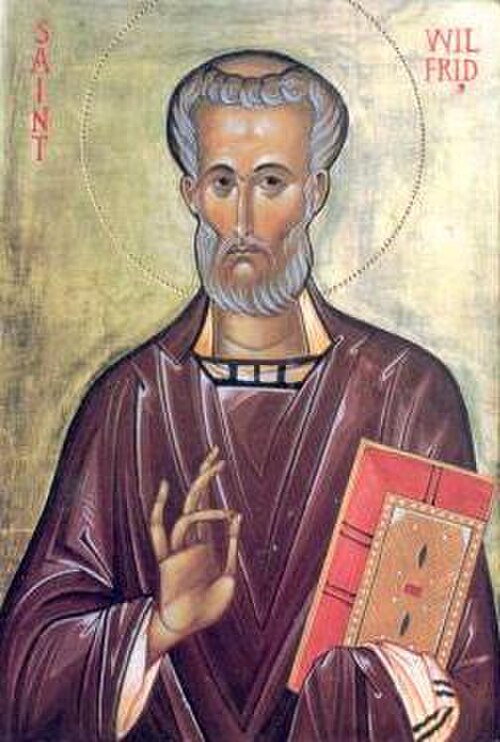
Saint
Wilfrid of York
Bishop of York
Bishop of York and missionary in Sussex and Frisia, reposed in 709.
Life
Saint Wilfrid of York (about 633 to 709 or 710) was an English bishop, missionary in Sussex and Frisia, and one of the most important prelates of seventh-century England. He came from a noble Northumbrian family and entered the religious life as a teenager.
Formation and the Synod of Whitby
He studied at Lindisfarne, at Canterbury, in Francia and at Rome, and returned to Northumbria around 660, becoming abbot of a newly founded monastery at Ripon. In 664, at the Synod of Whitby, he was spokesman for the Roman position and became famous for his speech arguing that the Roman method of calculating the date of Easter should be adopted. His success prompted the king's son, Alhfrith, to appoint him bishop of Northumbria. Wilfrid chose to be consecrated in Gaul because he considered that there were then no validly consecrated bishops in England. During his absence King Oswiu appointed Ceadda in his place, so Wilfrid retired to Ripon for a few years.
See, exile and mission
Theodore of Tarsus, who became archbishop of Canterbury in 668, resolved the situation by deposing Ceadda and restoring Wilfrid to his see. For nine years Wilfrid discharged his episcopal duties, founded monasteries, built churches and improved the liturgy. His diocese was, however, very large, and Theodore wished to reform the English Church by breaking up the larger dioceses. When Wilfrid quarrelled with King Ecgfrith, Theodore took the opportunity. After Ecgfrith expelled him from York, Wilfrid travelled to Rome to appeal to the pope (on the way, in 678 to 679, he preached to the Frisians); Pope Agatho ruled in his favour, but the king refused to honour the decree, imprisoned him and then exiled him.
He spent the next few years at Selsey in Sussex, where he founded an episcopal see and converted the pagan inhabitants of the kingdom of Sussex to Christianity. He and Theodore were reconciled, and Theodore urged the new Northumbrian king, Aldfrith, to allow his return, which was done; in 691, however, Aldfrith expelled him again. Wilfrid went to Mercia, where he helped missionaries and acted as bishop for the Mercian king. In 700 he appealed to the pope, who ordered an English council; this council, held at Austerfield in South Yorkshire in 702, attempted to confiscate all his possessions, and Wilfrid went again to Rome. His opponents in Northumbria excommunicated him, but the papacy upheld his side and he regained his monasteries of Ripon and Hexham. He died in 709 or 710.
Veneration
After his death he was venerated as a saint. His followers commissioned Stephen of Ripon to write the Life of Saint Wilfrid, and Saint Bede also wrote extensively about him. Wilfrid lived ostentatiously and travelled with a large retinue; he ruled many monasteries and claimed to be the first Englishman to introduce the Rule of Saint Benedict into English monasteries. Historians are divided: some see him mainly as a champion of Roman customs against the customs of the British and Irish churches, others as an advocate for monasticism. He is a saint of the undivided Church, commemorated on 24 April (new style; 7 May in the old style).
Commemorated the same day April 24
 MellitusSaint · Archbishop of CanterburyApr 24
 Doda of ReimsVenerable · Abbess of Saint Peter's, ReimsApr 24
 Sabbas StratelatesMartyr · Roman generalApr 24
 Branko DobrosavljevićHieromartyr · Serbian Orthodox priestApr 24
 Alexis KabalyukVenerable · Schema-archimandrite in TranscarpathiaApr 24
- Sava II BrankovićSaint · Metropolitan of TransylvaniaApr 24
 Ignatius SadkovskyHieromartyr · Bishop of SkopinApr 24
- Sava of the CavesVenerable · Monk of the Kyiv Caves LavraApr 24
- Simion ȘtefanSaint · Metropolitan of TransylvaniaApr 24
- Alexis the RecluseVenerable · Recluse of the Kiev CavesApr 24
- Joseph the ConfessorSaint · Bishop of MaramureșApr 24
 Alexander of LyonMartyr · Martyr of LyonApr 24