Saint
Abraham of Harran
Bishop of Harran
Syrian hermit born at Cyrrhus, bishop of Harran, called the Apostle of Lebanon; died in Constantinople in 422.
- Feast
- February 14old style February 27
- Reposed
- 4235th century
- Place
- Constantinople
- Order
- Hierarchs
Life
Venerable Abraham of Harran, also called Abramius and “the Apostle of Lebanon,” was a Syrian hermit from near Cyrrhus, bishop of Harran (Carrhae), who died at Constantinople in 422 or, by other reckonings, between 422 and 444. His life is told by Theodoret of Cyrrhus in the “Religious History.” He is venerated as a saint in the Orthodox, the Syriac and the Catholic Church and is remembered on 14 February.
The hermit
He was born near Cyrrhus in Syria and was educated at Carrhae, ancient Haran. He became a monk. By vigils, standing in prayer and fasting he wore his body down so much that for a very long time he remained motionless and could not walk. Receiving a wonderful healing from God, in gratitude he resolved to expose himself to saving dangers. He hid his monasticism and moved to a large village in Lebanon, of which he had learned that it was covered in the darkness of unbelief.
Apostle of Lebanon
The village was known for the walnuts of the surrounding country. Disguised as a merchant, Abraham came to Lebanon, with sacks, as if intending to buy walnuts. He hired a house for a small rent and kept silence in it three or four days. With other Christians in the house he began to perform the services quietly. When the locals heard the singing of psalms, a herald called all the men and women of the village, who blocked the doors of Abraham's house and then brought a great quantity of earth and threw it from the roof into the house. Nevertheless the inhabitants of the house only prayed to God. At the command of the village elder the people stilled their anger, opened the door, swept away the earth and ordered Abraham and his companions to leave the village.
Meanwhile tax collectors came to the village and began to punish the inhabitants cruelly for non-payment: some they put in chains, others they beat with whips. Abraham resolved to repay evil with good: he became surety, promising the collectors that after a certain time he would bring a hundred gold coins that were lacking. The inhabitants, who had treated him badly, were amazed at his love for people, begged his pardon and invited him to be their protector. Abraham went to the city of Emesa, found acquaintances there, borrowed a hundred gold coins from them and, returning to the Lebanese village, paid the taxes for the locals. After that the inhabitants asked Abraham to be their protector. Abraham agreed on condition that a Christian church be built in the village. The people agreed, and the church was built. Then they urged him to accept ordination, and he became a priest of the church. For three years he held the ministry, preparing priests for the church, then left the village and returned to his monastic cell. The village's name is not known, but it is believed to be Aqura-Afka, near the river Adonis.
Bishop of Harran
Later he was elected bishop of Carrhae, in Mesopotamia, where he laboured vigorously to correct existing abuses and did much good to the poor. As bishop he continued a strict life: he ate a little bread and water, lived without a bed and lit no fire. At night he performed forty psalmodies in turn, filling the intervals with twice as many prayers; toward the end of the night he sat on a chair and slept a little, sitting. Besides bread he ate raw greens: lettuce, chicory, parsley and fruit. He ate nothing cooked on fire. His clothing was coarse, made of animal skins. Despite his own abstinence, for the strangers who came to him he always had ready a bed, bread pure and tasty, fragrant wine, fish and vegetables. At noon he himself waited on them at table and ate nothing of the meal prepared for them. He was also a wise judge in the city, deciding justly all disputes among its inhabitants.
Repose
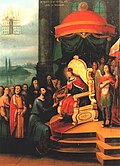
The emperor heard of Abraham and ordered him to come to the capital. Abraham spoke only Syriac and understood no Greek; nevertheless, when he came to Constantinople, the emperor and his children fell at the elder's hands and knees and begged his blessing. According to some sources Theodosius II kept one of his poor garments and wore it for some days as a sign of respect. In the capital he died. The emperor wished to lay Abraham's relics in the capital but then decided to give the body to the people of Carrhae. He himself offered to escort it to the harbour: he walked before all; after him a choir of empresses, then officials and subjects, soldiers and simple people. Abraham's body was carried by sea to Syria. His coffin was received with solemnity at Antioch and in other cities, as far as the river Euphrates. At the riverbank both locals and strangers gathered, each trying to get the blessing of the departed. The coffin was accompanied by many lictors, who frightened with whips those who tried to take the clothes from the body for even a scrap. The whole procession was accompanied by psalmody and mournful songs. Theodoret does not give the year of Abraham's death or the name of the emperor; the author of the article in the Orthodox Encyclopedia, M. V. Gratsiansky, holds that he died between 422 and 444. Some place it earlier, in 390, in the time of Theodosius I. His body was buried at Carrhae.
Commemorated the same day February 14
 CyrilEqual-to-the-Apostles · Apostle to the SlavsFeb 14
 MaronVenerable · Syriac HermitFeb 14
 Auxentius of BithyniaVenerable · Hermit of BithyniaFeb 14
 Antoninus of SorrentoVenerable · Abbot and hermitFeb 14
 Isaac of the Kiev CavesVenerable · Recluse of the Kiev CavesFeb 14
 Ephraim of KatounakiaVenerable · Athonite elder of KatounakiaFeb 14
 Modestinus, Florentinus and FlavianusHoly Martyrs · Martyrs of CampaniaFeb 14
 Damian the NewVenerable MartyrFeb 14
 The Twelve Greek CraftsmenHoly VenerablesFeb 14
- Barbara of SkvorchikhaFool-for-Christ · Fool for Christ and recluseFeb 14
- Paul DernovHieromartyr · ArchpriestFeb 14
- AgathonHieromartyr · Presbyter of AlexandriaFeb 14