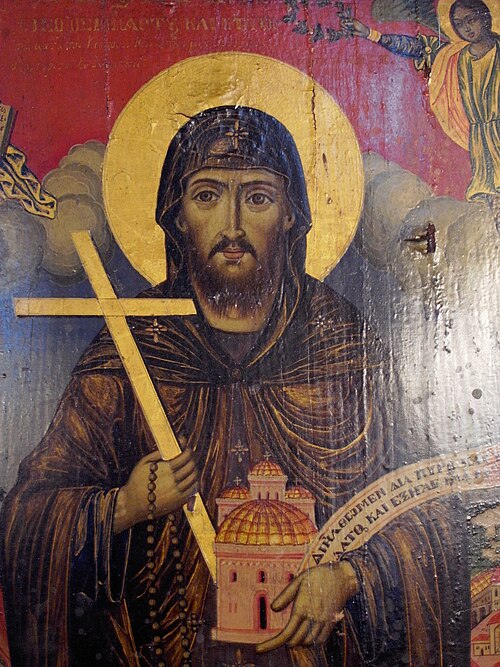
Venerable Martyr
Damian the New
Monk killed in 1568, honored for his intercession with God for the gift of children.
- Feast
- February 14old style February 27
- Reposed
- 156816th century
- Place
- Philotheou, Mount Athos
- Order
- Martyrs
Life
Venerable Martyr Damian the New was a monk and preacher in Thessaly, killed by the Ottomans in 1568, venerated as a helper of those who ask God for the gift of children. Born around 1512 (by other sources about 1495) in the village of Rihovo (or Merihovo, today Agia Triada, near Karditsa), to poor and pious parents, he was hanged and then burned at Larissa on 14 February 1568. He is commemorated on 14 February and on the first Sunday of July, at the monastery of the Honourable Forerunner.
Life
According to local tradition his parents bore the name Kanellis (cinnamon). Young, he was tonsured at Philotheou monastery on Mount Athos and, after some years, loving virtue above all, as the old synaxarion says, he passed to the hermit life under the guidance of the ascetic and wonderworker Dometios. After three years of unceasing struggle, Damian heard a divine voice: "Damian, you must seek not only your own benefit, but that of others." He then left the Holy Mountain and went to preach the word of God through the villages near Olympus, in the district of Kissavos (Ossa), from Larissa to Agrafa in Thessaly. It is thought he went to Olympus because of his compatriot, the abbot of Philotheou monastery, Dionysios (commemorated 24 January), who around 1524 had moved to Olympus and restored the monastery of the Honourable Forerunner, which became a spiritual centre of central Greece.
At Olympus he taught people repentance and urged enslaved Christians to follow the will of God, avoiding injustice toward others and every falsehood. Soon he was hated by the Turks and by many who called themselves Christians but lived without decency and condemned the monk. They claimed that he was in delusion and a liar, hindered him in every way and threatened his life. The saint withdrew into the Larissa region, where he met the same attacks from people, and settled in the mountain place of Agrafa, in the monastery of the Mother of God Pelekiti, where he lived about ten years, preaching the evangelical truths. In 1529 he finished building the monastery there, of which he is thought to have been abbot. At Agrafa some slandered him, calling him a false monk who stirs the people for no reason; because of these troubles he moved to Kissavos and preached in the eastern part of the mountain, near the town of Agia. Monks gathered around him and in 1550 he founded the monastery of Saint John the Baptist, known as the monastery of the Honourable Forerunner, in the southern part of the mountain, at a height of about 1100 m, four kilometres from the village of Selitsani (now Anatoli). The monastery had about two hundred hectares of arable land, twenty hectares of vineyards, some fifteen hundred sheep and up to a hundred and fifty oxen.
But he himself, even if he was abbot of the new monastery, from habit of the ascetic life, remained alone, in a cave (asketirion) made three kilometres to the west, under a great overhanging rock, separated from the monastery by the gorge of a dry stream, at the site of an ancient monastic centre called the "mountain of cells". So Abbot Damian continued to live in the coenobium and to struggle in the cave, praying and teaching at the same time. Many faithful from the surrounding area came to the monastery to hear his word and receive counsel, and he preached unceasingly. Even at Larissa, where the Turkish governor of the region was, the saint was not afraid to denounce the love of money, the immorality and the greed of the rich rulers friendly to the Turks. With the uncompromising nature of his preaching he touched the interests not only of the Turks but also of the Jews of Larissa, who made up the greater part of its population. He urged Christians insistently not to take part on Sundays in any trade or business, but to dedicate the day to prayer. The Turks and Jews gained great profit from the Sunday markets, held as festivals, and his preaching prepared Christians for independence from their oppressors, above all spiritual. The charge that he called for refusing to trade on Sundays was enough to condemn him to death by hanging.
Martyrdom
At the end of 1568 Abbot Damian went, on monastery business and to preach, to the village of Vulgarini (today Elafos), near Agia, where he was seized by the Turks and taken to the governor of the region at Larissa. Asked whether the charges were true, the saint answered with great courage, confirming that he had indeed urged Christians to be steadfast in the faith. The governor decided to punish him severely (to beat him) and keep him in prison, his neck and feet in heavy chains. At Vulgarini he was held fifteen days, receiving daily a hundred blows with a stick, and urged to renounce his faith; every two or three days a guard brought him a little water and bread. He was summoned again, and the governor urged him to change his faith, but he remained unmoved. The governor ordered him tortured, hanged and the body burned.
After the beatings, the bloodied martyr was taken to the common burial place, by the river Pineios, and hanged from a huge plane tree; before he died, one of the guards struck him hard on the head with an axe. The rope broke and the saint, still alive, was thrown into a large pyre already prepared. Fearing that Christians would venerate the relics, the Turks gathered all the ashes from the pyre and scattered them on the waters of the river. Four years later his veneration as a local saint of Thessaly began.
Veneration
The centres of his commemoration are the village of Agia Triada near Karditsa and the monastery of the Honourable Forerunner near Anatoli (Selitsani), where on the first Sunday of July, in the cave in which he struggled, the Divine Liturgy is celebrated with a moleben. Present veneration is connected above all with his prayer for parents asking God for children; in memory of the miracles boys and girls are named Damian. The monastery on Mount Kissavos, at 1194 m, was renewed in July 2000 as a convent; in 1980 monks from Athos had moved there, and the last lone monk of the old monastery, built around 1100 in Byzantine times, had died in 1889. According to other accounts he was burned at the stake on 14 February 1568, and the ashes were scattered over the Pineios.
Commemorated the same day February 14
 CyrilEqual-to-the-Apostles · Apostle to the SlavsFeb 14
 MaronVenerable · Syriac HermitFeb 14
 Auxentius of BithyniaVenerable · Hermit of BithyniaFeb 14
- Abraham of HarranSaint · Bishop of HarranFeb 14
 Antoninus of SorrentoVenerable · Abbot and hermitFeb 14
 Isaac of the Kiev CavesVenerable · Recluse of the Kiev CavesFeb 14
 Ephraim of KatounakiaVenerable · Athonite elder of KatounakiaFeb 14
 Modestinus, Florentinus and FlavianusHoly Martyrs · Martyrs of CampaniaFeb 14
 The Twelve Greek CraftsmenHoly VenerablesFeb 14
- Barbara of SkvorchikhaFool-for-Christ · Fool for Christ and recluseFeb 14
- Paul DernovHieromartyr · ArchpriestFeb 14
- AgathonHieromartyr · Presbyter of AlexandriaFeb 14