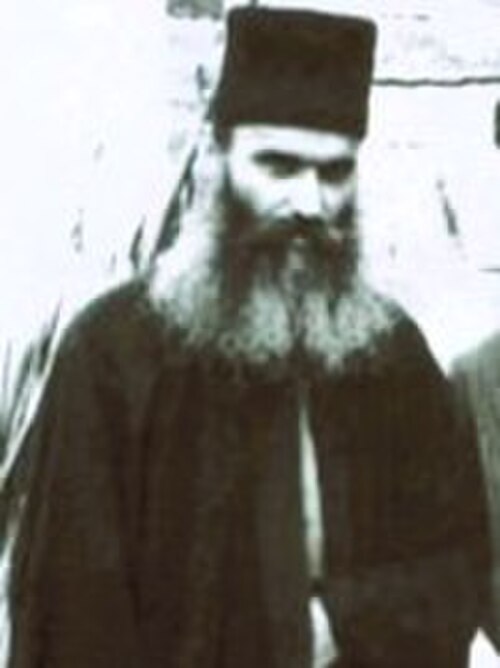
Venerable
Ephraim of Katounakia
Athonite elder of Katounakia
Greek monk on Mount Athos, born Evangelos Papanikitas in 1912, who died in 1998.
- Feast
- February 14old style February 27
- Reposed
- 199820th century
- Place
- Mount Athos
- Order
- Venerables
Life
Saint Ephraim of Katounakia, known in the world as Evangelos Papanikitas, was a Greek hieromonk who struggled for more than six decades in the desert of Katounakia, at the southern tip of the Holy Mountain of Athos. The Church remembers him above all for his boundless obedience to a very harsh elder, for the prayer of the heart he learned from Saint Joseph the Hesychast, and for the love with which he served the Divine Liturgy into deep old age.
He reposed in 1998, and the Ecumenical Patriarchate numbered him among the saints in 2020, together with three other great Athonite elders of the twentieth century.
Childhood and calling
He was born on 6 December 1912 in the village of Ampelochori in Boeotia, near Thebes, into a devout peasant family, and was baptised Evangelos. His grandfather Nikitas had been a priest, and his parents, Ioannis Papanikitas and Victoria, were deeply pious. They had three other children, Epaminondas, Eleni and Charalambos, and raised them all in the Christian virtues and in obedience to the law of God.
He spent his early years in his native village, but while he was still in primary school his parents moved to Thebes so that their children could be educated. From a young age he was drawn to monastic life. His health, however, was poor: at fourteen he developed swellings around his eyes, and later he suffered from a severe eczema of the ankle joint.
After finishing secondary school he tried to find a place for himself in the world but met with repeated failure. Convinced that only the Lord could set him on the right path, he resolved to become a monk. His mother Victoria saw in a dream an elder, said to be Saint Ephrem the Syrian, who showed her that her son's decision was according to the will of God, and so she did not stand in his way.
Beginnings in the Athonite desert
On 14 September 1933 Evangelos arrived at Katounakia, the place of hermits often called the desert of the Holy Mountain. He settled in the hermitage of Saint Ephrem the Syrian, in the community of the elders Ephraim and Nikephoros, old acquaintances of his family.
The beginning was hard, especially because of the severity of some of the older monks, but these trials only strengthened him spiritually and taught him humility and patience. Six months after his arrival he was tonsured into the small schema with the name Longinus. In 1935 he received the great schema from Elder Nikephoros and the name Ephraim, in honour of Saint Ephrem the Syrian, and the following year he was ordained a priest. From then on he was known as Father Ephraim of Katounakia.
Forty years of obedience
He lived and struggled at Katounakia according to the tradition of the hermits there. For nearly four decades, forty-two years by his own reckoning, he was the disciple of Elder Nikephoros, a very harsh man who was hard to please. Heavy tasks, insults, humiliations and even beatings from the elder and the older monks were part of his daily life. He later recalled that the elder sometimes struck him even in church, and that the years he spent with him could not be counted in years but in millions of minutes and seconds; he said this to show younger monks what obedience carried through to the end means.
Because of this obedience to so severe an elder, the Athonite fathers called him the grace-filled obedient one.
Meanwhile he had the joy of seeing his parents embrace monastic life. His father Ioannis, at the age of eighty-six, joined the brotherhood and was tonsured with the name Job, and his mother, also in old age, became a nun. Father Ephraim often spoke with joy of his parents who had received the angelic habit.
Disciple of Saint Joseph the Hesychast
With the blessing of Elder Nikephoros, Father Ephraim drew close to Saint Joseph the Hesychast (1898-1959) and became his spiritual disciple. Joseph taught him noetic work, the unceasing prayer of the heart, and explained to him the essence of contemplation, and his influence on the young monk was decisive.
When Joseph's brotherhood moved from the skete of Saint Basil to Little Saint Anne, the brothers began building a small church dedicated to Saint John the Baptist, and Father Ephraim worked on it with them. He lived there for about two months and, following the elder's example and teaching, entered ever more deeply, with God's help, into the mysteries of stillness.
He gave careful attention to keeping the rule, to prayer, and to attentive reading of Holy Scripture and of the writings of the Fathers, especially those gathered in the Philokalia. He celebrated the Divine Liturgy with particular reverence and continued to serve it into deep old age, as long as his bodily strength allowed.
After Saint Joseph's death in 1959, Father Ephraim continued to visit his brotherhood, then at the New Skete. He related that on the fortieth day after his repose the elder appeared to him and took leave of him, and that later he saw him several times in dreams. In 1994 the former abbot of Philotheou Monastery, with two monks, brought him the skull of Saint Joseph to venerate, fulfilling his wish to bow before it before his own death.
Elder and confessor
In 1973 Elder Nikephoros died, having first given him his blessing. Father Ephraim then took the brotherhood under his care and began to serve as elder and confessor. Hard labour brought on cyanosis, which grew worse, and he had to go to Thessaloniki for treatment.
On his return to Katounakia, following the counsel Saint Joseph had once given him to take disciples after Elder Nikephoros's death, he began to gather a brotherhood of his own, at first with a single disciple. By 1980 the community had taken shape.
Illness and repose
In 1996 he suffered a stroke that left him paralysed and bedridden. He bore this cross for about a year and a half and reposed on 14 February 1998 by the old calendar, that is, 27 February by the new. He was buried beside his cell, in a grave he had dug himself with his own hands.
Canonisation and veneration
On 20 October 2019, in the Protaton church at Karyes, Ecumenical Patriarch Bartholomew announced the canonisation of four great Athonite elders of the twentieth century: Daniel of Katounakia (died 1929), Jerome of Simonopetra (died 1957), Joseph the Hesychast (died 1959) and Ephraim of Katounakia (died 1998). The decision was formalised on 9 March 2020, when the Holy and Sacred Synod of the Ecumenical Patriarchate inscribed him by patriarchal and synodal act among the saints of the Orthodox Church.
Saint Ephraim of Katounakia is commemorated on 27 February, and on 14 February by those who keep the old calendar.
Commemorated the same day February 14
 CyrilEqual-to-the-Apostles · Apostle to the SlavsFeb 14
 MaronVenerable · Syriac HermitFeb 14
 Auxentius of BithyniaVenerable · Hermit of BithyniaFeb 14
- Abraham of HarranSaint · Bishop of HarranFeb 14
 Antoninus of SorrentoVenerable · Abbot and hermitFeb 14
 Isaac of the Kiev CavesVenerable · Recluse of the Kiev CavesFeb 14
 Modestinus, Florentinus and FlavianusHoly Martyrs · Martyrs of CampaniaFeb 14
 Damian the NewVenerable MartyrFeb 14
 The Twelve Greek CraftsmenHoly VenerablesFeb 14
- Barbara of SkvorchikhaFool-for-Christ · Fool for Christ and recluseFeb 14
- Paul DernovHieromartyr · ArchpriestFeb 14
- AgathonHieromartyr · Presbyter of AlexandriaFeb 14