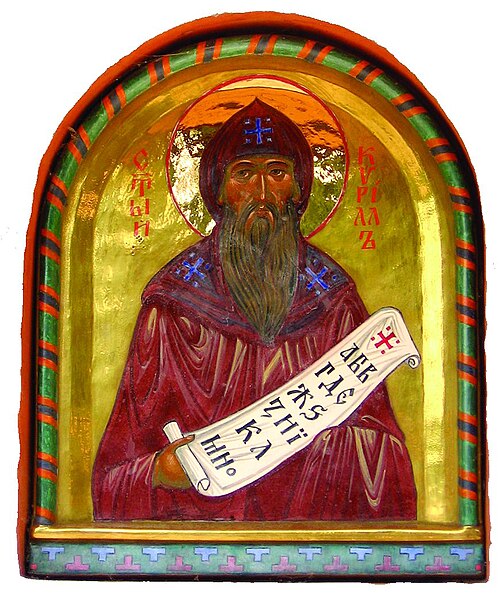
Equal-to-the-Apostles
Cyril
Apostle to the Slavs
Byzantine missionary from Thessalonica who devised the Glagolitic alphabet with his brother Methodius, died in Rome in 869.
- Feast
- February 14old style February 27
- Reposed
- 8699th century
- Place
- Rome
Life
Saint Cyril (Constantine the Philosopher), equal to the Apostles, was a Byzantine missionary from Thessalonica, creator, with his brother Methodius, of the Glagolitic alphabet and teacher of the Slavs. He died at Rome on 14 February 869. He is commemorated on 14 February (in the Catholic Church) and on 11 May (in the Orthodox Church), with Saint Methodius. In 1980 Pope John Paul II made them, with Saint Benedict, patrons of Europe.
Childhood and education
He was born at Thessalonica, in 826-827, named Constantine, one of the seven children (according to his Life, the youngest) of Leo, drungarios of the theme of Thessalonica, and Maria. His brother Methodius, born Michael, was older. It is not clear whether they were of Slavic or Greek origin. Their father died when Constantine was fourteen (according to others, twelve), and they came under the protection of the powerful logothete Theoktistos, who called them to Constantinople, to the Magnaura school. He studied philosophy, rhetoric, arithmetic, geometry, astronomy, music and foreign languages. From childhood he held Saint Gregory the Theologian dear. Among his teachers was Photius, the future patriarch. He refused a high marriage with a goddaughter of the logothete and was named keeper of the library (chartophylax) at Hagia Sophia; then he withdrew to a monastery on the Black Sea, but was brought back almost by force and made professor of philosophy at the same school, whence he was called “the Philosopher”. In a theological dispute he defeated the former iconoclast patriarch John the Grammarian.
The missions
Around 851-855 he was sent to the court of the Abbasid caliph, at Baghdad, to debate with Muslim theologians, who honoured his learning. After the killing of Theoktistos, in 856, he withdrew to the monastery where Methodius was abbot, and there a group formed around them from which came the thought of a Slavic alphabet. Around 860 Michael III and Patriarch Photius sent Cyril, at the request of the Khazars, to their khan, to debate with Jews and Saracens. At Cherson, preparing, he learned Hebrew and other scripts and found the relics of Saint Pope Clement; according to his Life, in the Khazar capital he baptized some two hundred people. The debate between Constantine, an imam and a rabbi did not end with the khan’s accepting Christianity.
In 862 envoys of Prince Rastislav of Great Moravia came to Constantinople, asking for teachers who could explain the faith “in our own language”. The emperor and patriarch sent the brothers from Thessalonica. First they took care to train assistants; from 863 they translated the Gospels and service books into the language now called Old Church Slavonic and went to Moravia to spread it. For this mission they devised the Glagolitic alphabet, the first suited to the features of the Slavic language, from which Cyrillic later came. They also wrote a Slavic code of laws. Services in Slavonic met opposition from German clergy, the “trilinguists”, who wanted services only in Hebrew, Greek and Latin.
At Rome
Around 867 the brothers left for Rome, stopping on the way in Pannonia, with Prince Koceľ, and at Venice, where they had a dispute with the trilinguists. At Rome Pope Hadrian II gave them leave to serve in Slavonic and served himself in this language in Saint Peter’s basilica. Constantine fell ill, became a monk in a Greek monastery, with the name Cyril (“of the Lord”), and died after fifty days, on 14 February 869; he was buried in the church of Saint Clement. Methodius was ordained bishop and continued the mission in Pannonia, and their disciples, among them Clement, Naum and Angelarius, carried the work on in Bulgaria. In 1880 Pope Leo XIII introduced their feast into the Roman calendar. The National Library “Saints Cyril and Methodius” in Sofia and an asteroid, 2609 Kiril-Metodi, bear their names.
Commemorated the same day February 14
 MaronVenerable · Syriac HermitFeb 14
 Auxentius of BithyniaVenerable · Hermit of BithyniaFeb 14
- Abraham of HarranSaint · Bishop of HarranFeb 14
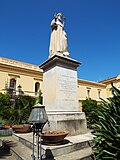 Antoninus of SorrentoVenerable · Abbot and hermitFeb 14
 Isaac of the Kiev CavesVenerable · Recluse of the Kiev CavesFeb 14
 Ephraim of KatounakiaVenerable · Athonite elder of KatounakiaFeb 14
 Modestinus, Florentinus and FlavianusHoly Martyrs · Martyrs of CampaniaFeb 14
 Damian the NewVenerable MartyrFeb 14
 The Twelve Greek CraftsmenHoly VenerablesFeb 14
- Barbara of SkvorchikhaFool-for-Christ · Fool for Christ and recluseFeb 14
- Paul DernovHieromartyr · ArchpriestFeb 14
- AgathonHieromartyr · Presbyter of AlexandriaFeb 14