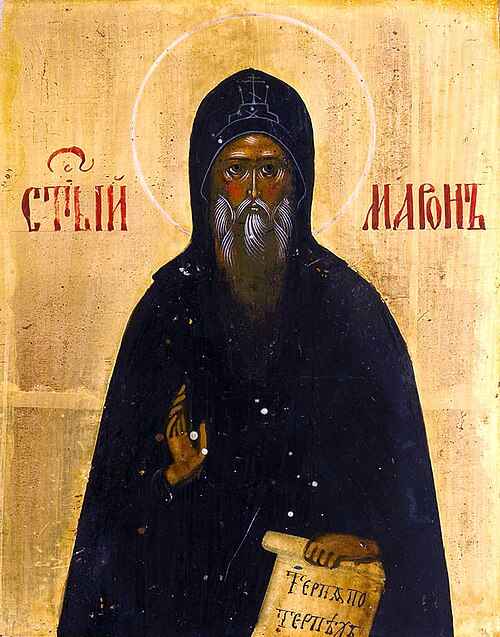
Venerable
Maron
Syriac Hermit
Syriac hermit of the Taurus Mountains, whose followers founded the Maronite community after his death.
- Feast
- February 14old style February 27
- Reposed
- 4105th century
- Place
- Levant
- Order
- Venerables
Life
Saint Maron (Maroun) was a hermit monk of Syria, in the fourth and the beginning of the fifth century, in the Taurus mountains, whose followers after his death founded the Christian movement called the Maronite Church. He is commemorated by the Orthodox Church on 14 February, and the Maronite Church commemorates him on 9 February.
Life
Theodoret of Cyrrhus speaks of his life, in chapter 16 of the “Religious History”. Born in Syria, he was a priest and then a hermit. He lived on the right bank of the Orontes, on a mountain peak near Cyrrhus, where pagans had formerly offered sacrifices in a grove. He sanctified the place of the old idol sacrifices and made it a place of service to God. He made himself a small hut, covered with skins, as a shelter from rain and snow, but rarely went into it; he lived in the open air, beside a temple which he turned into a church, and spent his time in prayer and vigil, exposed to sun, rain, hail and snow. Theodoret writes that this was a new form of asceticism, which spread quickly in Syria and Lebanon, and that among those who followed it many were guided by Maron. Many came to him, because God gave him the gift of miracles; by prayer he healed not only the illnesses of the body but also those of the soul.
Maron called Saint Zebinas, a monk of the same time, his spiritual father, teacher and example of every virtue, and told all who visited him to go to Zebinas and take his blessing. He asked to be buried in the same coffin, but the wish was not fulfilled. Saint John Chrysostom wrote to “the priest Maron, the ascetic”, around 405, showing his love and respect and asking his prayers. It is believed that the two studied together at Antioch. His disciples included James the Hermit and Limnaeus the Syrian, and Abraham of Cyrrhus, called the Apostle of Lebanon, carried his teaching to Lebanon and brought many non-Christians to the faith.
Death and veneration
Maron died after a short illness, around 410. After his death a great dispute arose over his relics: the inhabitants of a neighbouring, very large village came together, took the relics and drove the others away, so his body was not placed in the same coffin as Zebinas’. They built a great temple for him and appointed a feast in his memory, which became general. The fame of his austere life and of his miracles caused a monastery to be raised after his death on the site of his struggle. The exact place of burial is disputed: some say he was buried at Arethusa (al-Rastan, on the Orontes), others at Brad, north of Aleppo. Pope Benedict XIV wrote in 1753 a letter on Maron’s holiness. From those who followed him the Maronite Church was born, today in full communion with the See of Rome. He is usually shown in a black monastic habit, with a hanging stole, with a long staff with a globe and a cross on top.
Commemorated the same day February 14
 CyrilEqual-to-the-Apostles · Apostle to the SlavsFeb 14
 Auxentius of BithyniaVenerable · Hermit of BithyniaFeb 14
- Abraham of HarranSaint · Bishop of HarranFeb 14
 Antoninus of SorrentoVenerable · Abbot and hermitFeb 14
 Isaac of the Kiev CavesVenerable · Recluse of the Kiev CavesFeb 14
 Ephraim of KatounakiaVenerable · Athonite elder of KatounakiaFeb 14
 Modestinus, Florentinus and FlavianusHoly Martyrs · Martyrs of CampaniaFeb 14
 Damian the NewVenerable MartyrFeb 14
 The Twelve Greek CraftsmenHoly VenerablesFeb 14
- Barbara of SkvorchikhaFool-for-Christ · Fool for Christ and recluseFeb 14
- Paul DernovHieromartyr · ArchpriestFeb 14
- AgathonHieromartyr · Presbyter of AlexandriaFeb 14