Saint
Adeodatus of Naples
Bishop of Naples
Bishop of Naples from 653-654 to 671-672, venerated as a saint.
Life
Adeodatus of Naples (died 671 or 672) was bishop of Naples from 653 or 654 until his death and is venerated as a saint in the Roman Catholic Church, where he is commemorated on 27 June and on 1 October. Our sources do not show that he is commemorated in the Orthodox Church; we give him as a saint of the West, venerated locally at Naples.
Sources and episcopate
The main source about him is the first part of the "Acts of the Bishops of Naples", written at the turn of the eighth and ninth centuries by an unknown author; events at Naples in that time are also spoken of in Paul the Deacon's "History of the Lombards" and in the "Liber Pontificalis". No report about his origin or youthful years has survived. He rose to the episcopal throne after Saint Leontius, who died in 652 or 653; his enthronement may have been in 653 or 654.
From 661 medieval sources begin to mention the dukes of Naples, the first being Basil; it is thought that until then the city had been governed by bishops. The constant danger of Lombard attacks, however, made the nobles there entrust power to a man skilled in war. This change in the governing of the city was approved in 663 by the Byzantine emperor Constans II, who, at war with the Lombard king Grimoald and his son, the duke of Benevento Romuald I, came first to Rome, to Pope Vitalian, then to Naples, where he was received with honour by the people and clergy. From there he went to Reggio and then to Sicily (the Greek source says Syracuse).
Works and veneration
At Adeodatus's command an oratory was built at the basilica of Saint Restituta, then the cathedral of Naples, and her relics were brought there from the island of Ischia. In 670 the bishop performed a solemn ceremony of burial of the remains of Saint Patricia. He died in 671 or 672, after eighteen years of shepherding, and was buried in the monastery of the Mother of God, where later an altar in the crypt was dedicated to him and to Saint Constantius of Capri. His successor was Saint Agnellus. Soon after his death he was venerated by the Neapolitans as a saint, as shown by the mention of his name in the martyrology of the ninth century, whose author used older church sources.
Commemorated the same day June 27
 Cyril LucarisSaintJun 27
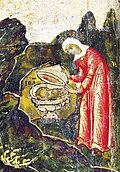 Joanna the Myrrh-bearerRighteous · Myrrh-bearer, wife of ChuzaJun 27
 George the HagioriteVenerable · Georgian monk on Mount AthosJun 27
 Sampson the HospitableVenerable · Protector of the poor of ConstantinopleJun 27
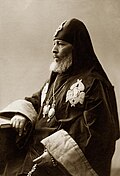 Kyrion II of GeorgiaSaint · Catholicos-Patriarch of GeorgiaJun 27
 Zoilus of CórdobaMartyrJun 27
 Serapion of KozheozeroVenerable · Founder of Theophany MonasteryJun 27
- Martin of TurovVenerable · Recluse monkJun 27
- AedhSaintJun 27
- Alexander SidorovHieromartyrJun 27
- Anectus of CaesareaMartyrJun 27
- AnthusaVenerableJun 27