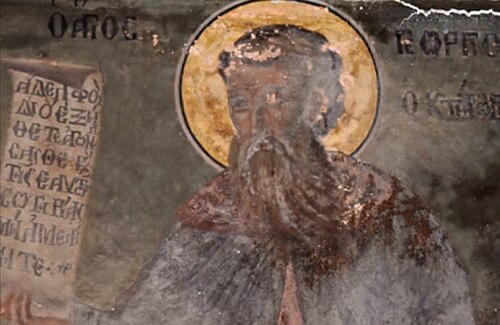
Venerable
George the Hagiorite
Georgian monk on Mount Athos
Georgian monk, calligrapher, writer and translator, who died in 1065.
- Feast
- June 27old style July 10
- Reposed
- 106511th century
- Place
- Athens
- Order
- Venerables
Life
The Venerable George the Hagiorite, also called George of Athos, George the Iberian or Mtatsmindeli, was a Georgian monk, calligrapher, writer, theologian and translator of the eleventh century, abbot of the Iviron monastery on Mount Athos. The Church of Georgia remembers him as one of its most venerated figures and as a bridge between Georgia and Byzantium.
He was born in 1009 at Trialeti, in southern Georgia, into a noble family, the son of Jacob, at times an envoy of King Bagrat III to Persia, and Mariam. At seven he was sent to learn at the monastery of Tadzrisi, then to that of Khakhuli. Around 1022 he was sent to Constantinople, where he learned Greek and Byzantine theology. He returned to Khakhuli in 1034 and took monastic tonsure, then went to Jerusalem and for a time was disciple of another Georgian monk, George the Recluse, on the Black Mountain near Antioch. In 1040 he settled at the Iviron monastery (of the Georgians) on Athos, and in 1044, after the death of Abbot Stephen, he was made abbot. He renewed the monastery and made it a lively centre of Georgian Orthodox culture.
Between 1052 and 1057 he went to Antioch, before the patriarch, to defend his brethren accused of heresy by some Greek clerics. The dispute quickly turned to the legitimacy of the autocephaly of the Church of Georgia. George relied on the Georgian tradition of the mission of the holy Apostle Andrew to Colchis and Iberia, and succeeded in persuading Patriarch Theodosius III to recognise the autocephaly. About the same time Byzantium gave up trying to subdue Georgia and made peace with King Bagrat IV. During the great schism of 1054 he held a more moderate position toward the West than many Eastern hierarchs: in 1064, before the emperor Constantine X, he said he did not consider the Latin Eucharistic practice heretical, but he regarded the Filioque as heresy and translated into Georgian the anti-Latin writings of Photius.
King Bagrat asked him several times to take charge of the Georgian Church; he declined, but in 1058 he came to the country for five years and set church affairs in order, defining the relation with royal power. He translated from Greek much of the Fathers, the Psalms, commentaries and synaxaria, some never before rendered in Georgian, and he corrected the translations of his predecessor Euthymius of Athos, to whom, with John of Athos, he dedicated his most important original work, the Lives of John and Euthymius. He obtained from the emperor leave to send young Georgians to study on Athos.
In 1065, on his way to Athos, he stopped at Constantinople, summoned by Constantine X to a theological dispute, and there he fell asleep, on 27-29 June 1065. He was buried at the Iviron monastery. His life was written by his disciple George Mtsire. The Georgian Orthodox Church commemorates him on 10 July.
Commemorated the same day June 27
 Cyril LucarisSaintJun 27
 Joanna the Myrrh-bearerRighteous · Myrrh-bearer, wife of ChuzaJun 27
 Sampson the HospitableVenerable · Protector of the poor of ConstantinopleJun 27
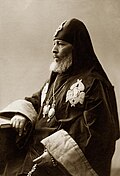 Kyrion II of GeorgiaSaint · Catholicos-Patriarch of GeorgiaJun 27
 Zoilus of CórdobaMartyrJun 27
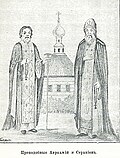 Serapion of KozheozeroVenerable · Founder of Theophany MonasteryJun 27
- Martin of TurovVenerable · Recluse monkJun 27
- Adeodatus of NaplesSaint · Bishop of NaplesJun 27
- AedhSaintJun 27
- Alexander SidorovHieromartyrJun 27
- Anectus of CaesareaMartyrJun 27
- AnthusaVenerableJun 27