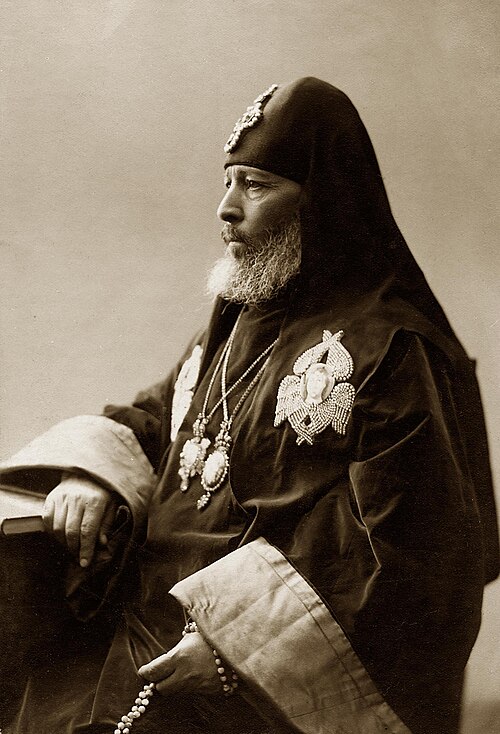
Saint
Kyrion II of Georgia
Catholicos-Patriarch of Georgia
Historian and first Catholicos-Patriarch of Georgia after the restoration of the Church's autocephaly; died in 1918.
Life
Saint Kyrion II was the first Catholicos-Patriarch of All Georgia after the restoration of the autocephaly of the Georgian Church from the Russian Church, in 1917, and a historian of his Church. He was born on 10 November 1855 and was killed in 1918. The Holy Synod of the Georgian Church canonized him on 17 October 2002. He is commemorated on 27 June.
Youth
He was born Giorgi Sadzaglishvili in the village of Nikozi, into a priest's family. He graduated from the seminary at Tbilisi in 1876 and the Kyiv Theological Academy in 1880, and was named deputy inspector at the Odessa seminary. Returning to Georgia, in 1883, he was a teacher at the theological schools of Gori, Kutaisi and Tbilisi. He published, under the pseudonyms Iverieli and Nikozeli, several works in Georgian and Russian on the history of the Georgian Church and Christianity in Georgia, found and studied unique medieval Georgian manuscripts, collected old Georgian coins, recorded folklore, helped talented Georgian students and collaborated with foreign scholars interested in Georgia.
Church service and exile
After the death of his wife and children, he was tonsured a monk in 1896 with the name Kyrion and named abbot at Kvabtakhevi monastery, then archimandrite in 1898. He was bishop of Alaverdi in 1898, of Gori in 1900 and in the following years in other places. In the early twentieth century, in the debates about the status of the Georgian Church, he was an active supporter of the autocephalist movement, calling for the restoration of the Church abolished by Russia in 1811. For this reason he was removed from Georgia, to Kamenets-Podolsk in 1902 and Kovno in 1903, then bishop of Novomyrhorod and vicar of Kherson from 1903 to 1904. In 1908 the Russian exarch of Georgia, Archbishop Nikon, was murdered at Tbilisi, and the Russian government used the occasion to remove Georgian bishops from their sees. Kyrion was deprived of the title of bishop, sent to Kuriazh in Ukraine and then confined in the Sanaksar monastery in Mordovia. In 1915 he was restored to his rank and named bishop of Polotsk and Vitebsk.
Catholicos-Patriarch
He could return to Georgia only after the February Revolution of 1917 at Saint Petersburg, which led to the de facto separation of Georgia from Russia. Returning in September 1917, he was welcomed by the Georgians as their spiritual guide. The Georgian clergy had already restored autocephaly, on 12 March 1917, and Kyrion was elected Catholicos-Patriarch and consecrated in Svetitskhoveli Cathedral on 1 October 1917. The Holy Synod of the Russian Church did not recognize the move and communion between the two Churches was broken. Only in 1943 did the Russian Church recognize the autocephaly of the Georgian Patriarchate. In his time Kyrion faced the opposition of a group of Georgian clerics who defied his authority. His death remains a mystery to this day: he was found murdered in his residence at Martqopi monastery early on 27 June 1918. He was buried in Sioni Cathedral in Tbilisi.
Commemorated the same day June 27
 Cyril LucarisSaintJun 27
 Joanna the Myrrh-bearerRighteous · Myrrh-bearer, wife of ChuzaJun 27
 George the HagioriteVenerable · Georgian monk on Mount AthosJun 27
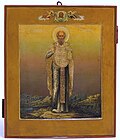 Sampson the HospitableVenerable · Protector of the poor of ConstantinopleJun 27
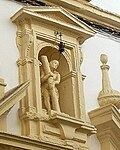 Zoilus of CórdobaMartyrJun 27
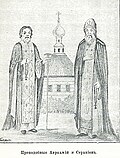 Serapion of KozheozeroVenerable · Founder of Theophany MonasteryJun 27
- Martin of TurovVenerable · Recluse monkJun 27
- Adeodatus of NaplesSaint · Bishop of NaplesJun 27
- AedhSaintJun 27
- Alexander SidorovHieromartyrJun 27
- Anectus of CaesareaMartyrJun 27
- AnthusaVenerableJun 27