Righteous
Joanna the Myrrh-bearer
Myrrh-bearer, wife of Chuza
Myrrh-bearer of the Gospels, wife of Chuza, healed by the Lord, who supported Him and His disciples.
- Feast
- June 27old style July 10
- Reposed
- 1001st century
- Place
- Galilee
- Order
- The Righteous
Life
Saint Joanna the Myrrh-bearer, the wife of Chuza, was one of the women of Galilee who followed the Saviour and served Him with their means, and after the crucifixion went to the tomb with spices. She is mentioned in the Gospel of Luke and is commemorated by the Church on 27 June and on the Sunday of the Myrrh-bearers.
In the Gospel
Luke says that Joanna was the wife of Chuza, appointed by Herod Antipas over his household, a post of weight. She is among the women healed of evil spirits and infirmities who followed Jesus and the apostles and served them out of what they had. Some think that, living in Chuza's house, she could have been a witness to what happened at the court of Herod, and that Luke may have learned some things from her. A Church commentator, Averky Taushev, suggested that Christ healed Chuza's son, perhaps the one of whom the Gospel of John speaks at Cana, and that this is why Joanna followed Him.
In chapter 24 of Luke, Joanna is named among the women who went to the tomb with spices, found the stone rolled away and the tomb empty, heard from the angels the news of the Resurrection and told it to the apostles. For this she is called myrrh-bearer, one who carries myrrh.
The Church's tradition
The Church commemorates her on 27 June and, together with the other myrrh-bearing women, on the third Sunday after Pascha, the Sunday of the Myrrh-bearers. Tradition says that she afterwards took her place among those who prayed with the apostles and the Mother of God, and was present at Pentecost. The Greek synaxaria say that she died in peace.
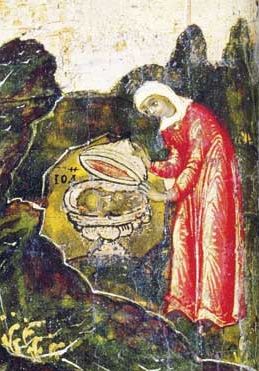
A tradition kept by Saint Demetrius of Rostov says that after the beheading of Saint John the Baptist his body was buried in secret by his disciples, while his head was hidden by Herodias in her palace. Joanna, the wife of Herod's steward, who knew the place, took the head by night, put it in an earthen vessel and buried it on the Mount of Olives, on one of Herod's estates. Later, according to the same tradition, the hidden relic was found by a nobleman named Innocent, who built a church on the site. The Serbian sources link it to the time of Constantine the Great.
Other views
Some scholars, among them Richard Bauckham, think that Joanna may be the same as Junia, mentioned by the Apostle Paul in Romans 16:7, Joanna being her Jewish name and Junia her Roman one. Other commentators observe that Junia is mentioned together with Andronicus, perhaps her husband, which would contradict the identification. It is a hypothesis, not a teaching of the Church.
Joanna is venerated as a saint in the Orthodox, Roman Catholic and Anglican Churches and others. The Orthodox commemorate her on 27 June, the Catholics on 24 May and the Anglicans on 3 August.
Commemorated the same day June 27
 Cyril LucarisSaintJun 27
 George the HagioriteVenerable · Georgian monk on Mount AthosJun 27
 Sampson the HospitableVenerable · Protector of the poor of ConstantinopleJun 27
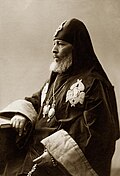 Kyrion II of GeorgiaSaint · Catholicos-Patriarch of GeorgiaJun 27
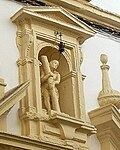 Zoilus of CórdobaMartyrJun 27
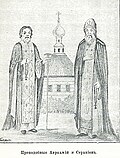 Serapion of KozheozeroVenerable · Founder of Theophany MonasteryJun 27
- Martin of TurovVenerable · Recluse monkJun 27
- Adeodatus of NaplesSaint · Bishop of NaplesJun 27
- AedhSaintJun 27
- Alexander SidorovHieromartyrJun 27
- Anectus of CaesareaMartyrJun 27
- AnthusaVenerableJun 27