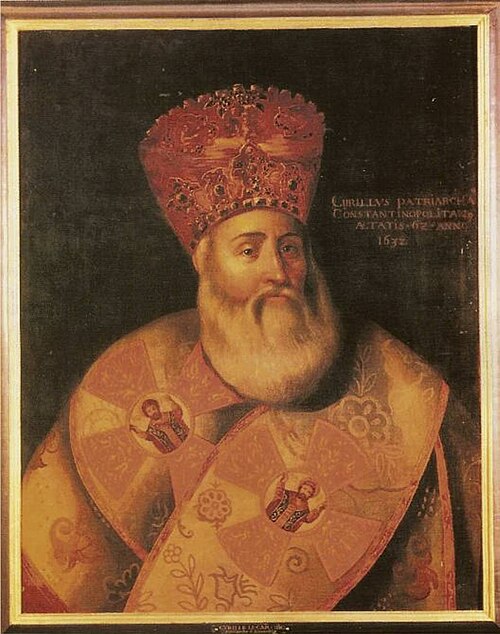
Saint
Cyril Lucaris
Cyril I of Constantinople (Cyril Lucaris or Kyrillos Loukaris (Greek: Κύριλλος Λούκαρις; 13 November 1572 – 27 June 1638) was a Greek prelate and theologian, and a native of Heraklion, Crete (then under the Republic of Venice).
Uncertain source. We are looking to verify this information as soon as we can.
Life
Cyril Lucaris (in Greek Kyrillos Loukaris, 1572 to 1638) was a Cretan scholar and hierarch, Patriarch of Alexandria from 1601 and several times Ecumenical Patriarch of Constantinople between 1620 and 1638. He is a contested figure. The Holy Synod of the Patriarchate of Alexandria glorified him as a hieromartyr on 6 October 2009, with his memory on 27 June. Yet a Confession of Faith in his name, with teaching close to Calvinism, was condemned by Orthodox synods after his death, and he is still not venerated everywhere in the Church. We give the facts as the sources state them.
Early years
He was born at Candia, today Heraklion, on Crete, on 13 November 1572, at a time when the island belonged to Venice. He was baptized Constantine and took the name Cyril as a monk. The Greek synaxarion says his father was a priest and that he studied at Venice and at Padua. He was tonsured at the monastery of Agarathos on Crete and was soon called to Egypt by his relative Meletios Pegas, Patriarch of Alexandria, who ordained him deacon and priest.
Meletios sent him to the Orthodox in Poland and Lithuania, who were under heavy pressure from the Union of Brest (1596). Cyril worked there for some years, taught at the Orthodox school and defended the Church against union with Rome. When Meletios died in 1601, Cyril was elected Patriarch of Alexandria at the age of twenty-nine.
Patriarch of Alexandria and of Constantinople
At Alexandria he held a synod at Cairo against Latin influence, travelled to Cyprus, Jerusalem and Damascus, repaired the patriarchal buildings and worked to clear the patriarchate's debts. In 1620 the synod of Constantinople elected him Ecumenical Patriarch. During his tenure he was removed and restored several times. Opponents included the Latin side and the French and Austrian ambassadors, and some Greek bishops, notably Cyril Kontaris. He was supported by the Dutch and English ambassadors.
He cared for the education of the clergy. He supported a Greek printing press at Constantinople, the first in the Ottoman Empire, which began work in 1627 and was closed within a year after French complaints about its anti-Catholic printing. He also supported a modern Greek translation of the New Testament by Maximos of Gallipoli, and he sent young Greek theologians to study in the West.
The Confession of Faith
In 1629 a Confession of Faith in his name was published at Geneva in Latin, and in 1633 in Greek. In its eighteen chapters it rejects the authority of the pope and, on grace, predestination and the Sacraments, speaks in ways close to Reformed teaching. Orthodox synods rejected it: Constantinople in 1638 and 1642, Iasi in 1642 and Jerusalem in 1672 under Patriarch Dositheos.
Scholars still disagree. Many Greek and Russian Orthodox scholars deny that Cyril wrote it, and the glorification of 2009 rests on that view. Other scholars point to a manuscript in his own hand and to what they take as his own acknowledgements, and hold that he did sympathize with the Reformed side. His correspondence with the Archbishop of Canterbury and his links with the Dutch and English embassies are also part of the record.
Death and relics
In June 1638 the Austrian ambassador accused him before the Ottoman authorities of planning a Cossack and Russian attack, with a Greek revolt. Sultan Murad IV, then on campaign against Baghdad, ordered his death. He was arrested on 22 June, held at Rumeli Hisari, and on 27 June 1638 was taken by boat and strangled by Janissaries. His body was buried in the sand, dug up and thrown into the sea, then recovered and buried on an island in the Gulf of Nicomedia. In 1641 Patriarch Parthenios I had it moved to the Halki monastery, and in 1975 his relics were given to the monastery of Agarathos on Crete, where they are kept.
Shortly after his death many honoured him as a martyr, and Saint Eugenios of Aitolia wrote a service for his memory. The question of his teaching has not been settled to everyone's satisfaction.
Commemorated the same day June 27
 Joanna the Myrrh-bearerRighteous · Myrrh-bearer, wife of ChuzaJun 27
 George the HagioriteVenerable · Georgian monk on Mount AthosJun 27
 Sampson the HospitableVenerable · Protector of the poor of ConstantinopleJun 27
 Kyrion II of GeorgiaSaint · Catholicos-Patriarch of GeorgiaJun 27
 Zoilus of CórdobaMartyrJun 27
 Serapion of KozheozeroVenerable · Founder of Theophany MonasteryJun 27
- Martin of TurovVenerable · Recluse monkJun 27
- Adeodatus of NaplesSaint · Bishop of NaplesJun 27
- AedhSaintJun 27
- Alexander SidorovHieromartyrJun 27
- Anectus of CaesareaMartyrJun 27
- AnthusaVenerableJun 27