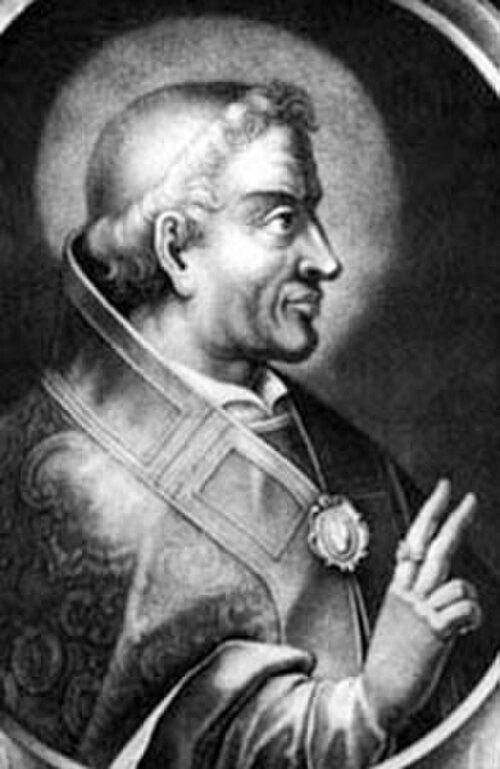
Confessor
Agapetus I of Rome
Bishop of Rome
Bishop of Rome from 535 to 536, who died at Constantinople during a mission to Emperor Justinian.
- Feast
- April 17old style April 30
- Reposed
- 5366th century
- Place
- Constantinople
- Order
- Confessors
Life
Saint Agapetus I of Rome was bishop of Rome from 13 May 535 until he reposed in Constantinople on 22 April 536. He led the Church for less than a year, yet that short time fell in the midst of grave events: the war between the empire and the Goths, and a dispute over the patriarchal throne of the capital. The Orthodox Church remembers him on 17 April (old style Menaion; 30 April in the civil calendar), as a defender of the faith of Chalcedon.
Origins and election
He was a Roman, born around the year 490, the son of the priest Gordian, who was killed in the street riots of the days of Pope Symmachus. Agapetus took the side of that pope's party, was ordained deacon (perhaps as early as 502) and rose to be archdeacon of Rome. A Romanian source adds that he gathered a rich library of the holy Fathers near the church of Saints John and Paul. He is also said to have helped Cassiodorus in the founding of his monastery at Vivarium.
He was chosen bishop after the death of Pope John II. His first act was a gesture of reconciliation: before the assembled clergy he burned the anathema which Boniface II had pronounced against his dead rival Dioscorus, on an accusation of simony, and which had been kept in the archives of the Roman Church.
The journey to Constantinople
In 535 the army of Justinian, led by Belisarius, began the reconquest of Italy from the Goths. King Theodahad, in fear, begged the pope to go to the emperor and dissuade him. The Church of Rome was so poor that Agapetus had to pledge its sacred vessels to pay for the journey. He set out in mid-winter with five bishops and a large retinue, and in February 536 he stood in the capital of the East.
The political mission failed: Justinian's preparations were too far advanced to be halted. But the pope turned at once to a matter of faith. The patriarchal throne was held by Anthimus, who had left his see of Trebizond and had been seated in Constantinople by the empress Theodora, against the protests of the Orthodox. Clergy of the city accused him of being an intruder and a heretic. Agapetus demanded of him a written confession of faith and a return to his former see, and when Anthimus refused, he deposed him.
The emperor threatened the pope with exile. According to tradition Agapetus answered that he had come longing to see a most Christian emperor and had found a Diocletian, but that threats did not frighten him. In the end Justinian gave in and presented a written confession of the Orthodox faith, which the pope received. Agapetus then personally consecrated the lawfully chosen new patriarch, Menas, which had never before been done by a bishop of Rome.
Wonders
The Orthodox synaxaria add that on the way to Constantinople Agapetus met a man who was lame and mute. The saint healed his lameness, and after the man received the Holy Mysteries he began to speak. In the capital he is also said to have healed a blind beggar. He took part in a local council in Constantinople, where he stood firmly for the Orthodox teaching against the heresy of Severus. (Some Orthodox sources name Theodoric as the king who sent him; the historical sender was Theodahad.)
Repose and veneration
Soon afterwards Agapetus fell ill and reposed on 22 April 536, after a pontificate of about ten months. His body was carried to Rome in a lead coffin and laid in the Basilica of Saint Peter. Four of his letters survive, two to Justinian, one to the bishops of Africa and one to the bishop of Carthage. Some Catholic sources keep his memory on 20 September, while the Roman Martyrology and the Eastern Churches commemorate him on the day of his repose. Both the Orthodox and the Roman Catholic Churches venerate him as a saint.
Commemorated the same day April 17
 Simeon bar SabbaeHieromartyr · Bishop of Seleucia-CtesiphonApr 17
 Alexander of SvirVenerable · Abbot of Svir MonasteryApr 17
 Acacius of MeliteneSaint · Bishop of MeliteneApr 17
 Macarius of CorinthSaint · Metropolitan of CorinthApr 17
 Zosimas of SolovkiVenerable · Co-founder of Solovki MonasteryApr 17
- UsthazadesMartyrApr 17
- Paisius of KyivVenerable · Monk of the Kyiv Caves LavraApr 17
- Abdelas of SeleuciaHieromartyrApr 17
- Adrian of CorinthMartyrApr 17
- Ananias of SeleuciaHieromartyrApr 17
- Askitreia of SeleuciaMartyrApr 17
- ChusdazatHieromartyrApr 17