Venerable
Paisius of Kyiv
Monk of the Kyiv Caves Lavra
Cassock-novice of the Kyiv Caves Lavra and fool for Christ; glorified by the Russian Church in 2017.
- Feast
- April 17old style April 30
- Reposed
- 189319th century
- Place
- Kyiv
- Order
- Venerables
Life
Venerable Paisius of Kyiv, in the world Prokopy Grigorievich Yarotsky (1821 to 1893), was a cassock-novice of the Kyiv Caves Lavra and a fool for Christ. The Russian Church honours him for the humility with which he bore men's scorn, for his gift of prayer, foresight and healing, and for the love he hid beneath the guise of folly. The Bishops' Council of the Russian Church glorified him for veneration throughout the Church on 30 November 2017.
Childhood and the road to the monastery
Prokopy was born on 8 July 1821 in the town of Lubny, in Poltava province, into a large and well-off family of townspeople. His mother was a deeply believing woman who raised all her children in piety and purity and loved above all to receive wanderers and pilgrims. As the youngest, he was especially dear to her.
At ten he was sent to the church school in Kyiv. The boy often ran from it to the Lavra, and teachers and relatives took him for wilful and disobedient and tried in vain to correct him. He left school unfinished and worked as a copyist for the city administration, where his elder brother was secretary.
At sixteen he was accepted into the Caves Lavra as a provisional novice. Almost three years passed in this uncertain state, because he could not gather the papers required, among them the written consent of his mother and brothers and a release from the townsmen's society. Losing hope, he wanted to leave, but fell gravely ill and was taken to the brothers' hospital. There he had a vision: the Mother of God revealed to him his future struggle and rebuked him for his faintness of heart. His spiritual father reported the vision to the abbot of the Lavra, Archimandrite Lavrenty, who at once ordered that he stay and that his papers be kept in the chancery. On 23 March 1850 he was enrolled as a full novice, with the obedience of singing in the choir at the Near Caves.
The beginnings of his folly
He chose Venerable Parthenius as his confessor (other sources say the elder Porphyry). Another great elder, Blessed Theophilus, also had a strong influence on him. In his choir duty Prokopy was often mocked by his fellow singers, and he increased his prayer all the more. The first signs of his folly were that he never read from a book in church but from memory, holding the book upside down. He addressed the Mother of God with the formal "you", behaved oddly in church at times and wiped the railings with his cassock.
In 1853, for this puzzling conduct, he was released from the choir and moved as a scribe to the Goloseevo hermitage. There he received another obedience, that of reading the prayer rule for Metropolitan Philaret of Kyiv. In 1854, with the hierarch's blessing, Hieroschemamonk Moses, the head of the hermitage, tonsured him a rassophore monk with the name Paisius.
Folly for Christ
Soon after the tonsure Father Paisius returned to the Lavra and began the hard labour of folly for Christ. He acted like a madman, wandered through the monasteries of Kyiv and came to the Lavra only for services. He slept anywhere, and no one ever saw him truly asleep. He dressed poorly, wore a dirty rag on his head and boots with holes or no soles. He always carried a stick wrapped in cloth. If someone gave him a cassock, he first soiled it in mud, cut it or tore it in places and only then put it on, and the inner cassocks he always gave to the poor. For every alms he received he made prostrations, naming all the benefactors one by one.
He ate the leftovers from the brothers' table, mixing every dish together on his plate and keeping the remains in a small pot, which he ate later, though it had become inedible for others. On 12 December 1854 he was given two months' leave to see his mother, who had not seen him for fourteen years, since he entered the monastery. On his return he was sent to the bakery, but on 10 November 1855, for lack of singers, he was brought back to the choir of the Near Caves. For some months he gave no open sign of folly but worked in secret on the perfecting of his spirit and was even named assistant to the rubricist. To escape temptations, he decided to withdraw from people for good.
He wandered through the city and the monasteries. He seldom came to the Lavra, during services, and beside the choir he muttered words without sense. He was moved from the singers' cell to a small hut but refused even that comfort and settled in an attic, where he spent his days in every hardship, in summer heat and winter frost. He prayed at times on his knees in the snow. In church he moved constantly, rebuking those at prayer and disturbing the service with cries and strange gestures. The monastery authorities regarded him as mentally ill. In 1867 the metropolitan of Kyiv tried to settle him at the Kitaev hermitage, under watch in a cell, but nothing came of it.
His gifts
Many mocked him, spat on him and struck him, and he forgave them all and prayed gently for them. For this humility and willing martyrdom the Lord gave him the gift of effective prayer, foresight and healing, and a great compassionate love for people, which he hid under the veil of folly. He addressed everyone as "dear little soul" and took the faults, secret thoughts and sins of the person before him upon himself, rebuking them as if they were his own.
Many came from distant towns and villages to see him. The blessed one foresaw the murder of Emperor Alexander II and the appointment of Saint Ioannikios (Rudnev, died 1900) to the metropolitan throne of Kyiv. He always appeared in time where he was needed, to comfort the downcast, reconcile those who quarrelled and encourage those in struggle. In time all of Kyiv came to love him.
From 1867 he lived at the Kitaev hermitage, and in 1879 he was placed in the brothers' almshouse there, where, though frail himself, he cared with great love for those still weaker. He also served his sick mother and saw her to her last rest.
Death and glorification
The elder knew the day of his death in advance. Feeling the end draw near, he went to the Lavra and was taken into the brothers' hospital. On 17 April 1893, after receiving the Holy Mysteries of Christ, he quietly fell asleep in the Lord. He was buried in the brothers' cemetery of the Transfiguration hermitage, attached to the Lavra and abolished in Soviet times. All Kyiv mourned him. The ground of the old cemetery now lies within a private garden in the old district of Myshelovka in Kyiv.
The Bishops' Council of the Russian Orthodox Church glorified him on 30 November 2017. Venerable Paisius is commemorated on 17 April and in the synaxes of the saints of Kyiv and of Poltava.
Commemorated the same day April 17
 Agapetus I of RomeConfessor · Bishop of RomeApr 17
 Simeon bar SabbaeHieromartyr · Bishop of Seleucia-CtesiphonApr 17
 Alexander of SvirVenerable · Abbot of Svir MonasteryApr 17
 Acacius of MeliteneSaint · Bishop of MeliteneApr 17
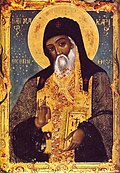 Macarius of CorinthSaint · Metropolitan of CorinthApr 17
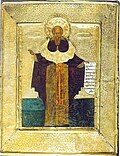 Zosimas of SolovkiVenerable · Co-founder of Solovki MonasteryApr 17
- UsthazadesMartyrApr 17
- Abdelas of SeleuciaHieromartyrApr 17
- Adrian of CorinthMartyrApr 17
- Ananias of SeleuciaHieromartyrApr 17
- Askitreia of SeleuciaMartyrApr 17
- ChusdazatHieromartyrApr 17