Venerable
Alexander of Svir
Abbot of Svir Monastery
Russian monk and abbot of the Alexander-Svirsky Monastery, who died in 1533 and was canonized in 1547.
- Feast
- April 17old style April 30
- Reposed
- 153316th century
- Place
- Alexander-Svirsky Monastery
- Order
- Venerables
Life
The Venerable Alexander of Svir, in baptism Amos, was a Russian monk and abbot, the founder of the Alexander-Svirsky monastery. The Russian Church canonised him at the Makaryev council of 1547. He is commemorated on 17 April (the finding of the relics) and on 30 August.
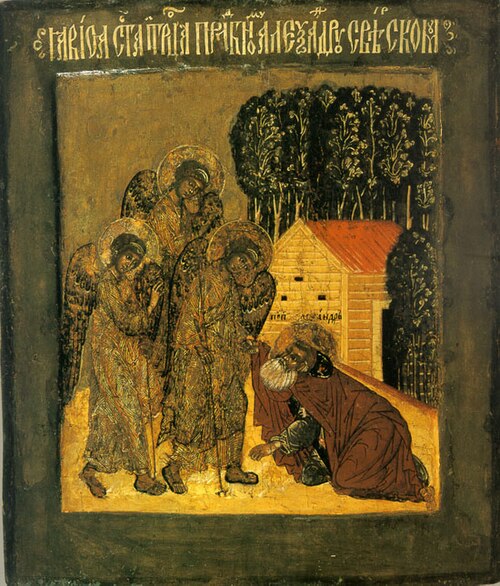
He was born on 15 June 1448 in the village of Mandera, in Obonezhye of Novgorod, east of Lake Ladoga, into a family of not very wealthy peasants, Stefan and Vassa, who later also took the monastic habit, with the names Sergius and Barbara. Some scholars consider him of Veps descent. According to his life, his mother asked God for a child for a long time and bore him after years of barrenness; he was named after the prophet Amos. Sent to learn, he learned with difficulty. At nineteen (in other sources, twenty-six) he left secretly for Valaam monastery, stayed seven years as a novice and in 1474 was tonsured with the name Alexander. He then withdrew to a solitary island, later called Holy, where he laboured about seven years in a cave. In 1485, with the abbot's blessing, he went to Holy Lake, near Olonets and the river Svir, where he lived in the forest, in a small hut. After twenty-five years of solitude, according to his life, he was granted to see the Holy Trinity, the only Russian saint to receive this vision: three angels with staves in hand, as at Abraham's, and a heavenly voice commanded him to raise there a church of the Holy Trinity and to gather brethren. An angel showed him the place for the church. On the place of his hermitage a monastery soon arose.
In 1506 Archbishop Serapion of Novgorod made him abbot of the monastery of the Holy Trinity (later Alexander-Svirsky). He was a good guide to his disciples and a true healer of souls; his humility and industry were an example. Many lay people came to the faith through him. He fell asleep on 30 August 1533, at the age of eighty-five. In 1545 his disciple Herodion wrote his life, at the order of Archbishop Theodosius of Novgorod, with the blessing of Metropolitan Macarius. Veneration throughout Russia began soon after his death, and in 1547, in the time of Ivan the Terrible, probably at the urging of Metropolitan Macarius, who had known him, the Makaryev council decreed his veneration in the whole Church. The tsar commanded that a side chapel of the church of the Intercession on the Moat be dedicated to him, in memory of the victory of the Russian army over the tsarevich Yepancha, on his commemoration day, in 1552.
His relics were found on 17 April 1641 and, according to his life, were incorrupt. Pilgrims gnawed at his cell and his log in the hope of curing toothache; the Synod ordered in 1735 that they be burned. On 22 October 1918, when the reliquary was opened, according to Soviet reports a wax doll was found instead of relics; the testimony of the monks present and a later Soviet commission showed, however, that a human body was in the coffin. His best-known disciples are Adrian Zavalishin, Gennady and Nikifor of Vazheozero, Cornelius of Padan, Theraponte of Voznesenye and Cassian of Solomen.
Commemorated the same day April 17
 Agapetus I of RomeConfessor · Bishop of RomeApr 17
 Simeon bar SabbaeHieromartyr · Bishop of Seleucia-CtesiphonApr 17
 Acacius of MeliteneSaint · Bishop of MeliteneApr 17
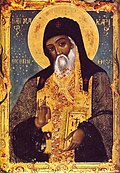 Macarius of CorinthSaint · Metropolitan of CorinthApr 17
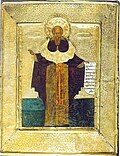 Zosimas of SolovkiVenerable · Co-founder of Solovki MonasteryApr 17
- UsthazadesMartyrApr 17
- Paisius of KyivVenerable · Monk of the Kyiv Caves LavraApr 17
- Abdelas of SeleuciaHieromartyrApr 17
- Adrian of CorinthMartyrApr 17
- Ananias of SeleuciaHieromartyrApr 17
- Askitreia of SeleuciaMartyrApr 17
- ChusdazatHieromartyrApr 17