Martyr
Askitreia of Seleucia
A martyr of Seleucia, put to death for her faith in Christ.
Life
Holy Martyr Askitreia of Seleucia suffered in Persia, around the year 344, in the persecution of King Shapur II (310-381), in the same company as Bishop Simeon of Seleucia-Ctesiphon and the priests Abdelas and Ananias. She was the daughter of Saint Pusicus and was put to death together with her father. The company is commemorated on 30 April.
Simeon, bishop of Seleucia-Ctesiphon, was accused of ties with the Greek state and of acting against the Persian king. In 344 the king issued a decree by which Christians were put under a heavy tax. When some refused to pay, the matter was presented as a rebellion and the king began a cruel persecution. Simeon was brought to trial in chains, together with the two priests, Abdelas and Ananias. The bishop did not bow even before the king. Asked why he had not given him due honour, he answered that formerly he had bowed to his rank, but now, when he was brought to renounce his God, it was not fitting to bow to him. The king tried to persuade him to bow to the sun, threatening that otherwise he would destroy Christianity in the land altogether. Neither exhortations nor threats shook the saint, and he was led to prison.
On the way the eunuch Usthazanes, the former tutor of the king, saw him. He rose and bowed to the bishop, but the saint turned away from him and reproached him that, being a Christian, he had bowed to the sun out of fear of the king. The eunuch repented from his heart, exchanged his costly garments for rough ones and wept bitterly at the door of the palace. King Shapur learned of the grief of his beloved teacher and asked what had happened. Usthazanes said openly that he bitterly repented of his denial and would no longer bow to the sun, but only to the one true God. The king marvelled at his resolve and gently urged him, but the old man remained unmoved and was condemned to death. His only request was that heralds proclaim through the whole city that he died not for any offence against the king, but as a Christian, and the king granted it. Learning of his death, Simeon thanked the Lord with tears. Summoned a second time before the king, he again refused to bow to the pagan gods and confessed his faith in Christ.
Angered, the king ordered all the Christians in the prison beheaded before the bishop's eyes. They went to their death without fear, blessed by the saint, and bowed their own heads under the sword. So the priest Abdelas, Simeon's companion, was also beheaded. When it was the turn of the priest Ananias, he suddenly trembled. Then one of the great officials, Pusicus, a secret Christian, feared that Ananias would renounce Christ and cried out loudly that he should not be afraid, should close his eyes, and would at once see the divine Light of the Lord Jesus Christ. By this cry he gave himself away. The king ordered Pusicus's tongue torn out and his skin flayed. With Pusicus his daughter, the martyr Askitreia, was also tormented. The last to come to the executioner was Bishop Simeon, who with prayer bowed his head on the block, on 13 April 344. The executions continued all through Easter week, until 23 April. The eunuch Azat, an official close to the king, also received a martyr's death. The sources indicate that a thousand martyrs suffered, then a hundred more, and a hundred and fifty more.
Commemorated the same day April 17
 Agapetus I of RomeConfessor · Bishop of RomeApr 17
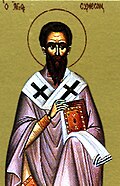 Simeon bar SabbaeHieromartyr · Bishop of Seleucia-CtesiphonApr 17
 Alexander of SvirVenerable · Abbot of Svir MonasteryApr 17
 Acacius of MeliteneSaint · Bishop of MeliteneApr 17
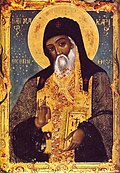 Macarius of CorinthSaint · Metropolitan of CorinthApr 17
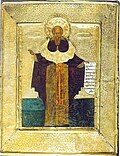 Zosimas of SolovkiVenerable · Co-founder of Solovki MonasteryApr 17
- UsthazadesMartyrApr 17
- Paisius of KyivVenerable · Monk of the Kyiv Caves LavraApr 17
- Abdelas of SeleuciaHieromartyrApr 17
- Adrian of CorinthMartyrApr 17
- Ananias of SeleuciaHieromartyrApr 17
- ChusdazatHieromartyrApr 17