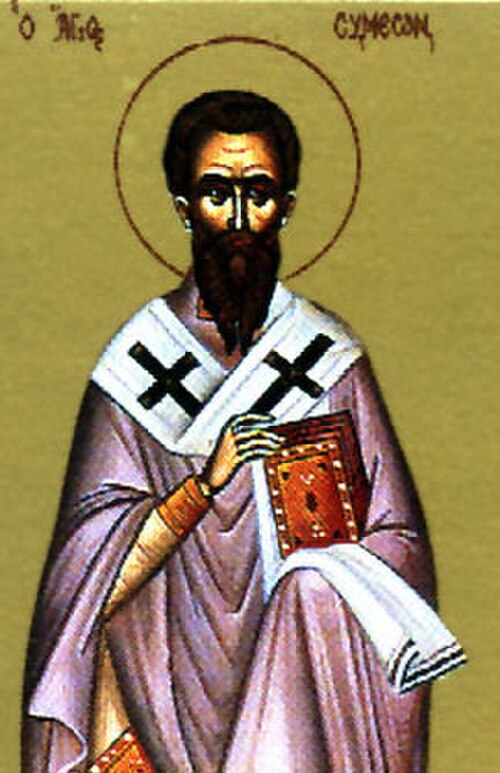
Hieromartyr
Simeon bar Sabbae
Bishop of Seleucia-Ctesiphon
Bishop of Seleucia-Ctesiphon and head of the Church in Persia, who died a martyr in the royal persecution.
Life
Saint Simeon bar Sabbae, hieromartyr, was bishop of Seleucia-Ctesiphon and in effect head of the Church in Persia. He received the crown of martyrdom in the persecution begun by Shah Shapur II, on Great Friday, in 341 or, according to other sources, in 344 or 345, together with many of his own. The Church commemorates him on 17 April.
Shepherd of the Church in Persia Simeon was the son of a fuller. The name bar Sabbae is usually explained as son of the dyers or son of the fuller. He had two sisters, one of whom was named Tarbula. In 316 he was appointed coadjutor, then successor, of Papa bar Gaggai at Seleucia-Ctesiphon, near present-day Baghdad. From that see he shepherded the Christians of the Persian Sasanian empire.
The Christians of Persia fell under the shah's suspicion after Emperor Constantine accepted Christianity, for they were seen as friends of the Roman enemy. In 339 Shapur II laid a double tax on them, and the collection was entrusted to Simeon. He refused. There were further accusations that he kept secret correspondence with the emperor and, according to some, that he had brought the shah's mother, Ifra Hormizd, to Christianity.
Martyrdom Simeon was arrested with five bishops, a hundred priests and his sister Tarbula. Among those put to death with him were the priests Abdella and Ananias, the royal officer Pusai with his daughter, the virgin Askitrea, and others. Before them had suffered the royal eunuch Ustazan, who at first denied Christ but, rebuked by Simeon, confessed his faith again before the shah.
To the place of execution nearly a thousand Christians were led alongside Simeon, according to some sources 1150 or a hundred. Simeon held back, so as to be the last to be beheaded and to be able to strengthen the others to the end. When the priest Ananias laid his head on the block, he trembled in all his body. Pusai, the royal officer who was a secret Christian, encouraged him: “Do not be afraid, old man, close your eyes and be brave, that you may see the divine light.” At once he was called as a Christian, condemned and tortured, and then his daughter suffered too. At last Simeon was beheaded.
The next year, also on Great Friday, the shah's beloved eunuch Azad was killed with a thousand other believers. The shah, moved by his death, stopped the persecution. The historian Sozomen wrote that the number of the dead was sixteen thousand. An Arab historian of the tenth century speaks even of two hundred thousand.
The Orthodox Church commemorates Saint Simeon on 17 April as hieromartyr.
Commemorated the same day April 17
 Agapetus I of RomeConfessor · Bishop of RomeApr 17
 Alexander of SvirVenerable · Abbot of Svir MonasteryApr 17
 Acacius of MeliteneSaint · Bishop of MeliteneApr 17
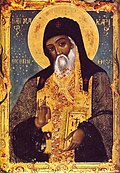 Macarius of CorinthSaint · Metropolitan of CorinthApr 17
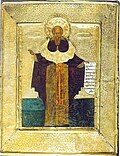 Zosimas of SolovkiVenerable · Co-founder of Solovki MonasteryApr 17
- UsthazadesMartyrApr 17
- Paisius of KyivVenerable · Monk of the Kyiv Caves LavraApr 17
- Abdelas of SeleuciaHieromartyrApr 17
- Adrian of CorinthMartyrApr 17
- Ananias of SeleuciaHieromartyrApr 17
- Askitreia of SeleuciaMartyrApr 17
- ChusdazatHieromartyrApr 17