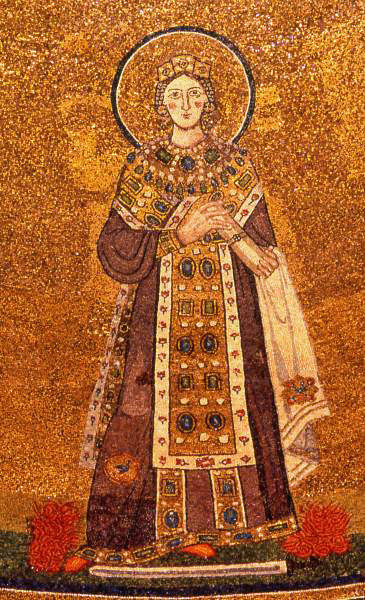
Martyr
Agnes of Rome
of Rome
Young Roman Christian killed for her faith at the beginning of the fourth century.
- Feast
- January 21old style February 3
- Reposed
- 3044th century
- Place
- Rome
- Order
- Martyrs
Life
The Holy Martyr Agnes of Rome was a young Christian girl, killed for her faith at the beginning of the fourth century, in the persecution of Diocletian according to the most widespread tradition. She was twelve or thirteen years old. The Church commemorates her on 21 January, and in the Greek calendar on 5 July (old style). Her veneration at Rome is attested from the fourth century.
Life
Born at Rome of Christian parents, Agnes refused her many suitors, saying that she could have no other Bridegroom but Christ. The son of the official Symphronius was rejected, and one of his companions told him that Agnes was a Christian. The eparch ordered her to offer sacrifice to the goddess Vesta and, because she refused, resolved to put her to shame: he ordered her stripped and taken to a brothel.
The Lord did not allow the shame. As soon as she was stripped, long thick hair grew on her head and covered her body like a garment. An angel guarded her at the door, shining so brightly that those who drew near were blinded. The eparch's son went in to defile her, but fell dead before he could touch her. At Agnes's prayer he was raised to life and confessed before his father and the crowd: There is one God in heaven and on earth, the God of the Christians, and the other gods are dust and ashes. A hundred and sixty people believed, were baptised and were martyred, according to the Synaxarion.
Martyrdom
At the demand of the pagan priests, Agnes was tortured. They tried to burn her as a sorceress, but she remained unharmed in the fire, praying. Then she was killed with a sword thrust into her throat, at the age of thirteen. Her parents buried her in a field of theirs, outside Rome, on the Via Nomentana.
The story with the whole sequence (hair, angel, fire) rests on the Passion of Saint Agnes, written in the fifth century on popular tradition. The oldest testimonies are the writings of Saint Ambrose (On Virgins), the verses Pope Damasus placed on her tomb and the hymn of Prudentius. They show a very young, steadfast girl who met her end without fear. The details cannot be proven: the sources do not say for certain whether she was beheaded or burned, nor whether she suffered under Valerian (around 258) or under Diocletian (around 304).
The tomb and veneration
At her tomb, a girl of her own age, Emerentiana, was found praying and was stoned to death by pagans; according to some sources she was Agnes's foster-sister. She too is venerated as a saint. Later Constantina, daughter of Constantine the Great, was healed of a grave illness at the tomb of Agnes. In thanks she raised a church above the tomb, in 345, and later a convent of virgins. This is the basilica of Sant'Agnese fuori le mura on the Via Nomentana. Under its altar lie the saint's bones, while her skull is kept in the church of Sant'Agnese in Agone on Piazza Navona.
The name Agnes comes from the Greek hagne, pure, and through resemblance to the Latin agnus, lamb, she came to be depicted with a lamb. The oldest depiction with a lamb is the mosaic of Sant'Apollinare Nuovo at Ravenna, from the sixth century. At Rome two lambs are blessed on 21 January, and from their wool the pallia of archbishops are woven. Her troparion sings that she showed the image of purity and chastity and was clothed in the royal purple of the martyrs.
Commemorated the same day January 21
 Maximus the GreekVenerable · Monk and scholar in RussiaJan 21
 Publius of MaltaHieromartyr · Bishop of Malta and AthensJan 21
 Fructuosus of TarragonaHieromartyr · Bishop of TarragonaJan 21
 Meinrad of EinsiedelnVenerable Martyr · Hermit of EinsiedelnJan 21
 Neophytos of NicaeaMartyr · Martyr of NicaeaJan 21
 Patroclus of TroyesMartyr · Martyr of TroyesJan 21
 Eugenius of TrebizondMartyrJan 21
 Callistratus of GeorgiaSaint · Catholicos-Patriarch of GeorgiaJan 21
 Publius of AthensHieromartyr · Bishop of AthensJan 21
 Zosimus of SyracuseSaint · Bishop of SyracuseJan 21
- Anastasius the ApocrisiariusVenerable · Disciple of Saint MaximusJan 21
- Apollonios the AnchoriteVenerable MartyrJan 21