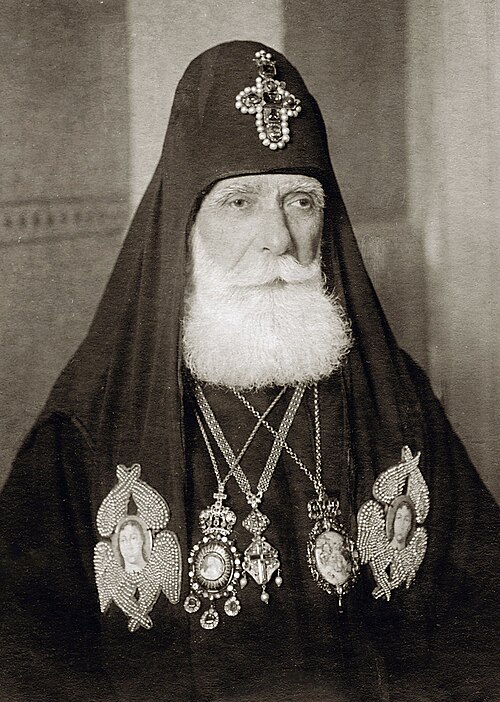
Saint
Callistratus of Georgia
Catholicos-Patriarch of Georgia
Catholicos-Patriarch of All Georgia from 1932 until his death in 1952.
- Feast
- January 21old style February 3
- Reposed
- 195220th century
- Place
- Tbilisi
- Order
- Hierarchs
Life
Saint Callistratus (Tsintsadze) was Catholicos-Patriarch of All Georgia from 1932 to 1952, in the hardest years of Soviet rule. A married parish priest in Tbilisi for more than three decades, a historian of the Georgian Church and a scholar of Georgian Christian literature, he later became bishop and primate, striving to preserve the Church in a time of persecution and to win recognition of its autocephaly. The Orthodox Church of Georgia numbered him among the saints in 2016.
Childhood and schooling
In the world he was Callistratus (Bichiko) Mikhailovich Tsintsadze, born on 12 April 1866 (24 April in the New Style) into a priest's family in the village of Tobanieri in Imereti (today in the Vani district). He studied at the Kutaisi theological school and then at the Tiflis Theological Seminary, from which he graduated in 1888. In both schools he stood out for his gifts and diligence and finished first in his class.
Seeing his talent, the benefactor David Saradzhishvili sent him at his own expense to the Kiev Theological Academy, from which he graduated in 1892 as a candidate of theology. In Kiev he met his future wife, Ottilie Thomas, a German Lutheran, who soon embraced Orthodoxy with the name Nino.
Priest in Tbilisi
In 1892 he was ordained priest for the Didube church in Tiflis (Tbilisi). In 1903 he was transferred to the Kashveti church, and in 1909 he was raised to the rank of archpriest. For thirty-two years he served in various churches of the city and taught religion at the Gymnasium of the Nobility, the Lewandowski boys' gymnasium and the First Boys' Gymnasium, and sat on the board of the Tiflis Seminary.
He joined his pastoral ministry with public service: he was a member of the City Duma and a secretary and member of learned societies. He was a distinguished historian and scholar of the sources of the Georgian Church, of the heritage of Shota Rustaveli and of Georgian Christian literature, the author of articles and monographs, and a doctor of theology.
Defender of autocephaly
The Georgian Church had lost its autocephaly in 1811 and was governed by exarchs sent by the Russian Church. Father Callistratus was a steadfast supporter of its restoration. In 1905 he published in Tiflis a historical study of the autocephaly of the Georgian Church from the fourth to the eleventh century, and in 1906 a historical reply to G. V. Samuilov on the same question.
When the University of Tbilisi opened in 1918 he was offered a professorship and the right to lecture, on condition that he shave his beard and lay aside his cassock. Archpriest Callistratus refused, saying that he would not betray his flock. This did not prevent him from giving his large library to the new university.
Prison and episcopate
In 1923 he was arrested together with Catholicos-Patriarch Ambrose and other clergy and imprisoned in the Metekhi prison. He was released in 1925. Having been widowed, on 31 October 1925 he was consecrated bishop without monastic tonsure, in the Sioni Cathedral of Tbilisi. Some sources say he was first named Metropolitan of Ninotsminda and from 1927 of Manglisi; others that he was raised at once to the rank of Metropolitan of Manglisi.
Catholicos-Patriarch
On 21 June 1932, after the brief tenure of Catholicos Christopher III, the Sixth Council of the Georgian Church elected him Catholicos-Patriarch of All Georgia, Archbishop of Mtskheta and Tbilisi. On 24 June he was enthroned in the Svetitskhoveli Cathedral.
On taking up the government of the Church he strove to halt the closing, demolition and plundering of churches and monasteries. He sought to keep loyal relations with the Soviet authorities in order to ease the pressure on the Church, and asked for relief from the taxes that were crushing it. Many times he drew the authorities' attention to violations of the law on freedom of conscience. Through his efforts, together with the Georgian intelligentsia, the Metekhi and Kashveti churches in Tbilisi and the churches of the Gelati Monastery were saved from destruction. A particular concern of his was the recognition of the autocephaly of the Georgian Church by the other Orthodox Churches.
The war years
During the Second World War the Soviet government softened its religious policy, and the Catholicos was able to improve the position of the Church. Through his personal intercession Bishop Ephraim (Sidamonidze), the future catholicos, Archpriest John Lozovoy and Protodeacon Ambrose Akhobadze were released from the camps, and 23 churches were reopened.
The Georgian Church collected gifts for the front: in February 1943 the faithful deposited 85,000 roubles for the army, and in March 1944 a further 150,000 roubles for gifts to the soldiers. Like all the hierarchs in the Soviet Union of that time, the Catholicos also had to send telegrams of greeting to the head of state, which were published in the press.
Reconciliation with the Russian Church
After Metropolitan Sergius was elected Patriarch of Moscow, the Catholicos sent him a telegram of congratulation on 14 September 1943, expressing the hope that relations between the two Churches would be set right. Communion was restored on 31 October 1943, when the Catholicos concelebrated with Archbishop Anthony (Romanovsky) of Stavropol in the Sioni Cathedral in Tbilisi. On 10 November 1943 the Holy Synod of the Russian Church declared the communion in prayer and the Eucharist between the two autocephalous sister Churches restored. The Russian parishes in Georgia passed under the Georgian Church, with the right to keep their inherited customs, and the Catholicos was also asked to care for the Russian parishes in Armenia.
Last years
On 28 March 1945 he presided over the Council of the Georgian Church, which adopted a new statute of administration. That same year he took part in the Local Council of the Russian Church (31 January to 2 February 1945). In July 1948 he attended in Moscow the celebrations of five hundred years of Russian autocephaly and the conference of the heads of the Orthodox Churches; as the eldest of all, he always sat at the right hand of Patriarch Alexis I, in a black cassock and a black koukoulion with a diamond cross.
On 5 August 1950 he met in Tbilisi with Patriarch Alexis I and the Catholicos of All Armenians, Gevorg VI, and on 23 July 1951 he took part in a meeting of the primates of five autocephalous Churches at the Trinity-Sergius Lavra. From 1948 he was a member of the Soviet Peace Committee and signed, together with other primates, appeals to the Christians of the world.
Repose and glorification
He reposed on 3 February 1952 in Tbilisi, at almost eighty-six years of age. A delegation of the Russian Church was present at his funeral in the Sioni Cathedral, and he was buried in that cathedral. A street in Tbilisi bears his name.
On 22 December 2016 the Holy Synod of the Orthodox Church of Georgia numbered him among the saints, with his feast on 3 June (21 May in the Old Style).
Commemorated the same day January 21
 Agnes of RomeMartyr · of RomeJan 21
 Maximus the GreekVenerable · Monk and scholar in RussiaJan 21
 Publius of MaltaHieromartyr · Bishop of Malta and AthensJan 21
 Fructuosus of TarragonaHieromartyr · Bishop of TarragonaJan 21
 Meinrad of EinsiedelnVenerable Martyr · Hermit of EinsiedelnJan 21
 Neophytos of NicaeaMartyr · Martyr of NicaeaJan 21
 Patroclus of TroyesMartyr · Martyr of TroyesJan 21
 Eugenius of TrebizondMartyrJan 21
 Publius of AthensHieromartyr · Bishop of AthensJan 21
 Zosimus of SyracuseSaint · Bishop of SyracuseJan 21
- Anastasius the ApocrisiariusVenerable · Disciple of Saint MaximusJan 21
- Apollonios the AnchoriteVenerable MartyrJan 21